Assuming the best ATS is the one with the most features is how bad purchases happen. In recruitment, the best system depends on how you hire, not on how many functions it stacks up. An agency, a staffing firm and an in-house team don't need the same balance of pipeline, multiposting, automation, integrations, localisation, GDPR and total cost.
So this guide doesn't simply reward the "most famous" ATS. It rewards the one that removes real work for recruiters, headhunters and staffing teams in Spain, and it draws a clear line between pure ATS products and HR suites that also happen to handle hiring. If your job isn't only to manage the applications that come to you, but to find talent proactively, you need another layer on top of the ATS.
That's where HeyTalent ATS comes in. It takes the top spot because it is free and because it works both as an operational base and as an intelligent sourcing companion. Going by its ATS product page, the proposition fits recruiters who want to post roles, organise processes and work with pipelines, employer branding, custom application forms and a candidate database in a simple flow, without depending on a single source of applications HeyTalent ATS. And if your team also wants to speed up search, enrich contact data and automate first touch, it's worth looking at alongside whatever ATS you already run.
1. HeyTalent ATS
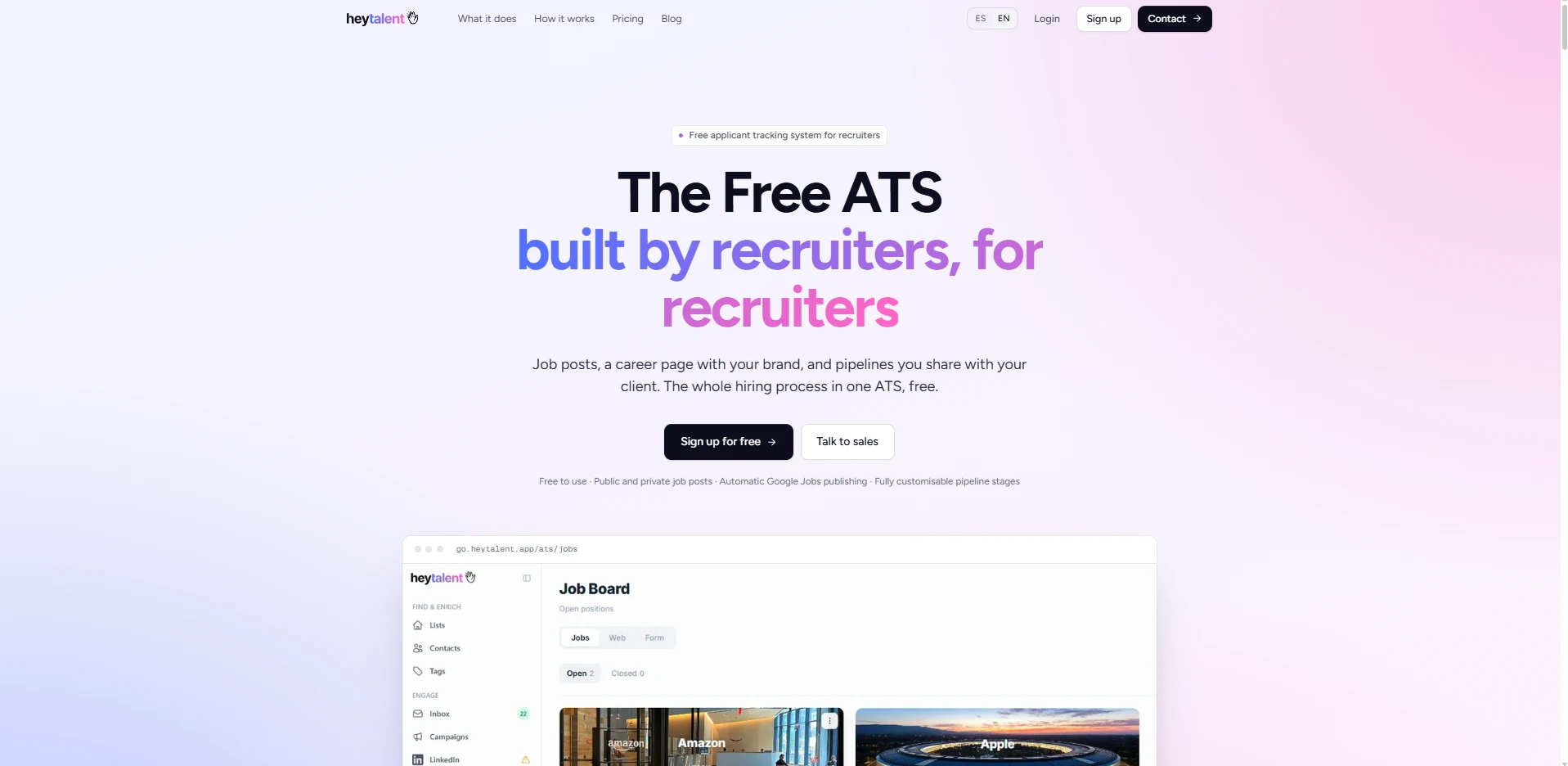
HeyTalent stands out because it doesn't force you to choose between an ATS and sourcing. For recruiters, headhunters, agencies and staffing firms, that matters more than a long feature list nobody ends up using. Its value lies in organising processes while speeding up the most expensive part of the job: finding and contacting relevant talent.
The platform positions itself as a free ATS and as an AI-powered intelligent sourcing system. In practice, that means you can run Boolean searches on LinkedIn, enrich profiles with emails and phone numbers, apply customisable AI variables to filter candidates and launch automated connection-with-note sequences. For high-volume teams, clear control over credits and costs also counts, because it avoids surprises when sourcing scales.
Rule of thumb: if your team spends more time looking for candidates than evaluating them, your problem isn't only the ATS. It's access to talent.
HeyTalent works as a companion to any ATS on the market, and also as an entry point if you want to start at no cost. That makes it especially useful for agencies comparing software without wanting to commit to a heavy suite up front. If you want to understand the system's role in a modern hiring flow, this internal resource on what an ATS is helps you place it in the process.
What works best
- Free entry point, useful for testing the flow before expanding usage.
- Complements any ATS rather than competing with it.
- Reduces dependence on LinkedIn Recruiter by speeding up sourcing, filtering and first contact.
What's less comfortable
- Its full value shows up in combination with a clear internal process.
- Credit consumption has to be matched to your monthly search volume.
2. Bizneo HR, ATS module

Bizneo HR isn't a pure ATS. It's an HR suite with a Recruitment module aimed at companies that want to centralise processes and work with a single vendor. That gives it an edge in organisations with several layers of internal management and a need for close support in Spain. It works better in SMEs and mid-market companies than in an agency that lives on intensive sourcing.
Its strengths are multiposting, a customisable career site, recruitment analytics and migration from other systems. Local implementation counts too, because most decisions fail in the data handover and in team adoption, not in the demo. For companies that need to preserve context and move information without losing traceability, that support matters more than a flashy interface.
The trade-off with a suite is clear. Bizneo handles hiring, but it also pushes you towards other HR modules, so it doesn't feel as light as an ATS built for agencies. If your priority is running high volumes of external search, it's worth comparing it against a complementary tool. For that angle, recruitment software for small agencies is worth reviewing, because it forces you to look at total cost and operational agility, not just brand.
When yes and when no
Yes for companies that want to unify hiring with other HR processes.
Yes if you value support and localisation in Spain.
No if you need a highly specialised tool for active search and sourcing.
No if you're after a pure ATS experience built for agencies.
The final price depends on modules and volume, so the real comparison is operational. Bizneo makes sense when internal governance matters more than extreme flexibility.
3. Teamtailor
Teamtailor tends to win when the team prioritises candidate experience and ease of use. It isn't designed to be the "toughest" system for complex processes, but to do collaboration between recruiters and hiring managers well, with a more polished visual layer. That makes it very attractive in companies that care about employer branding and want every role to look good.
Its greatest strength lies in career sites, nurturing automations and the integrations ecosystem. In practice, that reduces daily friction and improves adoption among non-technical managers. If an in-house team struggles to get everyone involved in hiring, Teamtailor usually solves that better than many more rigid ATS products.
The trade-off is clear: it doesn't publish pricing and works with custom quotes. That forces you to look at renewals, support and real scope before buying. It's also worth understanding that its convenience may be enough for many teams, but agencies that live on extraction, filtering and direct contact will normally need an external sourcing layer.
Teamtailor isn't competing to be the most aggressive ATS for active sourcing. It's competing to be one of the easiest to adopt for collaborative hiring.
Best fit for
- In-house teams focused on candidate experience.
- Companies that value employer branding.
- Organisations that already have a separate sourcing strategy.
4. ePreselec by InfoJobs
ePreselec has a simple, powerful argument: it's natively integrated with InfoJobs. In Spain that matters, because many companies still depend on job boards and want to centralise incoming applications without building an overly complex system. For operational roles, retail and high-turnover environments, that approach still makes sense.
Its proposition includes direct InfoJobs integration, distribution to job boards, a basic career site and asynchronous video interviews. That makes it a very practical option for centralising inbound flow and managing basic processes without much implementation effort. If your team posts heavily on InfoJobs, access to the country's largest candidate ecosystem remains a real argument.
The limit appears as the process grows. Against best-of-breed options, ePreselec is usually less flexible for agencies or teams with complex flows, heavily customised scoring or advanced multichannel sourcing. Public pricing information is also limited, so the purchase happens through consultative selling rather than transparent comparison.
What to check before deciding
Your real posting volume on InfoJobs.
Whether you need to centralise only the basics or the full cycle.
Your team's ability to work with a less flexible ATS.
If your business lives on mass posting and inbound management, ePreselec is still a logical choice. If your problem is finding profiles, enriching contact data and moving passive candidates quickly, you're going to need another layer on top of the ATS.
5. Recruitee
Recruitee, now part of Tellent, is one of the most comfortable options for collaborative teams. It works well when you want recruiters and hiring managers in the same flow without fighting the tool. Its strength isn't extreme sophistication but the combination of usability, automation and reporting.
The platform stands out for its hiring process automations, its analytics and its integrations marketplace. On many plans it also works with unlimited users, which is very useful when several people are involved per role. That reduces adoption friction and keeps the ATS from being locked inside HR.
The weak point is visibility on exact pricing. Recruitee doesn't always show clear euro amounts and tiers can vary, so buyers need to validate scope, slots and future growth before signing. For SMEs and scale-ups that isn't disqualifying, but it does mean comparing rigorously.
If your team wants speed of implementation, Recruitee is a solid bet. If you need deep sourcing and contact enrichment, it shouldn't be your only tool.
For agencies and consultancies, the right reading is this: Recruitee can be a good operational ATS, but for the active search part it's worth combining it with a solution that gives you faster access to profiles and contact data.
6. Factorial, Recruitment module
Factorial fits when the priority is bringing recruitment and the rest of HR into a single suite. In growing companies, that reduces scattered tools and stops hiring, people and admin from living in different systems. In Spain, its local support and Spanish-language usage help adoption.
The Recruitment module includes templates, workflows, external integrations, AI features and centralised candidate data. It works well for teams that want a unified environment rather than assembling a stack piece by piece. If the company already uses Factorial for internal management, bringing the ATS inside the same system is usually the most logical decision.
The trade-off is clear. It isn't the nimblest ATS if you're after intense, highly specialised hiring. It isn't a transparent-price purchase either, because it's sold by proposal and you should ask for exact scope, module by module. For anyone comparing options with agency operations or very active search in mind, the reference should be something more specialised.
The operational read
Better if you want to unify HR + recruiting.
Less advisable if your job is mass, highly specialised sourcing.
Useful if you prioritise local support and a suite that keeps evolving.
Factorial is an ecosystem purchase. If your main problem is attracting, filtering and contacting faster, an internal ATS doesn't cover everything and you need an external layer for sourcing, enrichment and automated outreach.
7. Personio, Recruitment module
Personio sits well with SMEs and mid-market companies that want a complete HR suite with a solid Recruiting module. Its own job portal, multiposting and the integration between HR and hiring make the flow fairly smooth for teams that don't want to manage isolated tools. Spanish-language documentation also helps lower adoption barriers.
The advantage is clear: if you already work within the Personio ecosystem, recruitment slots in quite naturally. That reduces friction between the approved requisition, the published role and the employee record. For companies moving from manual hiring to a more orderly process, it's a reasonable foundation.
But it's still a suite. That means the purchase has to be assessed on total scope, not on the module in isolation. Pricing is modular and not public, so the conversation with sales matters more than a surface-level comparison. If your company has more external sourcing volume than internal management, the ATS alone will fall short.
Personio works best when hiring and employee management need to live together. It isn't the option that most accelerates active headhunting.
For recruitment teams that need to move between ATS, data and outreach, the real value appears when a tool like HeyTalent covers the part Personio doesn't handle as nimbly.
8. Greenhouse
Greenhouse remains a clear reference among best-of-breed ATS products for complex processes. It's used by teams that need configurable pipelines, advanced analytics and integrations at scale. If your hiring is technical, structured and demands a lot of collaboration, this platform is closer to what you need than a generalist suite.
Its marketplace ecosystem and pipeline automation give it an edge in mid-market and enterprise. Documentation and the user community also tend to make day-to-day operation easier, which is valuable once the ATS is part of the core hiring system. Greenhouse doesn't aim to be light; it aims to be deep.
Cost and quote-based selling make it a serious purchase from the start. It isn't a tool you adopt on impulse, and it isn't the best adapted to the Spanish market in support or localisation either. If your team already runs demanding processes, that may be acceptable. If you're after fast deployment and cost clarity, it isn't the simplest route.
What to genuinely expect
Powerful configuration.
Real pipeline automation.
Less onboarding comfort than simpler options.
Greenhouse is a purchase for mature teams that already know what they want to standardise. It isn't the first choice for an agency that needs sourcing, enrichment and fast outreach.
9. Workable
Workable is one of the most practical ATS options for SMEs and growing companies that want to start quickly. It has public tiered pricing, online purchase and a very clear focus on combining multiposting, templates and AI. For teams that value commercial clarity, that's already a significant advantage.
Its AI for sourcing and job-ad writing, branded Agent, positions it well for operations that want to reduce repetitive tasks without building a complex architecture. Its integrations catalogue also makes it easier to slot in calendars, assessments and HRIS without fighting IT too much. That mix of speed and balance makes it very easy to recommend in resource-constrained environments.
The point to watch is that some advanced capabilities move up into higher plans. If your team grows or needs more automation, the real cost can increase. For agencies and headhunters, it's also worth reviewing how Workable connects with an external sourcing strategy, because the ATS alone doesn't give you faster access to passive profiles.
You can go deeper on filters and search with this guide to a free online ATS filter, useful if you want to sort candidates before pouring time into interviews.
10. Kenjo, HRIS with a Recruitment module
Kenjo occupies a very clear category: it's an HRIS focused on the Spanish-speaking market and local compliance. Its eRecruiting/ATS module is designed for SMEs that want to unify hiring, employees, time and absence in a single tool. That makes sense in organisations where HR needs operational control, not just attraction.
The advantage is the coherence of the whole. If your company values regulatory compliance and an easy-to-understand per-employee model, Kenjo enters the conversation strongly. In Spanish SMEs, that operational clarity can matter more than a more sophisticated but harder-to-implement ATS.
The limit is the same one every suite runs into: the ATS isn't as deep as a pure solution for intensive tech hiring or advanced sourcing. If your team needs to go beyond managing internal applications, the tool can fall short on speed of attraction. In that case, it's better seen as an HR foundation, with an external solution added for sourcing and direct contact.
11. Talent Clue
Talent Clue is among the most logical options when the goal is to simplify hiring without adding much IT complexity. Its focus is on distribution automation, pipeline management and a decent candidate experience for SMEs and mid-sized companies. In Spain it also has a presence and support that make adoption easier.
Its proposition works well for teams that want to tidy up the process without depending on oversized software. Employer branding tools and Spanish-language support help keep usage alive, not just get it implemented. That alone makes it a reasonable alternative to colder or overly heavy options.
The limit is in the integrations ecosystem and the absence of public pricing. If your organisation needs complex connections, the comparison becomes more technical. For agencies, staffing firms and headhunters, Talent Clue can be a good operational ATS, but it doesn't replace an active sourcing, enrichment and outreach layer.
Talent Clue handles process management well. On its own, it doesn't solve the proactive search for hard-to-find talent.
11 ATS products in Spain compared, 2026
| Product | Key features | Experience / Quality | Target audience | Price / Differentiator |
|---|---|---|---|---|
| HeyTalent ATS | Free ATS; AI sourcing from LinkedIn; email/phone enrichment; customisable AI variables; automated outreach | Smooth for recruiters; fast and scalable; priority support | Recruiters, headhunters, agencies, staffing firms; freelancers to large teams | Plans in € (2,000–14,000 candidates/month); credit control; GDPR; complements any ATS |
| Bizneo HR – ATS module | Multiposting; customisable career site; analytics; migration/import; modular suite | Local support in Spain; consultative implementation; on-site demos | SMEs and mid-market companies looking for an integrated HR suite | Modular pricing (from ~€6 as a guide); strong local presence |
| Teamtailor | Attractive career sites; automations; nurturing; integrations ecosystem | Excellent UX; low learning curve; centred on candidate experience | Companies focused on employer branding and internal collaboration | Custom quote; strong employer branding focus |
| ePreselec (InfoJobs) | Native InfoJobs integration; job board distribution; asynchronous video interviews | Mass candidate access; centralised flow for high volumes | Companies posting heavily on InfoJobs (retail, operational roles) | Consultative selling; tightly tied to the InfoJobs base; less flexible for complex processes |
| Recruitee (Tellent) | Automations; reporting; integrations marketplace; unlimited users | Easy deployment; good usability and collaboration | SMEs and scale-ups that need hiring manager collaboration | Transparency on migrations; prices/tiers vary by plan |
| Factorial (Recruitment module) | HRIS + recruiting module; integrations; AI features; career site | Unified HR+Recruiting ecosystem; local support in Spanish | SMEs looking to unify HR and hiring | Custom pricing; integration with the rest of HR; active roadmap |
| Personio – Recruitment module | Own job portal; multiposting; HR integration; Spanish-language resources | Smooth HR–Recruiting flow; support and customer base in Spain | European SMEs and mid-market companies wanting an integrated HRIS | Modular pricing; contracting via sales and demo |
| Greenhouse | Integrations marketplace; pipeline automation; advanced analytics | Scalable and configurable; extensive documentation and community | Technical teams and companies with complex processes (mid/enterprise) | Custom quote; a standard in large/tech companies |
| Workable | Public tiered pricing; AI for sourcing/writing; multiposting; templates | Fast implementation; good balance between function and cost | SMEs and growing companies | Clear pricing online; advanced features on higher plans |
| Kenjo (HRIS with ATS) | Employee management and time tracking; eRecruiting module; Spanish legal compliance | Good regulatory fit; support in Spanish | Spanish-speaking SMEs that need local compliance | Per-employee pricing model; ATS less deep than pure solutions |
| Talent Clue | Distribution automation; pipeline management; reporting; employer branding | Manageable learning curve; local support in Spain | SMEs/mid-sized companies wanting faster hiring without IT complexity | Contracting by demo; more limited integrations |
Which ATS to choose for your team and your process
The right decision depends on your business model. HeyTalent ATS is the logical option if you want to start at no cost and reinforce sourcing, AI filtering, enrichment and automated outreach without breaking your current flow. Teamtailor and Talent Clue work better when candidate experience and ease of use carry the most weight. ePreselec makes sense if your inbound depends heavily on InfoJobs. Workable and Recruitee fit SMEs and scale-ups that prioritise fast deployment. Bizneo HR, Factorial, Personio and Kenjo are stronger when you want to join hiring and HR in a single suite. Greenhouse is for complex mid-market or enterprise processes.
Don't buy on features alone. Review total cost, migration, permissions, GDPR, data residency and export, integrations, support and volume limits. If you're an agency, a staffing firm or a recruitment team under daily pressure, the useful question isn't which software "has more things", but which one removes the most operational work without blocking you tomorrow.
My recommendation is direct. If your current ATS covers posting and pipeline, add an intelligent sourcing layer before replacing it. If you're comparing software from scratch, start by trying a free option that lets you validate the full flow and measure whether it genuinely speeds up search, contact and candidate response.