Candidate relationship management works through eight concrete workflows: multichannel outreach sequences, qualification by behavioural signals, closing skills gaps, activating referrals after a placement, passive candidate nurturing, hiring manager feedback loops, handling objections and win-loss analysis. Each example has its own trigger, main metric and effort. None of them means sending more messages: all of them combine segmentation, timing, personalisation and measurement to re-engage a cold candidate base.
What is candidate relationship management
Candidate relationship management (candidate CRM) is the practice of maintaining and activating relationships with candidates before, during and after a specific vacancy. It is defined as the set of data, messages and rules that decide whom to contact, when, with which argument and which result to measure.
Candidate CRM differs from an ATS in when it acts: the ATS organises people already in a hiring process; candidate CRM works with people who are not in one yet, above all passive talent.
The value of a candidate CRM lies in useful information, not volume. An analysis of 756,888 job postings in Spain found that more than 77% required previous experience in the sector or in a similar role, according to data on the experience required in job postings. That is why it pays to record each candidate's track record, specialisation, availability and consent.
Comparison of the 8 candidate CRM workflows in 2026
The eight candidate relationship management workflows are compared on the same attributes: what triggers them, which metric decides them and which part HeyTalent covers.
| Workflow | Trigger | Main metric | Effort | What HeyTalent covers |
|---|---|---|---|---|
| Multichannel sequences | New search | Qualified replies | Medium-high | Sequences, email and phone |
| Behaviour-based qualification | Reply or job change | Conversation to interview | Medium | AI variables to prioritise |
| Skills gaps | Almost-ready profile | Reactivated profiles | High | AI variables to detect the gap |
| Referrals | Confirmed placement | Referrals reaching interview | Medium | Referral's profile and contact |
| Passive nurturing | Segment with no open role | Re-engageable relationships | Low-medium | Real-time profiles and sequences |
| Hiring manager feedback | Shortlist sent | Time to feedback | Medium | Pipeline shared with the client |
| Objections | Candidate declines | Accepted reactivations | Medium | Inbox by job and move to ATS |
| Wins and losses | Role closed | Placements by source | Medium-high | Tuning of searches and variables |
How HeyTalent covers an agency's candidate CRM
HeyTalent is an intelligent sourcing platform that feeds candidate CRM from the start: it finds the person, gets their contact details and opens the conversation. Starting from a Boolean search, HeyTalent extracts LinkedIn profiles in real time, so the track record the recruiter sees is the one the candidate has today.
On that list, the team defines AI variables to filter by (English level, sector, a specific certification) and HeyTalent finds email and phone. It then launches automated outreach sequences that send invitations, follow-ups and InMails without the recruiter having to keep track. HeyTalent reports a x2.5 reply rate among its users thanks to those automated sequences.
Replies land in a shared inbox, filterable by job and by recruiter, from which a candidate is sent to the ATS in one click. HeyTalent's ATS costs €0 because the company charges only for sourcing, and it includes a candidate database with filters and manual upload, one pipeline per job with configurable stages and process notes. On a sourcing plan, the HeyTalent team helps migrate the candidates the agency already had.
HeyTalent has two limits worth knowing before choosing it as the base of a candidate CRM. It has no sales CRM for managing clients and no temp back office. And it does not publish a native integration with external ATSs such as Teamtailor, Viterbit or Workable: if the agency keeps one of them, the handover is a CSV export, unlimited on every plan.
Example 1: multichannel candidate outreach sequences
A multichannel candidate relationship management sequence works when every touchpoint adds new context: it does not repeat the same message on LinkedIn, email and phone, but builds a conversation from the profile and the previous reply. Spacing touchpoints two to four days apart avoids a feeling of pressure.
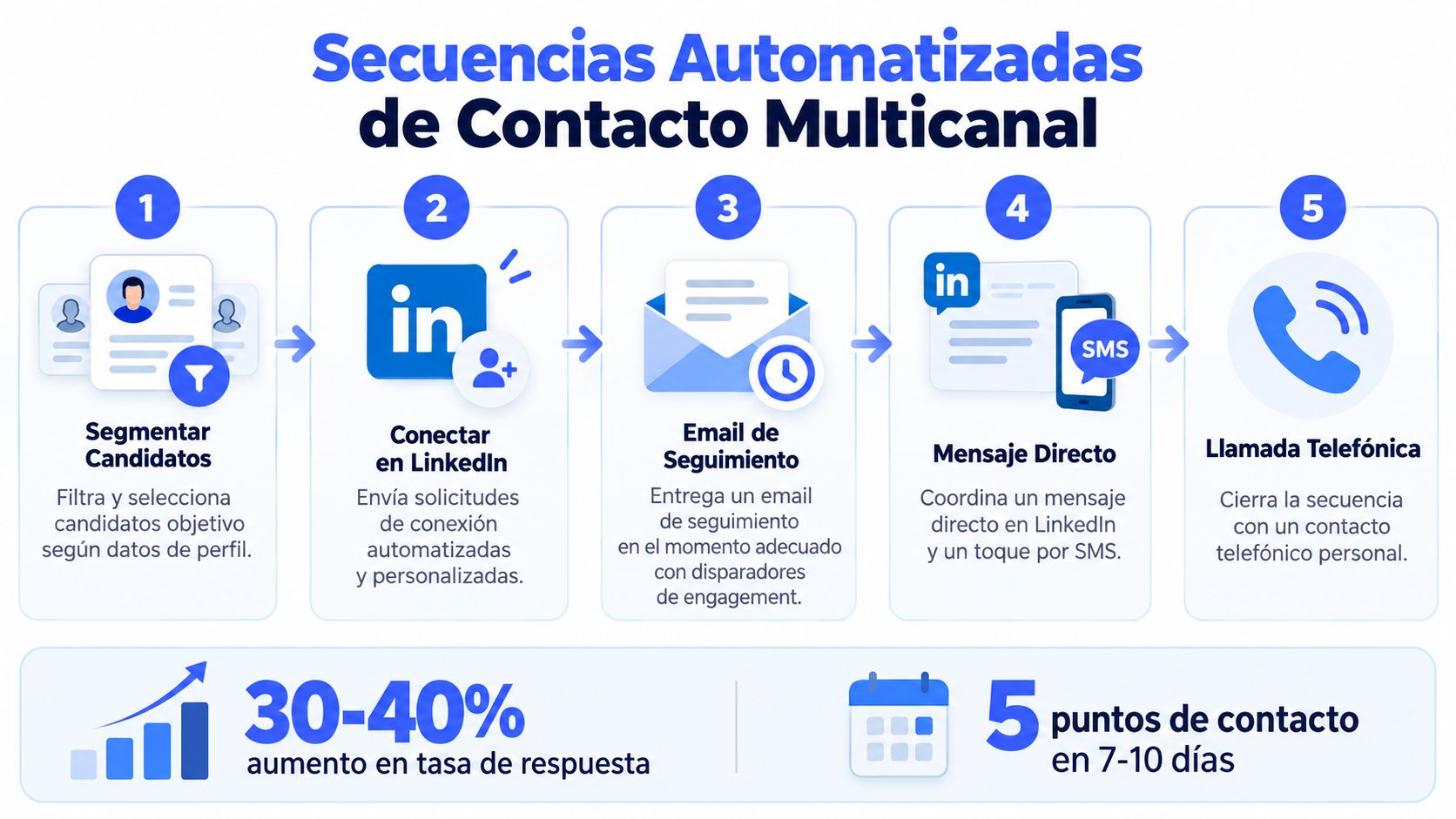
A well-built multichannel sequence follows four rules:
- Segment before you reach out: specialty, seniority, location and last interaction.
- Personalise the first paragraph: a specific experience, not a generic compliment.
- Define automatic exits: the sequence stops when the candidate replies or opts out.
- Measure the whole funnel: reply, interview, submission to the client and placement.
In HeyTalent, the sequence, the email and phone finder and the inbox live in the same tool, with no separate data provider to add. To design messages and limits, see the guide to automating LinkedIn messages. The operating rule: automate the calendar, not the judgement.
Example 2: qualifying candidates by behavioural signals
Behaviour-based qualification turns a candidate's signals into a priority queue for deciding whom to call first, not into automatic rejection. A passive profile may take time to reply and still be a perfect fit for a strategic search.
The recruiter cross-references replies and recent career changes with skills, location, availability and language, with different thresholds for active and passive talent. HeyTalent lets the team configure AI variables to rank profiles on those criteria, but the recruiter decides what "interest" really means. In Spain, the AEPD explains the safeguards that apply to using AI to analyse CVs, including avoiding decisions based solely on automated processing.

Rule of thumb: an engagement signal prioritises a human review. On its own, it does not make a profile a suitable candidate.
Example 3: workflows to close skills gaps
A skills-gap workflow keeps in the candidate CRM the profiles that do not fit today because of one specific distance: a certification, a tool or a language level. Instead of marking them "not suitable", the recruiter records the gap and schedules a review.
A tech recruiter can spot Python developers without a cloud certification, share training resources with them and check back two weeks later. In HeyTalent, an AI variable such as "has a cloud certification" separates those almost-ready profiles from the ones that already qualify.
The skills-gap workflow costs time and pays off when the gap is specific and the client has recurring demand. To build the strategy, see the guide to upskilling and reskilling.
Example 4: activating referrals after a placement
Referral activation turns a placed candidate into a source of recommendations, always after confirming that the onboarding is going well and that the person agrees to keep receiving communications.
Instead of "do you know anyone?", the referral message states the specialty, location and level sought, and explains how the referred person's data will be handled. When a name comes in, HeyTalent finds their LinkedIn profile and contact details, and the recruiter records them with the source "referral". To organise incentives and follow-up, this guide to scaling sales in 2026 offers a complementary framework.

Example 5: nurturing passive candidates
Passive candidate nurturing keeps the relationship alive with relevant information, low frequency and a clear opt-out, without a vacancy in every message. The goal is to keep relationships that can be re-engaged, not to inflate the size of the talent pool.
A nurturing campaign starts with a segment (function, industry or location) and records, per person, interests, last interaction, legal basis and next action. HeyTalent contributes two pieces: real-time extraction, which avoids writing to someone about a job title they held two years ago, and automatic follow-ups, which keep the cadence without relying on the recruiter's memory.