Finding contact details is not the same as sourcing. A database can get you an email address or a phone number, but not necessarily Boolean search on LinkedIn, candidate filtering, profile enrichment, outreach automation or a reliable cost-per-opportunity figure. That is why choosing between ContactOut alternatives means looking at a recruiter's entire workflow, not just the number of records on offer.
The comparison below focuses on search sources, contact accuracy and verification, credits and limits, automation, integrations, GDPR and how well each tool suits freelancers, agencies, staffing firms and in-house teams. The Spanish market makes data quality especially important: there are 1,142 talent acquisition companies identified by activity, with Madrid and Barcelona as the main hubs, according to this sector map of talent acquisition firms in Spain.
HeyTalent shows up here as a working alternative to LinkedIn Recruiter and as a complement to your ATS. It does not replace Teamtailor, Viterbit or Workable. It sits in the sourcing, enrichment and outreach layer that plugs into whatever hiring system your team already uses.
1. HeyTalent
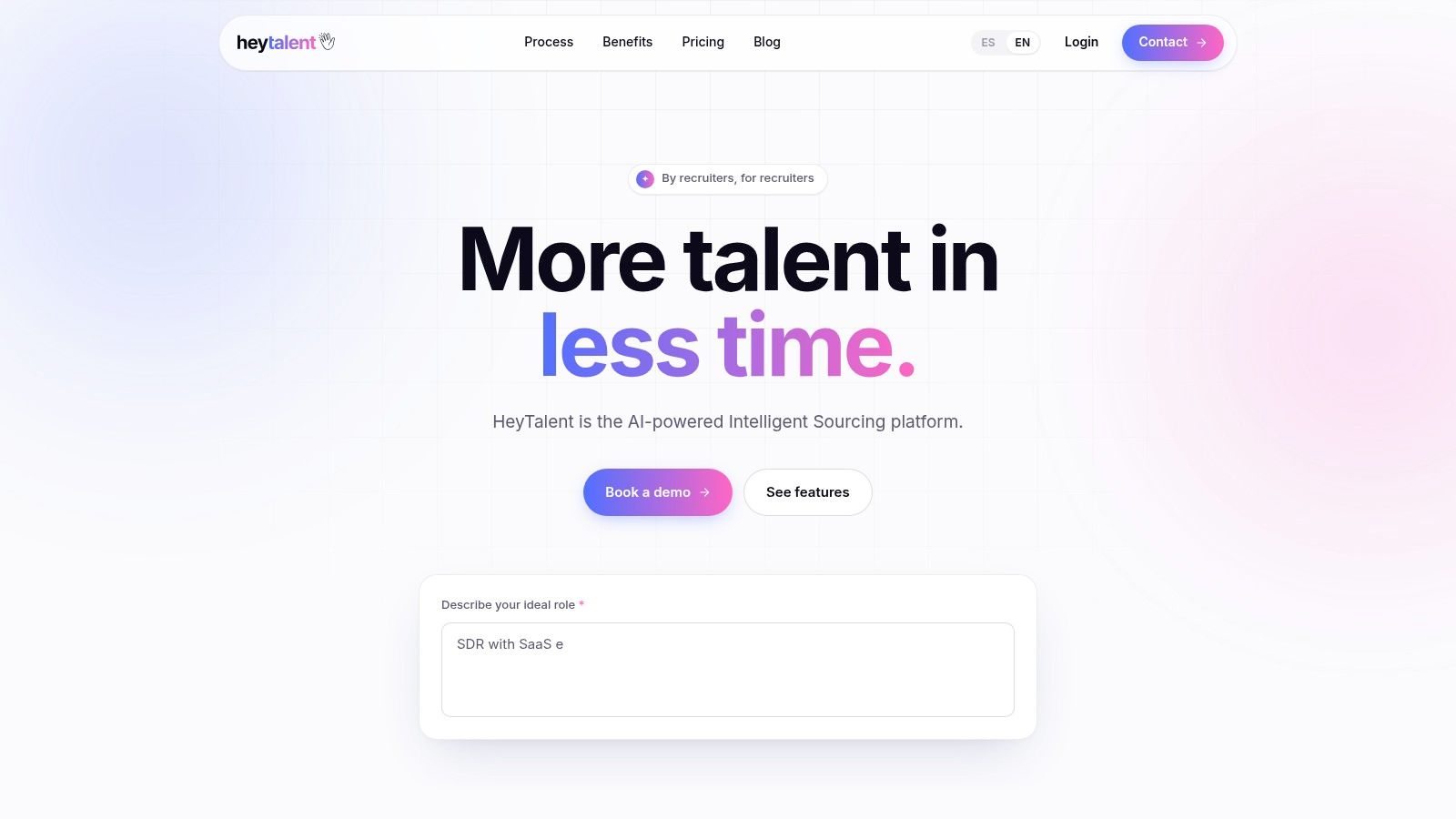
HeyTalent brings profile discovery, contact enrichment, filtering and outreach into a single flow. It extracts public profiles from LinkedIn and other sources, helps you locate contact emails and phone numbers, and lets you rank candidates using configurable AI variables.
Boolean searches support job title, keywords, location, experience and company size. From there, the recruiter can layer on additional criteria such as relevant experience, English level or industry fit. These variables are indicative signals, not hard facts. They help you prioritise who to review — they should not automatically rule anyone out.
Recommended use: combine objective filters, human review and personalised messages. Automation should cut repetitive work while leaving judgement with the recruiter.
The flow that removes manual work
The operational value lies in keeping sourcing, enrichment, shortlisting and follow-up inside one tool. The team avoids exporting profiles into a contact finder, checking the data in a second app and preparing follow-ups in a third. Sequences let you personalise messages and schedule follow-ups, which helps headhunters juggling several roles at once.
HeyTalent reports up to 60% more speed during the first month, 2.5x higher response rates and savings of up to 5x compared with LinkedIn Recruiter. These are vendor-reported metrics, not an independent benchmark. An agency should test them in a controlled trial, using profiles and vacancies close to its usual workload.
Published plans start at €109 per month for Recruiter, with up to 2,000 candidates a month; €214 per month for Agency, with up to 5,000 candidates; and €599 per month for Ultra, with up to 14,000 candidates and priority support. All three plans include unlimited users; what changes is the number of automated outreach accounts (one, two and three respectively). Billing is quarterly, and the annual option applies a 15% discount, according to the product information on HeyTalent.
Strengths and limits
- End-to-end flow: covers sourcing, enrichment, AI filtering and outreach.
- Predictable running cost: the plan is defined by monthly candidate volume and billed per organisation rather than per seat, which makes it easier to tie spend to the opportunities generated.
- Custom filters: adapts the search to each vacancy, well beyond the job title.
- Scalability: works for freelancers, agencies and in-house teams alike.
- Compliance: processes public data under legitimate interest and offers immediate opt-out, according to the vendor's policy.
Connection campaigns with a note may require LinkedIn Premium Business. Extraction depends on public sources and LinkedIn, so coverage can vary by profile and market. AI inferences also need checking before you prioritise or definitively discard someone, especially in processes subject to EU compliance requirements.
For a freelancer, the main benefit is fewer apps and a lower running cost. An agency will care more about the monthly volume included and the extra automated outreach accounts. In an in-house team, it is worth measuring data quality, response rate and cost per opportunity before rolling it out more widely.
2. Apollo.io
Apollo.io fits best when the team wants a B2B contact database and engagement in the same suite. Its search comes with advanced filters, while email sequences, the built-in dialer, meeting scheduling and CRM or ATS integrations cut down the constant app-switching.
For a recruiter, the strength is combining identification and contact in one place. Apollo can work for passive candidate campaigns, especially when the strategy leans on email and calls as well as LinkedIn. It is not a platform built exclusively for hiring, so some of its filters and signals are designed for sales prospecting.
Cost and credit control
The model is based on credits and users, with Free, Starter, Growth and Scale plans. That structure can be reasonable for an agency that needs moderate volume and wants to add outreach without buying a separate sequencer. It can also get messy when several recruiters search, verify and export data using different criteria.
Data quality and availability can vary by region and industry. In Spain, where the supply of actionable data is uneven, you should not judge Apollo on database size alone. A trial should measure how many emails are valid, how many phone numbers are actually useful, and how many credits a real search burns through.
Best for: agencies and in-house teams that want data, sequences and a dialer in a single environment.
Main limit: cost grows with seats and volume, and its logic sits closer to sales engagement than to specialised sourcing.
Check the current capabilities directly at Apollo.io.
3. Lusha
Lusha is designed to surface contact data right where the recruiter is already working. Its browser extension works on LinkedIn and other sites, and lets you enrich profiles or sync information with a CRM. The experience is straightforward, which matters for one-off lookups where you have already identified the person and just need a way to reach them.
The tool also puts weight on privacy and compliance. Its trust centre lists frameworks and certifications including SOC 2, ISO 27001, ISO 27701, ISO 27017 and ePrivacyseal. That does not remove the controller's obligation to document its legal basis, purpose and objection process, but it does make initial vendor assessment easier.
When it adds value
Lusha works well as an enrichment layer for a recruiter browsing profiles one by one. It does not set out to replace a full Boolean search engine, candidate prioritisation or advanced outreach automation. It becomes more useful once the team already has the list and needs to complete the record.
Pricing information is dynamic and some capabilities require talking to sales. Credits can also disappear quickly, particularly when you are chasing mobile numbers. So an agency should first test a representative sample of Spanish profiles before making it a primary source.
To understand where enrichment fits in the process, read this guide to data enrichment for recruiting.
Best for: recruiters doing manual searches who need a lightweight extension.
Main limit: on its own it does not deliver the full discovery, filtering and automated outreach flow.
More information at Lusha.
4. RocketReach
RocketReach is especially useful as a backup source. It lets you search by name, company, domain or profile URL, and offers a LinkedIn extension alongside bulk enrichment options. In an agency's daily work, it can slot in at exactly the point where your primary source fails to find the email or phone number of a hard-to-reach profile.
Its value is not necessarily in becoming your central sourcing system. It is more practical as a second lookup for scarce candidates, executive profiles or contacts whose professional details have changed recently. Bulk search also helps when the team needs to complete a list before handing it to an ATS or outreach tool.
Assess the data before you scale
RocketReach uses prepaid credits and offers individual and team plans. The official page shows pricing dynamically, so the real cost has to be checked during the purchase process. That lack of a stable figure makes it harder to compare cost per contactable candidate against a solution with more predictable plans.
Coverage and validation can be uneven across sectors and countries. An email you found is not automatically an email that is ready to send. It pays to validate contacts, record the date they were checked and drop doubtful addresses before you start a sequence.
Operating rule: use RocketReach as a fallback when your first source comes up empty, not as an automatic guarantee that every contact it finds will be usable.
Best for: recruiters who need an additional source of emails and phone numbers.
Main limit: coverage has to be tested by location, function and seniority before you rely on it for broad campaigns.
Visit RocketReach to review its current options.
5. Hunter
Hunter focuses on one specific job: finding and verifying professional email addresses. It lets you search by domain, pattern and person, and adds deliverability-oriented checks. For a headhunter who already has the name, company and role, that specialisation can be more useful than a broad platform full of features they will never touch.
It also offers public pricing and a free plan with limited credits. That transparency makes it easier to model the cost of a small campaign, though it does not remove the need to check data validity before sending. Hunter does not cover phone numbers, so any process that depends on calls will need a second source.
An email component, not a sourcing flow
Its privacy documentation covers GDPR, DPAs and the vendor's infrastructure, with primary servers listed in GCP Belgium. For European teams, having accessible documentation simplifies vendor review, but the recruiter remains responsible for justifying the purpose and handling objection requests.
In Spain, deliverability has improved in the GDMA benchmark cited by BillionVerify on email addresses in Spain: soft bounces fell from 1.45% to 0.49%, hard bounces from 0.67% to 0.45%, and acceptance reached 99.07% in 2025. That context makes protecting list hygiene more important. A bad record does not just waste a credit — it can also damage your domain reputation.
For more on professional email addresses, read contact data for recruiting.
Best for: freelancers and small agencies that need to find professional emails with a cost that is simple to model.
Main limit: no phone numbers and no full candidate search.
More information at Hunter.
6. Snov.io
Snov.io combines an email finder and verifier with automated drip campaigns and a lightweight CRM. That mix appeals to freelancers and agencies that do not need a new ATS but do want to store contacts, schedule follow-ups and handle moderate volume from a single place.
The product makes sense when the bottleneck appears after you have found the candidate. A recruiter can build a list, verify the emails and trigger a sequence with staggered messages. The approach is more compact than an enterprise platform and can reduce the number of tools a small team has to run.
What it does not cover
Plans are credit-based and scale for larger volumes. Cost per email can be competitive for a small business, but you need to watch which actions consume credits and how failed attempts are counted. Agencies should split consumption by client to understand the real cost of each search.
LinkedIn support is limited for intensive sourcing and phone coverage is thinner. If your process depends on finding mobile numbers for passive candidates, Snov.io will need pairing with another source. It is also worth reviewing the legal basis for your sequences: automating the send does not turn an unauthorised message into a legitimate one.
Best for: freelance recruiters and small agencies that want to combine email finding with basic campaigns.
Main limit: not the best option for intensive technical sourcing or a phone-first workflow.
See Snov.io.
7. ZoomInfo
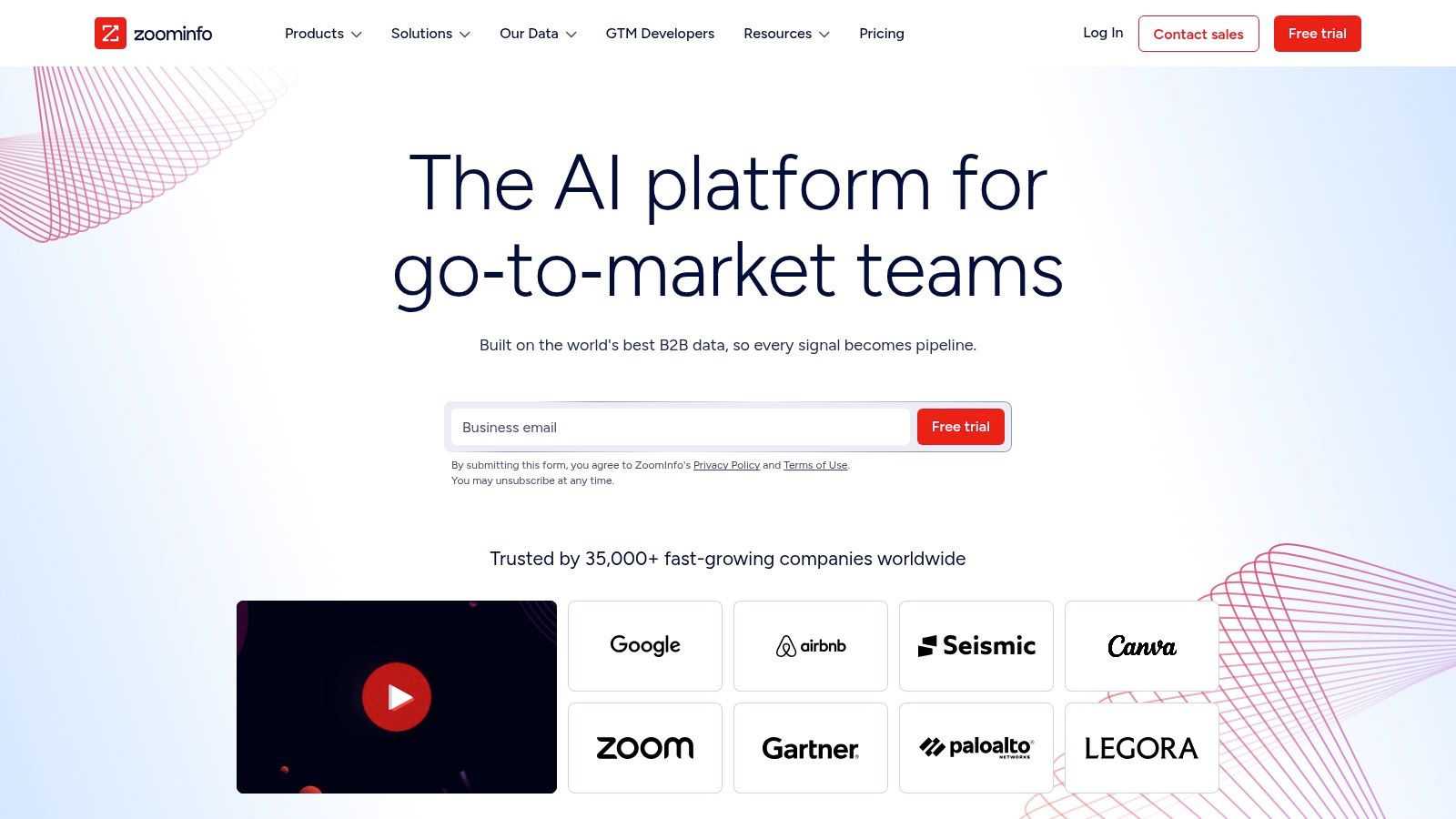
ZoomInfo is aimed at enterprise organisations that need broad B2B coverage, signals and corporate integrations. Its catalogue includes products for Sales, Marketing, Operations and Talent, so it can fit structures where recruiting shares data infrastructure with other teams.
For a Talent Acquisition department, the potential advantage is scale and the connection to existing processes. The drawback shows up before the first search: full access is contracted through a quote and an annual agreement, with no public price list that would let you quickly work out cost per opportunity.
When it can be justified
ZoomInfo makes sense when volume, integrations, support and coverage matter more than simplicity. A large team may value the governance, the API and the link to corporate systems. A small agency, on the other hand, should weigh total cost against the number of roles it actually fills and how often it uses phone numbers, emails and signals.
The platform should not be confused with an ATS. It can complement systems like Teamtailor, Viterbit or Workable, but candidate and process management will still depend on the hiring system the company has chosen.
A GDPR assessment requires reviewing data provenance, purpose, retention and applicable rights. In Spain, candidate data may come from LinkedIn and public professional sources to verify or complete information, always subject to access and erasure rights, as reflected in the context described by Eurostat on job vacancy statistics in Spain.
Best for: enterprise teams with budget, procurement processes and broad data needs.
Main limit: non-public pricing, an annual commitment and potentially high cost for small teams.
More information at ZoomInfo.
For a deeper look at the legal criteria, read this guide to GDPR-compliant sourcing tools.
8. Swordfish AI
Swordfish AI prioritises access to mobile numbers, direct dials and emails pulled from several sources. It is a solid alternative when the phone plays a central role in your outreach strategy — for example, in executive search or urgent processes where waiting for an email reply delays the shortlist.
The tool also explains alternative pricing models, including unlimited plans subject to fair use. That information helps compare credits against usage-based models, though some of the comparisons come from the vendor itself and should be read as marketing material, not an independent audit.
The phone changes the maths
For an agency, one useful mobile number can justify a dedicated tool — but only if the contact is valid, relevant and defensible from a privacy standpoint. Having access to a number does not imply authorisation to run any campaign you like. The team has to document where the data came from, the professional purpose and how someone can object to further contact.
Swordfish may need pairing with another solution for email campaigns and follow-up. Its main job is discovering data, not necessarily managing the whole outreach cycle. Before committing to a large plan, test profiles across several industries and locations, record the results and compare the cost per genuinely usable phone number.
Best for: recruiters and headhunters who treat mobile numbers as a priority.
Main limit: may require a second tool for advanced verification, sequences and full contact management.
Explore Swordfish AI.
9. SignalHire
SignalHire stands out for working across several sites, including LinkedIn, GitHub, X and Facebook. That coverage matters for technical recruiters, because many hard-to-find profiles do not concentrate their professional activity on LinkedIn. The extension lets you find emails and phone numbers, export lists and work with data at volume.
The unlimited-users model on certain plans, combined with a shared credit pool, can be more comfortable for an agency that does not want to pay a separate licence for everyone involved in sourcing. Even so, the team should check how each action consumes credits and how usage is split across clients.
A clear advantage for technical profiles
The platform cites a base of roughly 850 million profiles, a figure published by the vendor in its own marketing material. It should not be read as the number of profiles available or verifiable in Spain. Coverage and accuracy can vary by region and industry, and mobile numbers may need an extra check.
It also offers an API and a policy of not charging a credit for empty results through that API, according to its documentation. That condition can matter for integrations, but it should be confirmed in the contract and the specific plan.
Best for: teams sourcing technical talent across GitHub, X and LinkedIn.
Main limit: the advertised volume does not guarantee consistent quality in every market, nor that every phone number is ready to use.
Visit SignalHire.
10. Nymeria
Nymeria is a lightweight option for pulling emails and phone numbers from a browser extension or a web app. Its credit model, with monthly or annual packages, makes it easy to start without a heavy implementation. For a freelance recruiter or a small agency, that simplicity can matter more than a broad integration ecosystem.
Searches can start from a profile or a domain. It also offers a free trial with no card required, according to its FAQ — a useful condition for checking coverage before committing budget. That trial should be run on the profiles the team actually works with, not on contacts that are easy to find.
A backup tool
Nymeria works best as support for a sourcing suite, or as the primary tool for simple email lookups. It has fewer integrations and advanced features than the larger platforms, so it can fall short if you need candidate filters, AI, complex sequences or deep sync with agency processes.
Coverage and verification also need double-checking in the cases that matter. An address that was valid when you found it can stop being useful once the person changes company. Record the enrichment date and validate the data before starting a campaign.
Best for: freelancers and small agencies looking for a minimal setup and an easy-to-understand cost per lead.
Main limit: less automation and fewer integrations than the full suites.
See Nymeria.
Comparison: 10 ContactOut alternatives
| Product | Key features | Experience & metrics | Value proposition (USP) | Target audience | Pricing (indicative) |
|---|---|---|---|---|---|
| HeyTalent (Recommended) | Real-time extraction (LinkedIn), email/phone enrichment, custom AI variables, automated outreach | Up to 60% faster, 2.5x response rate; monthly candidate volume per organisation and unlimited users | End-to-end all-in-one flow + AI to prioritise candidates; GDPR compliance | Headhunters, agencies, TA teams, freelance recruiters | Recruiter €109/mo (2k), Agency €214 (5k), Ultra €599 (14k); quarterly billing (-15% annual opt.) |
| Apollo.io | B2B database, email verification, sequences, dialer, CRM/ATS integrations | Good feature-to-price ratio on entry plans; credit-based model | Unifies sourcing and engagement in one suite | Teams that want to combine sourcing and outreach | Credit-based plans (Free/Starter/Growth/Scale), variable |
| Lusha | Browser extension for LinkedIn/web, CRM enrichment, security certifications | Shallow learning curve; fast for one-off lookups | Simplicity and a strong privacy/GDPR focus | Recruiters doing one-off lookups; EU companies | Dynamic pricing; credit-based model |
| RocketReach | Search by person/domain/company, LinkedIn extension, exports and bulk lookups | Useful as a fallback when other sources fail | Recovers data that is hard to find in other tools | Recruiters who need an alternative/backup source | Prepaid credits; individual and team plans |
| Hunter | Finds and verifies emails, deliverability checker, DPA/GDPR, EU servers | Clear pricing; free plan with limited credits | Pricing transparency and a solid privacy framework | Teams that only need verified professional emails | Public credit-based pricing; limited free plan |
| Snov.io | Email finder + verifier, drip campaigns, lightweight CRM | Good cost per email; basic automation built in | Compact package with outreach for SMBs/agencies | SMBs, agencies and freelancers with moderate volume | Credit-based plans; scales with usage |
| ZoomInfo | Enterprise-scale B2B database, signals, integrations and Talent modules | Broad coverage and signals valuable for large accounts | Enterprise-grade data and signals with an integrable ecosystem | Large companies and enterprise teams | Quote-based annual contract |
| Swordfish AI | Mobile and direct-dial coverage + emails, pricing options (unlimited/credits) | Strong on mobile lookups; useful as a complement | Specialised in mobile numbers when email fails | Recruiters who prioritise phone outreach | Credit-based or unlimited models (plan dependent) |
| SignalHire | Multi-site extension (LinkedIn, GitHub, X…), verified emails and phones, bulk export, API | Good for technical sourcing; unlimited users on some tiers | Multi-channel sourcing for technical profiles and bulk export | Technical recruiters, TA teams indexing multiple sources | Plans with a credit pool; variable pricing |
| Nymeria | Extension and web app, search by profile/domain, credit model, free trial | Minimal setup and simple to use; competitive cost per lead | Light and affordable as a backup tool | Freelancers and small agencies | Monthly/annual credit packages; trial without a card |
Which alternative fits your recruiting model
The best alternative depends on exactly where ContactOut stops solving your problem. If all you need is to complete an email address, a full suite may add unnecessary cost and complexity. If the bottleneck is finding, filtering and contacting candidates, a standalone enrichment tool will force you to keep too many manual steps.
For freelancers and independent headhunters, HeyTalent fits when one person has to cover Boolean search, AI filters, email and phone enrichment and outreach. Hunter or Nymeria are narrower options for finding emails on a tight budget. Lusha and RocketReach work as spot tools when you already have the profile and only the contact details are missing.
For small and mid-sized agencies, Snov.io and Apollo.io can be useful if the process combines data with campaigns. The decision should account for cost per client, not just the cost of the licence. If the agency works on technical profiles, SignalHire can add sources such as GitHub and X. If the phone is the priority, Swordfish AI deserves a dedicated trial.
For in-house Talent Acquisition teams, RPOs and staffing firms, HeyTalent can act as a sourcing layer connected to the existing ATS. That matters because the challenge is not replacing Teamtailor, Viterbit or Workable, but speeding up how qualified candidates enter the process. The hiring pressure is real: Yena reports that 93% of companies in Spain find hiring as hard or harder than in 2022, while 72% say they struggle to find talent. In that context, cutting manual work can have more impact than adding another database with no workflow around it.
ZoomInfo stays reserved for enterprise organisations with budget, structured procurement and a need for broad coverage. Its quote-based, annually committed contract requires justifying the return with volume and constant use. It is not a logical decision for every team, even if it suits a corporate data architecture.