Lateral recruiting is hiring professionals who already work at another company into an equivalent or broader role, and in Spain it is now the main route to many senior and tech profiles: 56% of ICT professionals received an outside job offer in the last year, according to a labour mobility survey published in February 2026. It differs from inbound hiring because the candidate is not looking, and from internal mobility because the candidate comes from outside. Doing it well takes four steps: define role equivalence, map the source companies, reach out with a short, personalised cadence, and measure every conversion with GDPR in mind.
What is lateral recruiting
Lateral recruiting is the direct search for professionals employed at comparable companies to bring them into an equivalent or more senior role, so that they contribute useful experience from the first month. The ideal candidate in a lateral search is usually not looking for a job.
Lateral recruiting is not internal mobility (changing roles within the same company) or aggressive headhunting (poaching talent from a competitor without checking fit or motivation).
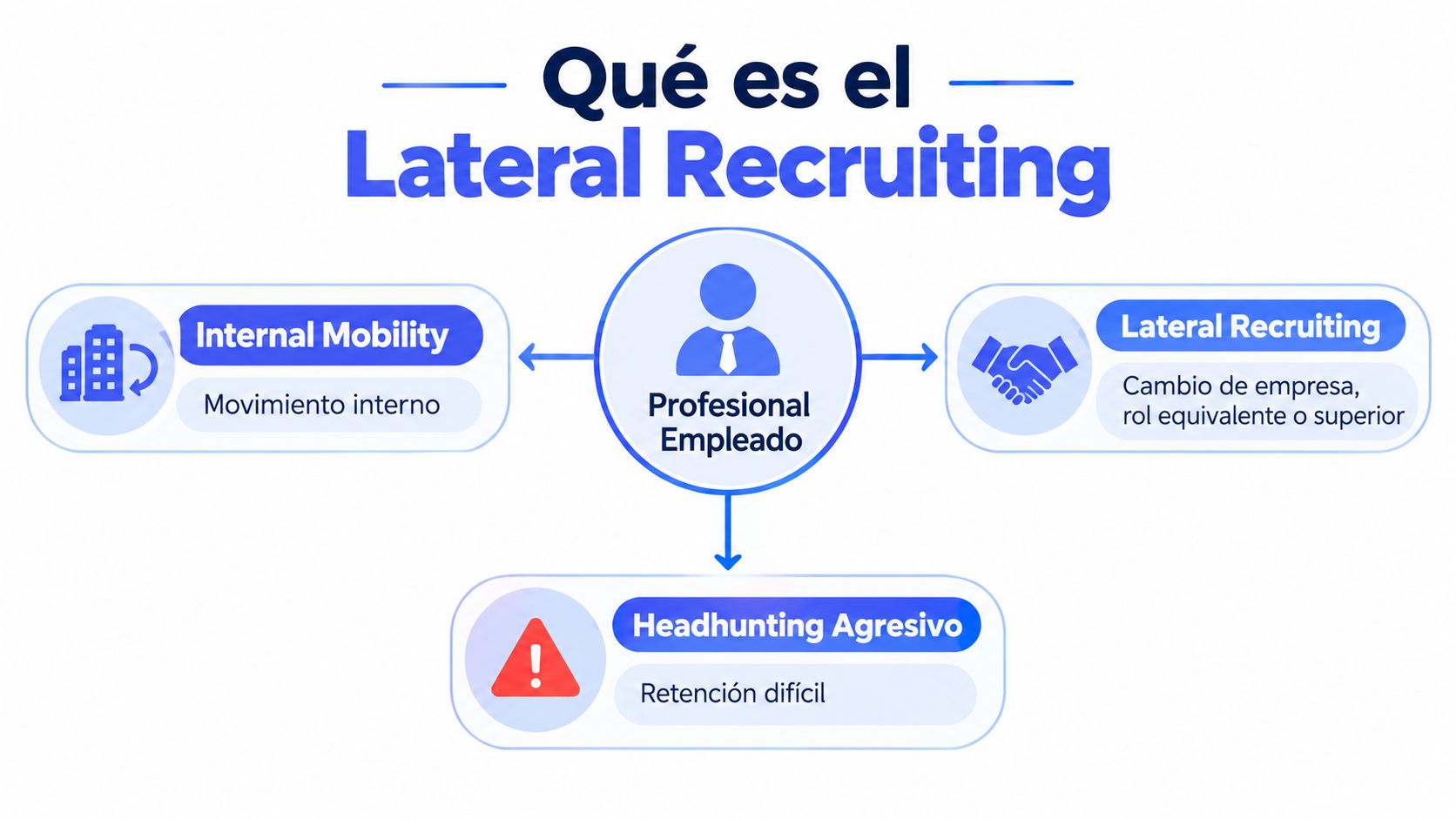
In lateral recruiting, the job title matters less than what the job actually involves: responsibilities, team size, type of client and proven results.
Lateral recruiting vs inbound hiring and internal mobility: 2026 comparison
Lateral recruiting differs from inbound hiring in who it reaches, and from aggressive headhunting in how it validates fit:
| Criterion | Lateral recruiting | Inbound (job posting) | Internal mobility | Aggressive headhunting |
|---|---|---|---|---|
| Who it reaches | Professionals employed at comparable companies | Active job seekers | Your own staff | Talent at one specific competitor |
| Starting point | Map of source companies and skills | Ad on job boards | Internal career plan | List of names |
| Time to productivity | Short | Variable | Short if the role is close | Short if the fit is there |
| Where the effort goes | Finding, contacting and persuading | Screening volume | Training and backfill | Persuading |
| Main risk | Weak case for the move | Applicants who don't fit | Gap in the original team | Reputation |
In lateral recruiting, the effort is concentrated in finding and contacting, which is exactly the stretch HeyTalent automates; in inbound hiring, the work is screening what has already arrived. Choosing between the two by seniority and scarcity is covered in the guide to active and passive recruitment.
Lateral recruiting tools in 2026: HeyTalent, LinkedIn Recruiter and the ATS
HeyTalent, LinkedIn Recruiter and an ATS cover different stretches of a lateral search. HeyTalent covers the whole identification and outreach stretch: it extracts LinkedIn profiles in real time, including outside the recruiter's network and without a Recruiter licence, filters them with AI variables, finds email and phone, and launches sequences of invitations, messages, InMails and follow-ups.
The HeyTalent agent turns a plain-language brief into a search with advanced LinkedIn filters. Because it extracts profiles at the moment of the query, the experience shown is current, which is exactly the criterion in a lateral search.
A lateral search is often shared across several recruiters, and that is where the billing model matters: HeyTalent bills one licence for the whole organisation, while LinkedIn Recruiter charges for each seat, and the company estimates this means paying up to 5x less. For a headhunter working alone, that gap narrows. Billed annually, HeyTalent starts at €93/month (October 2026 pricing).
HeyTalent also offers its ATS at no cost and charges for the sourcing layer: an agency-branded career page, job posts on Google Jobs, a candidate database and pipelines the client can view, seeing only the stages the agency chooses. If the agency already uses Teamtailor, Viterbit or Workable, HeyTalent works alongside that ATS through CSV export.
HeyTalent does not replace the recruiter's judgement or the funnel analytics of an advanced ATS, and sending connection invitations with a note can require a LinkedIn Premium Business account.
Why senior roles stay open for weeks in Spain
Senior roles stay open because the candidate who would fill them is already employed and never sees the ad. According to the same INESE survey, 35% of Spanish workers changed employer in the previous five years, 15% made more than two moves and two in five received at least one outside offer in the last year.
A typical case: an agency is hiring a B2B SaaS Head of Sales in Madrid. The ad attracts salespeople with no leadership experience, while the right person runs sales at a similar company and isn't looking. Inbound hiring can't see that person; with HeyTalent, the recruiter can find them on LinkedIn even outside their own network.
When lateral recruiting makes sense and when it is a mistake
Lateral recruiting makes sense when a role combines scarcity, experience and urgency: senior positions, technical profiles, sales leaders and roles where a bad hire costs more than a direct search.
Lateral recruiting is a mistake for junior roles with plenty of active applicants, or when the company can't explain why a candidate should move.
A four-question filter decides whether there is a case for a lateral search:
- Does the person currently work in a comparable context?
- Have they already done tasks that shorten the learning curve?
- Does the move keep or raise their level of responsibility?
- Is there a solid professional reason to move?
How to do lateral sourcing step by step
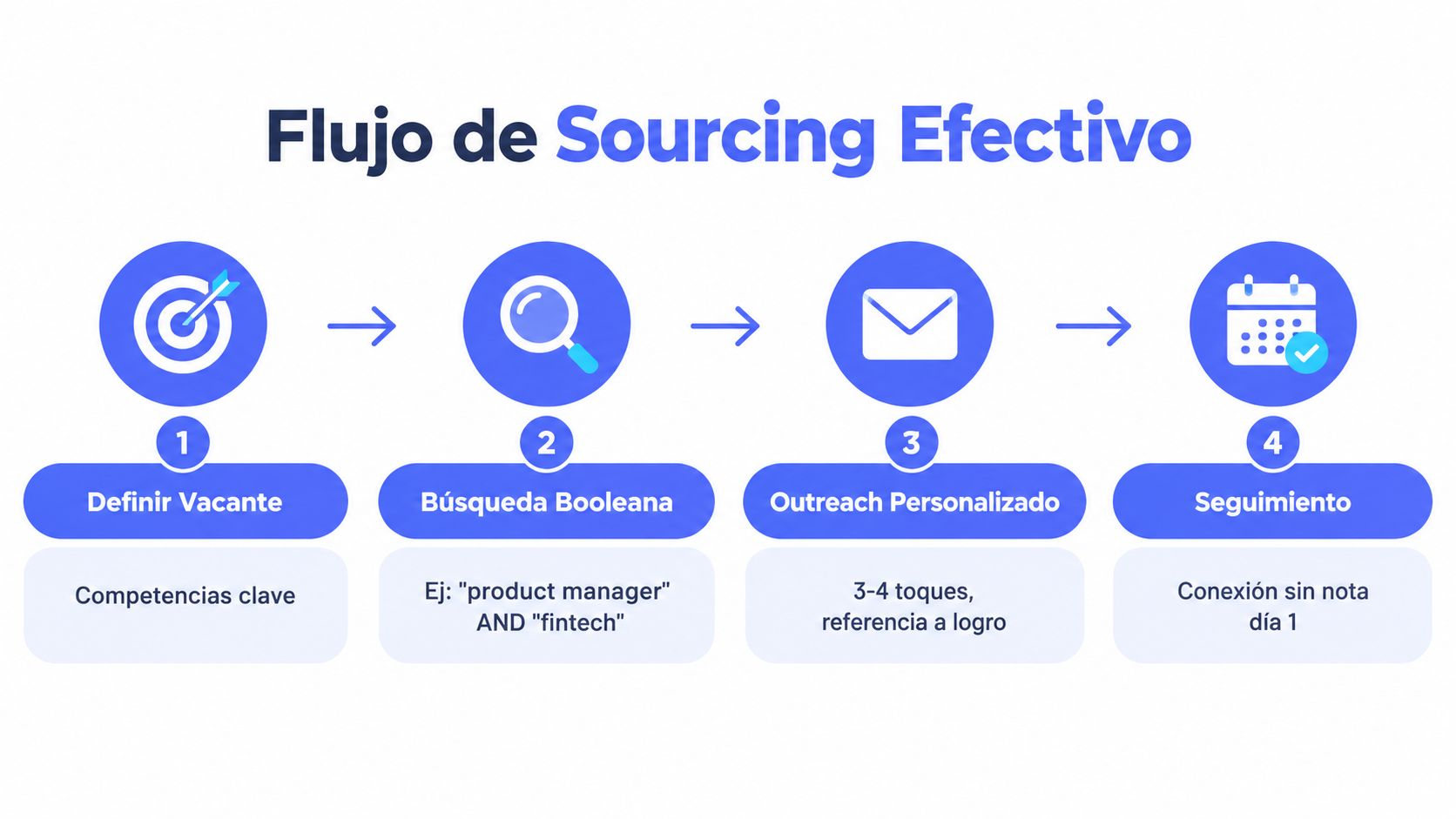
Lateral sourcing starts with the role, not the tool: before opening LinkedIn, write down what results the person must deliver and which skills are essential. For the B2B Head of Sales in Madrid, the order of criteria is:
- Skills: consultative B2B selling, enterprise negotiation and team leadership.
- Seniority: quota ownership and account scope.
- Sector: SaaS, payments or fintech, with similar sales cycles.
- Location: Madrid or willingness to work there.
An initial Boolean search for that profile could be:
("head of sales" OR "sales director" OR "sales manager") AND (SaaS OR "software as a service") AND (B2B OR enterprise) NOT recruiter
HeyTalent's AI variables then filter for what a Boolean string can't read well, such as English level. The guide to what sourcing is explains this stage.
Why industry should not filter a lateral search
Filtering by industry first removes valid candidates from a lateral search: start broad with skills and use industry as context. In Spain in 2023, 2,257,242 of the 15,444,205 contracts recorded by SEPE, the Spanish public employment service, went to people who changed sector, 18.11%, with occupational mobility at 39.69% (SEPE analysis of mobility across sectors and occupations). In 2024 the figure was 2,204,757, 17.90% of contracts for people with previous employment, according to SEPE's cross-sector mobility report.

Defining what the profile must solve before searching holds in any context, as this guide on how to hire staff for events in Morelos shows.
How to contact lateral candidates without sounding like spam
The first lateral recruiting message should show you understand the person's career, not sell the company, within a short cadence:
- Day 1: connection request without a note.
- Day 2 or 3: a message that mentions a specific project or achievement.
- Day 7: a second touch with a market data point or the scope of the role.
- Day 14: a friendly close that leaves the door open.
For the Head of Sales, the message starts with the candidate:
"I saw you've built enterprise sales in SaaS with complex cycles. I'm running a search to lead B2B sales in Madrid, with a team and key accounts. If you'd consider a step up in scope, I can share the context."
With forty candidates in play, keeping that cadence by hand is where follow-ups get lost. According to the figures HeyTalent publishes, its automated sequences, which schedule invitations, messages and reminders, multiply the response each user was getting before by 2.5.