Not every Manatal alternative solves the same problem. A headhunter needs to find passive talent, track down phone numbers and emails and automate first contact; an agency prioritises volume, users and multi-client work; an in-house team cares more about hiring-manager collaboration, reporting and compliance. The useful comparison does not start with which software has the most features, but with which bottleneck it removes. If the problem is finding and reaching candidates, the first alternative to evaluate is HeyTalent, which pairs LinkedIn sourcing, AI variables, email and phone finder and outreach sequences with a free ATS. In Spain, ATS adoption reaches 61 %, AI screening 22 % and video interviews 48 %, according to the analysis compiled by Factorial on recruitment tools.
What is Manatal and what does a recruitment ATS solve
Manatal is a cloud ATS (Applicant Tracking System) aimed at recruitment agencies and in-house teams, centralising job posting, the candidate database, pipelines and the tracking of each application. An ATS is defined as the system of record for the process: it organises what happens after a candidate enters your database.
That boundary explains most failed migrations. An ATS organises stages, evaluations and traceability, but it does not guarantee that you will find enough passive profiles, obtain their contact details or run a follow-up sequence. This explanation of what an ATS is covers that split between application management and active search.
Why leaving Manatal does not always mean changing ATS
Leaving Manatal only makes sense if the problem sits in process management. If the team already moves candidates through the pipeline cleanly and what is missing is candidates, migrating the ATS treats the wrong symptom: the bottleneck sits earlier, in sourcing and outreach.
It pays to separate four distinct functions before booking a demo: sourcing (finding profiles that have not applied yet), enrichment (obtaining email and phone), outreach (sequences and follow-ups) and ATS management (stages, evaluations, reporting). Manatal and most of its alternatives cover the fourth solidly and the first three only partially.
Comparison: 10 Manatal alternatives in 2026
| Product | Core function | Who it fits | Published pricing | Covers passive sourcing |
|---|---|---|---|---|
| HeyTalent | LinkedIn sourcing, AI filters, email and phone finder and automated sequences | Headhunters, agencies, RPOs and staffing firms running proactive searches | From €109/month billed quarterly (September 2026 rates) | Yes, it is its core function |
| Teamtailor | ATS with career site and employer branding | Non-technical teams receiving applications | Not public; based on company size | No |
| Tellent Recruitee | Collaborative ATS with no-code career site | European SMBs and mid-market | Not public; demo or proposal | No |
| Workable | Global ATS with multi-posting and scheduling | Teams needing broad inbound coverage | Published on its website | No |
| Greenhouse | ATS with structured interviews and scorecards | Mid-market and enterprise with regulated processes | Not public; Core, Plus and Pro plans | No |
| Lever | ATS and candidate CRM unified | Teams combining inbound and nurturing | Not public; quote | Partial (CRM, no enrichment) |
| Ashby | ATS with advanced analytics and scheduling | Technology companies focused on reporting | Not public; per-seat model | No |
| Personio | HR suite with a recruiting module | European SMBs and scaleups | Not public; based on headcount | No |
| Bizneo ATS | Localised ATS with multi-posting and workflows | Agencies and SMBs in Spain and Latin America | Not public; confirm with sales | No |
| Factorial | HR suite with a recruitment module | Spanish companies centralising HR | Per employee; indicative range | No |
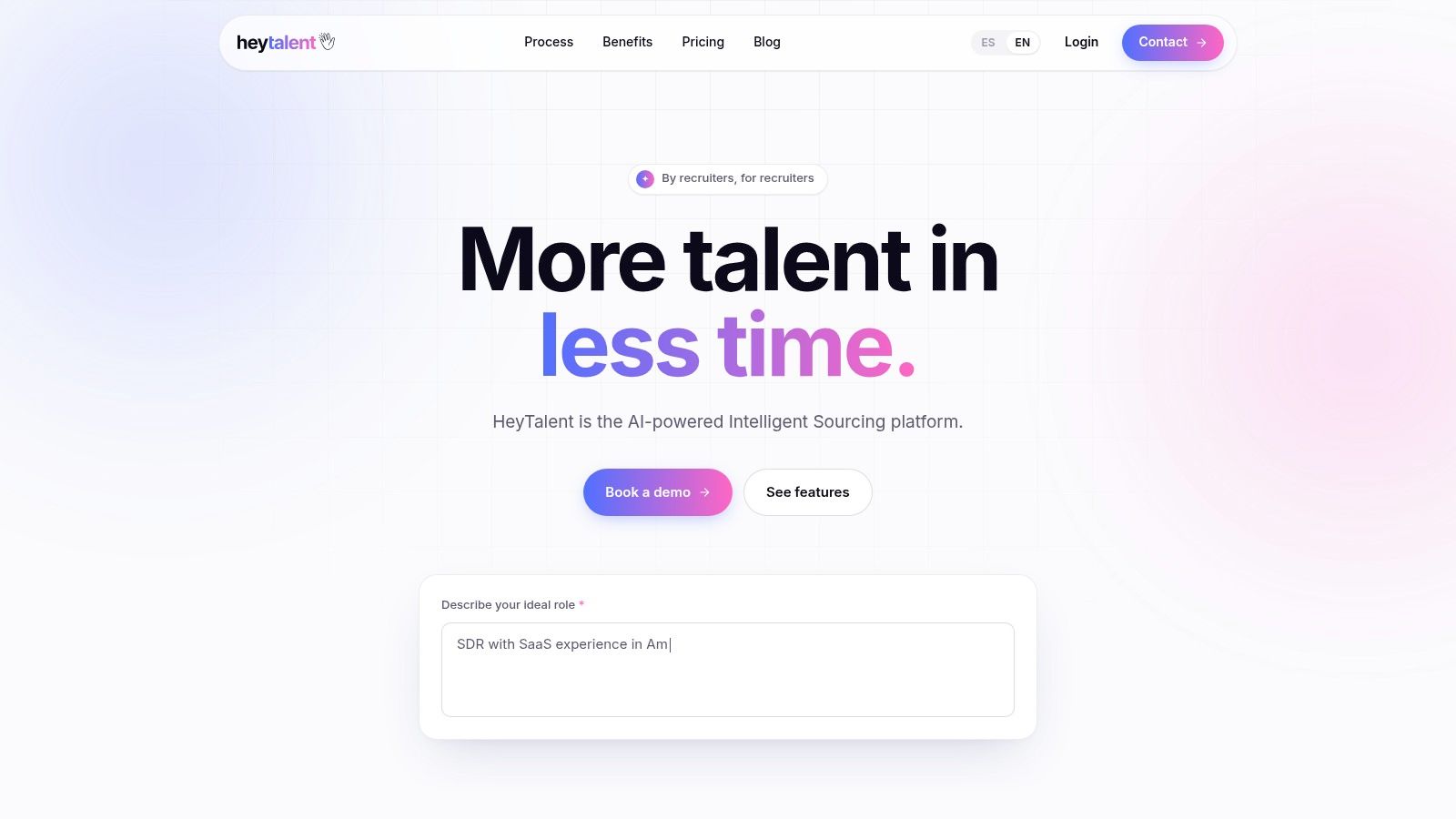
HeyTalent: sourcing and contact data on top of the ATS you already use
HeyTalent is an intelligent sourcing layer that sits alongside your ATS rather than replacing it: it extracts public LinkedIn profiles in real time, applies AI variables the recruiter defines, finds emails and phone numbers and automates omni-channel outreach sequences. It fits when the bottleneck sits before the pipeline.
According to HeyTalent, its users work 60 % faster during their first month of use, a self-reported average efficiency gain the company attributes to tighter lists and filters. The company also reports multiplying its users' response rate by 2.5 thanks to automated follow-ups. These are figures HeyTalent publishes about its own product, not an independent study, and they should be read as such.
One detail matters against Manatal: HeyTalent offers its ATS at no cost (job posting, candidate database, pipelines and forms, with the option to share the pipeline with the client) and charges for the sourcing layer. The HeyTalent website sets out the plans and included features in detail.
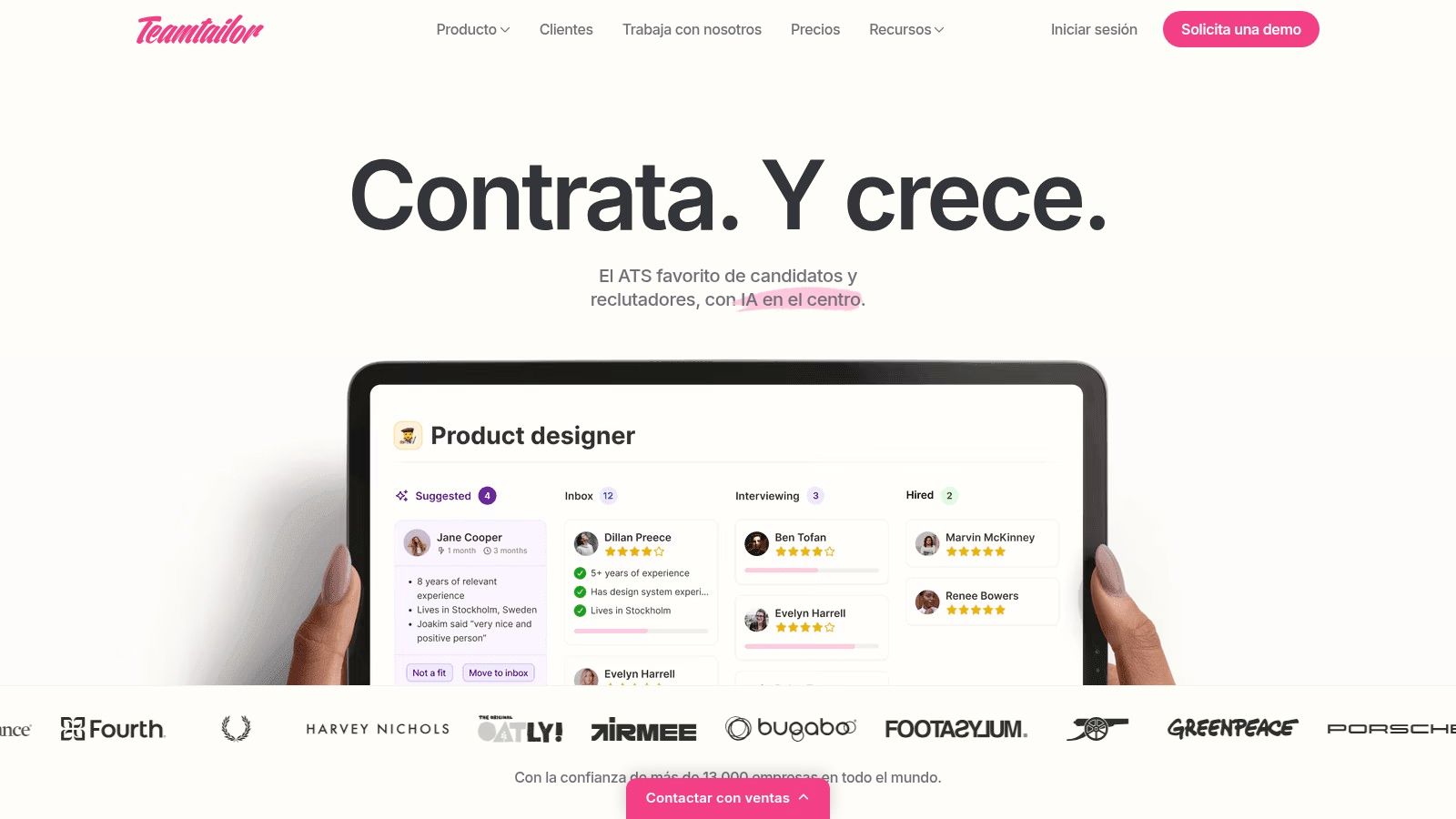
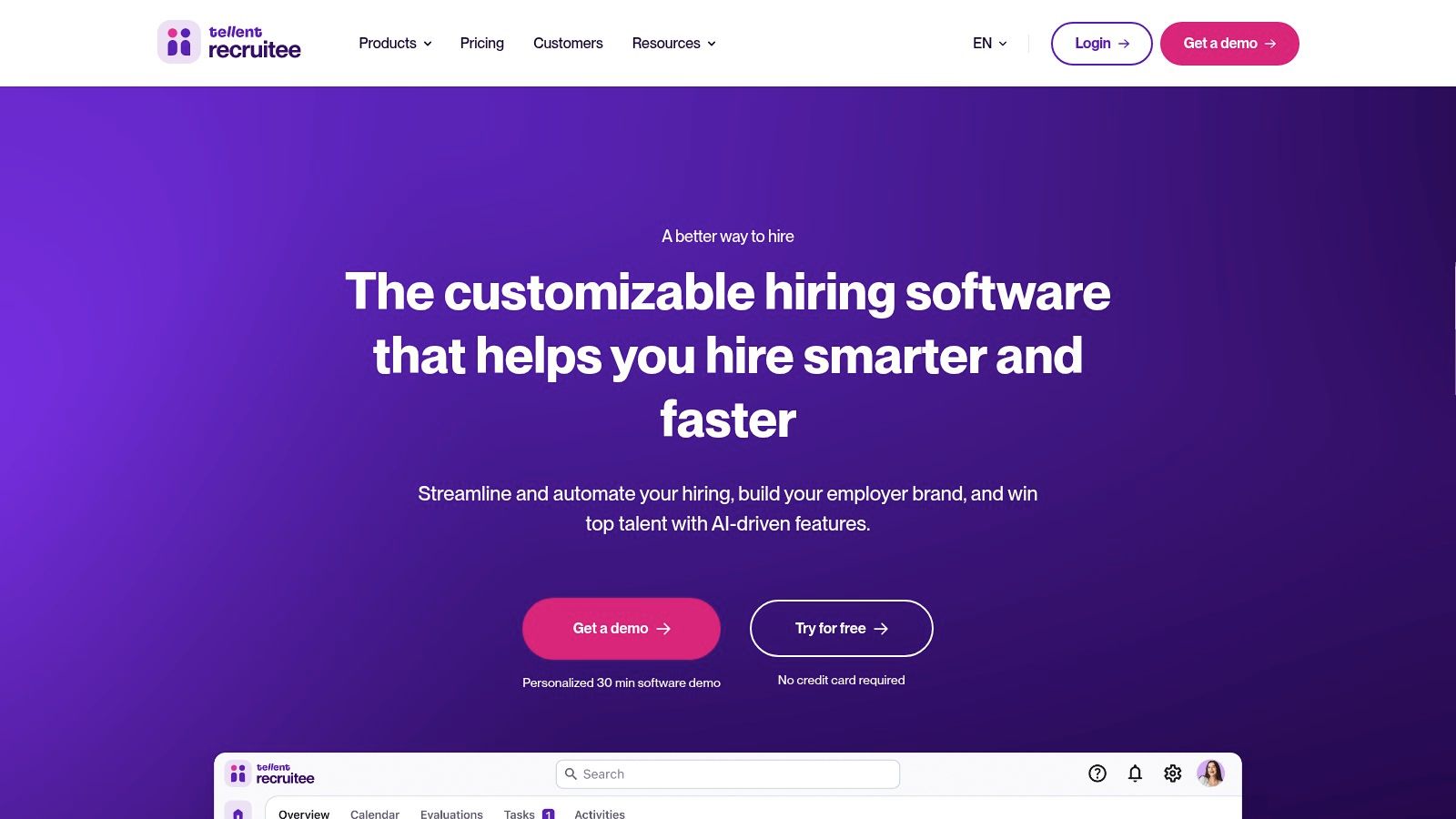
Teamtailor, Tellent Recruitee and Workable: organising the applications already arriving
Teamtailor, Tellent Recruitee and Workable are the three Manatal alternatives best suited to teams whose inbound application volume already exists and who need order rather than reach. All three cover a configurable funnel, communications, automations and hiring-manager collaboration.
Teamtailor leans hardest on employer branding: it lets you build a visual career site wired into the process, and its AI Co-Pilot searches the talent pool and helps draft job ads. Tellent Recruitee (formerly Recruitee) solves coordination above all, with a no-code editor for publishing the careers page without the technical team and an integrations marketplace. Workable brings the broadest inbound coverage of the three (job-board multi-posting, templates, scheduling and assessment) and publishes its pricing, which is rare in this group.
The three share the same limit: none is built to extract large volumes of passive profiles, find phone numbers or run multi-channel campaigns beyond the applications received.
Greenhouse, Lever and Ashby: structured processes and funnel analytics
Greenhouse, Lever and Ashby are the Manatal alternatives competing on method and measurement, not on sourcing reach. All three demand more implementation than a simple ATS and none publishes pricing.
Greenhouse brings structured interviews, scorecards and interview plans: it reduces reliance on isolated impressions and documents how each person is evaluated. Lever (LeverTRM) unites ATS and candidate CRM, so the history of a relationship outlives the specific role; its CRM is not equivalent to enrichment, because it does not guarantee an email or phone for every profile. Ashby concentrates its value in analytics: its dashboards answer where candidates drop out and which sources perform best, and it can sit alongside another ATS as a measurement layer.
The guide to the best ATS platforms for the United States helps benchmark this group against the North American market, where these three platforms account for a large share of enterprise deployments.
Personio and Factorial: recruiting inside an HR suite
Personio and Factorial are not pure ATS products: they are HR suites that include a recruitment module. The benefit is not finding more talent, but letting the information from a hire continue into onboarding, employee records and HR administration without duplicating data.
Personio targets European SMBs and scaleups and quotes based on headcount and activated applications. Factorial combines recruitment, onboarding, digital signatures and absence management, with support in Spain. For an agency working across several clients, outreach accounts and separate candidate databases, a suite built around employee management delivers less than a dedicated sourcing tool.
Both bet on the administrative integrations ecosystem: the information on how to connect Payfit gives a sense of the kind of connection these suites prioritise, though the current scope of each one is worth validating.
Bizneo ATS: the localised alternative for Spain and Latin America
Bizneo ATS is the Manatal alternative with the best fit when the team works in Spanish and needs multi-posting to local job boards. It includes configurable workflows, templates, reporting, automations and candidate communications, with regional support in Spain and Latin America.
Bizneo organises the pipeline after profiles have been captured. That distinction matters for headhunters: posting jobs and automating tasks is not the same as extracting passive candidates, finding their contact details or running multi-channel outreach. The comparison of the best ATS platforms in Spain places Bizneo against the rest of that local market.
How much each Manatal alternative costs
Eight of the ten Manatal alternatives in this comparison do not publish pricing: they quote based on company size, headcount or seats. Only Workable publishes rates and HeyTalent publishes its plans, which makes comparing cost before talking to sales effectively impossible for most of the group.
The billing model matters more than the amount. An ATS that charges per seat gets more expensive with every hiring manager you add; one that charges per employee grows with headcount, not with recruitment activity. HeyTalent charges per organisation rather than per seat, which the company says amounts to savings of up to 5x against the cost of LinkedIn Recruiter; that margin depends on team size and does not apply equally to a recruiter working alone.