RocketReach is not the only way to find contact details. The usual mistake in comparison articles is treating every tool as if it solved the same problem. It doesn't work that way. A freelance recruiter usually wants self-service and speed. An agency may prioritise volume and outreach. A staffing firm may need traceability and internal control. And a corporate talent acquisition team tends to look at compliance, integration and data governance long before it counts credits.
There is a second point worth making. The right question is not simply which tool finds emails or phone numbers. The useful question is which part of the workflow actually improves: profile discovery, enrichment, verification, filtering or first contact. That is where so-called RocketReach alternatives really start to diverge.
The regulatory context shapes the decision too. In the EU, the GDPR requires consent to be "freely given, specific, informed and unambiguous", and when data comes from third parties there is an obligation to inform the data subject within 1 month, per the text of the GDPR published on EUR-Lex and in Spain's official gazette. For European recruiting, that turns sourcing and enrichment into a compliance process, not just a productivity question.
So this comparison doesn't rank tools by popularity. It compares them by the real problem they solve, data source, verification, filters, integration, outreach, indicative price, limitations and operational fit. One idea is worth stating up front: none of them replaces an ATS such as Teamtailor, Viterbit or Workable. The normal outcome is that they complement it.
If you are trying to save time, cut manual work and speed up first contact without breaking your internal processes, the differences between these tools matter. Let's get to the useful part.
1. HeyTalent
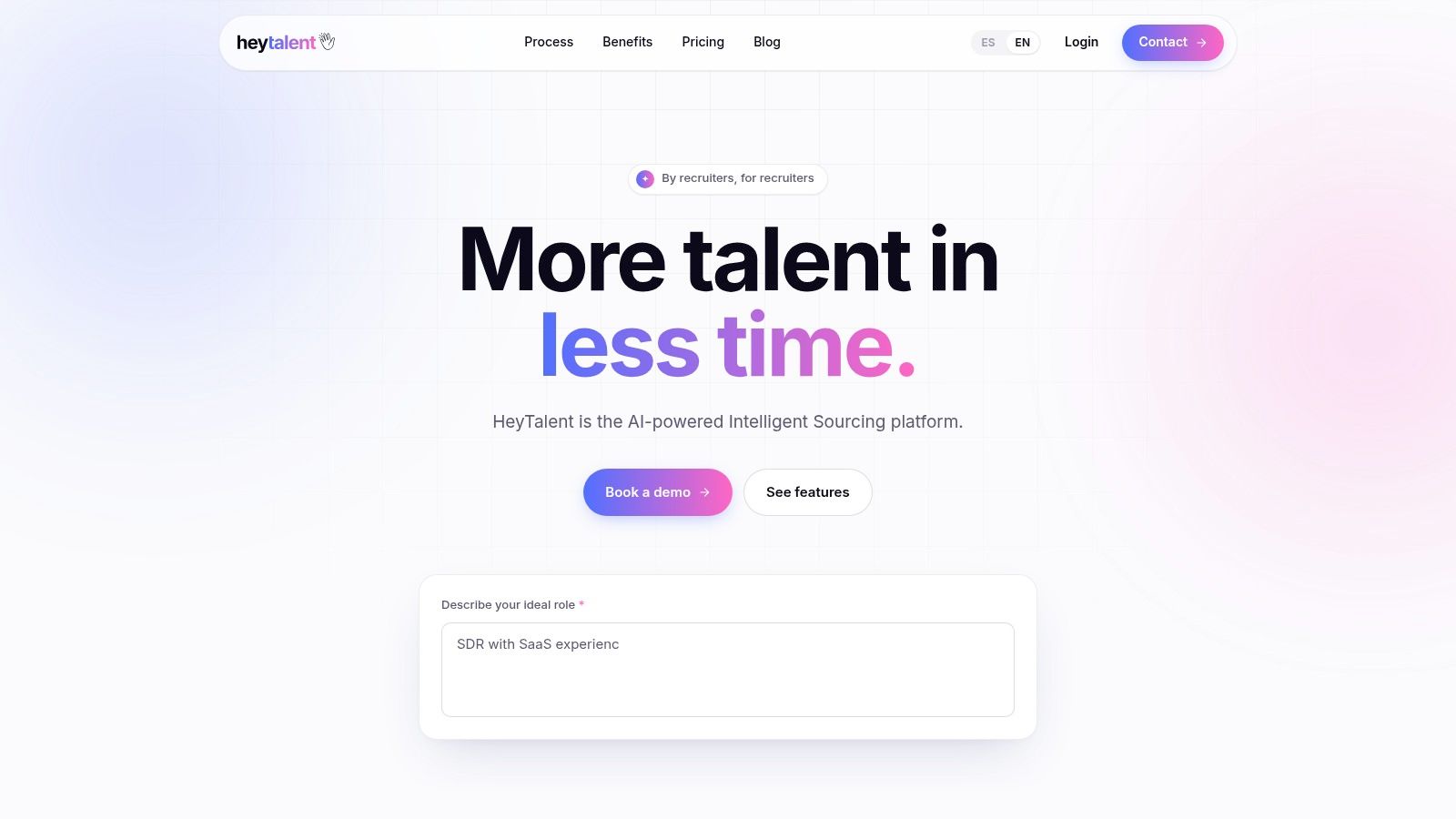
RocketReach usually performs better as a generalist contact database than as an end-to-end recruiting tool. HeyTalent takes a different shape: it organises the work around a recruiter's actual flow — discover profiles on LinkedIn, filter them with more context, enrich contact data and launch outreach without switching tools at every step.
That approach matters. The Fundación Atresmedia report on connected talent documents, for the Spanish market, how much weight LinkedIn carries in candidate search among those who use social networks to recruit — a pattern that holds well beyond Spain. If discovery starts there, the operational difference isn't only about finding an email address. It's about reducing manual handoffs between sourcing, prioritisation and contact.
Which part of the job it replaces, and which it doesn't
HeyTalent covers three blocks better than RocketReach tends to in a recruiting context. The first is discovery, with Boolean searches and filters by job title, keywords, location, experience or company size. The second is enrichment, with verified emails and phone numbers for the profiles you've found. The third is operational filtering, using configurable AI variables to prioritise candidates against the criteria of the role.
That third layer deserves attention. For a recruiter or an agency, the problem is rarely generating a long list. The real cost shows up afterwards, when someone has to review profiles, separate useful signal from noise and decide who to contact first. A tool that shortens that stretch can save more time than one with a bigger database that fits the selection workflow less well.
Rule of thumb: if the team discovers profiles on LinkedIn, copies them into a spreadsheet, reviews them one by one and then sends manual messages, the bottleneck is in the sequence of work, not only in a shortage of contacts.
Fit with an ATS and with different team shapes
This is worth being precise about. HeyTalent does not replace an ATS such as Teamtailor, Viterbit or Workable, because it isn't designed to manage pipeline, hiring-manager coordination, stages or process reporting. What it can replace is part of what many teams use RocketReach for: the pre-ATS phase, where profiles are discovered, data is enriched and first outreach goes out.
For agencies, RPOs and independent recruiters, that consolidation of tools carries real weight. Fewer jumps between extensions, spreadsheets and sequences means less administrative work. In corporate teams, the value depends more on how it fits internal processes and legal review.
Pricing and how to read the cost
The pricing structure is public, which makes comparison easier. Recruiter costs €109/month billed quarterly, with up to 2,000 candidates a month. Agency goes up to €214/month with up to 5,000 candidates. Ultra reaches €599/month with up to 14,000 candidates a month, priority support and more accounts. The plans include an AI co-pilot for sourcing, email and phone lookup, unlimited CSV export and unlimited users.
The useful reading isn't only the monthly price. What work it avoids matters too. If an agency needs to combine LinkedIn sourcing, enrichment, prioritisation and contact sequences, paying for a single integrated layer can work out better than stacking several cheaper but disconnected tools. Conversely, if the team already has a stable stack and only wants occasional contact verification, the potential saving drops.
Real strengths and limits
- Better fit for recruiter-first discovery and filtering: the usage logic starts from roles and profiles, not from generic sales prospecting.
- Enrichment inside the same flow: fewer steps between identifying a candidate and activating contact.
- Prioritisation with configurable variables: useful in searches where job title alone generates too much noise.
- Legible pricing from the start: helps freelancers and small agencies estimate cost without going through a sales process.
- Complements the ATS: covers sourcing and initial outreach, but doesn't replace process management, evaluation or internal coordination.
It has limits too. Part of the workflow depends on LinkedIn and its practical restrictions. And although the tool states GDPR compliance and opt-out options, responsibility for the legal basis, candidate notification and internal processing policy still sits with the company. In European recruiting, that part isn't delegated.
2. Cognism
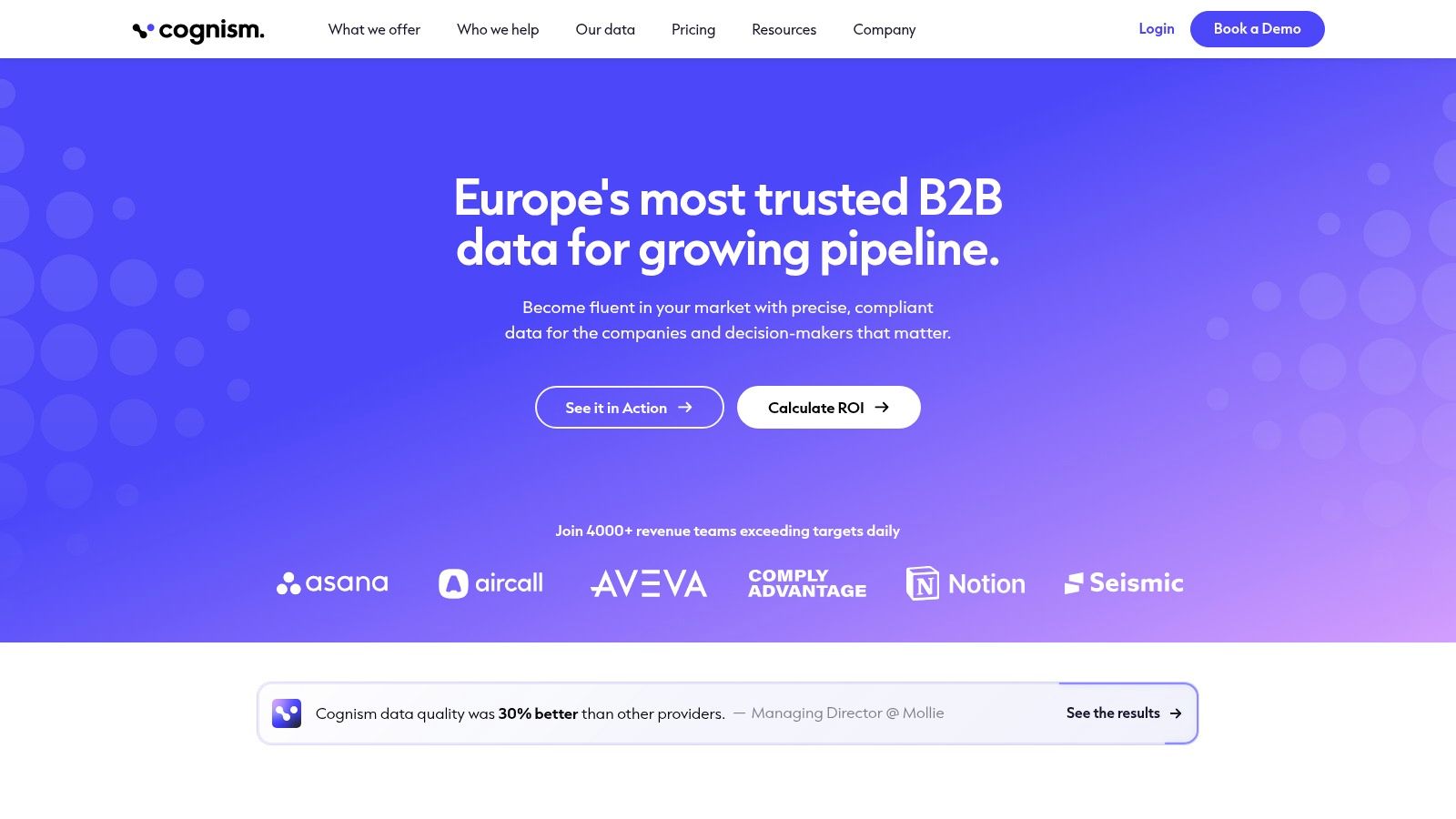
Cognism makes sense when the main problem isn't finding any contact, but getting direct mobile numbers with a European focus and a more visible compliance posture. For recruiters working difficult searches across EMEA, that changes the day-to-day considerably, especially in roles where the phone is still a useful channel.
It isn't the simplest option to start with. Nor the most accessible for an independent recruiter. But for agencies with volume, or corporate teams that need more control, it can fit better than tools built around self-service.
When it adds more than RocketReach
Cognism works well when sourcing and contact are separate activities. That is, your team discovers talent on LinkedIn, through referrals or in internal databases, and then needs to enrich and activate contact at volume with CRM or API support. Its logic resembles a data and prospecting layer more than a recruiter-first tool.
The useful angle for the EU is compliance. LinkedIn's EU policies show concrete retention and usage windows for contact lists — 30 days for encrypted contact lists and 90 days for derived audiences — according to LinkedIn's EU privacy policy. That kind of limit is a reminder that "having the data" isn't enough. You have to know where it came from, how long you keep it and what you use it for.
Pros and real limits
- Strong in EMEA: a good option if the direct mobile number matters more than the email.
- Useful for integration: API, bulk enrichment and CRM fit well in larger agencies.
- Better for mature processes: if sourcing is already solved and you're looking to scale contact.
If your team needs a demo, procurement and legal validation before buying, Cognism belongs in the conversation. If you need to start tomorrow with self-service, it usually isn't the first option.
The main limit is the commercial model. Pricing isn't public and buying goes through sales. For freelance recruiters or small boutiques, that rules the tool out regardless of how good the data is.
The official site is Cognism.
3. Lusha
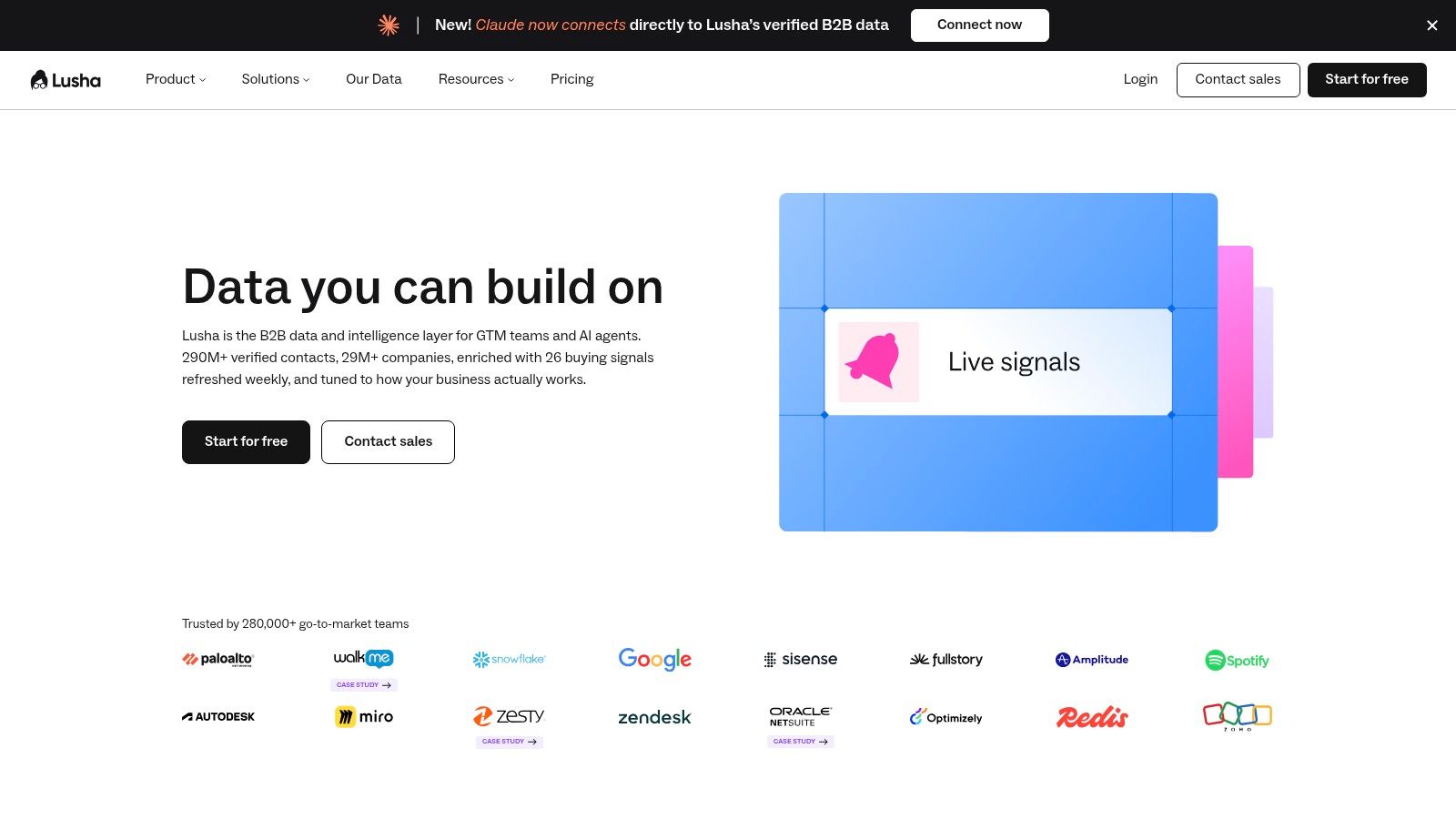
Lusha tends to work best in one very specific scenario: you've already found the profile and now you need to go from "I have a name" to "I have a usable way to reach them" without building a more complex operation. For recruiters working out of LinkedIn, and for small agencies with little room for trial and error, that difference matters more than having an enormous database.
Its proposition is easier to understand if you split the flow into stages. In discovery and filtering, Lusha contributes less than tools built around search or sequences. In enrichment and quick lookup, it does gain points for simplicity. The browser extension and the credit model let you calculate operating cost fairly clearly. An email consumes fewer credits than a phone number, so the tool favours strategies where you try email first and only escalate to mobile for priority profiles.
That detail changes real usage.
If your ATS — whether Teamtailor, Viterbit or Workable — is handling pipeline, candidate status and internal collaboration, Lusha can complement the contact piece well. It doesn't replace that system. Nor does it replace everything RocketReach does for teams that depend on broad coverage, batch work or more connected outreach processes. It replaces one specific fraction of the job: pulling contact data quickly with a low learning curve. To sharpen that judgement, it's worth reviewing how to assess the quality and use of contact data in recruiting.
Friction usually appears when you scale. If a search demands several attempts per candidate, or if your main channel is the phone, credit consumption rises quickly and the monthly forecast stops being comfortable. It's also worth reviewing in detail the legal basis for use and the fit between data type, contact channel and internal storage.
In short, Lusha fits better as a fast enrichment tool than as a central recruiting platform.
The official site is Lusha.
4. Apollo.io
Apollo.io doesn't usually stand out for one single thing. Its value lies elsewhere: it reduces tool-switching inside the flow. For a recruiter who needs to discover profiles, enrich data, filter it with some logic and launch first contact without leaving the same environment, that difference weighs more than a slightly larger database or a simpler interface.
That's why it competes with RocketReach from a different angle.
RocketReach fits better when the priority is locating contact data. Apollo tries to cover a wider slice of the process, especially from enrichment through to outreach. In practice, that means fewer manual steps between search, list building and sequences. For small agencies or talent acquisition teams with medium volume, that reduction in operational friction can save more time than a marginal improvement in coverage.
The limit appears as soon as you separate the problem into phases.
In discovery, Apollo offers filters and a broad base, but it doesn't fully replace specialised sourcing work if your market is very niche or if you depend on unstructured local signals. In enrichment and outreach, by contrast, it makes more sense because it combines data, lists and basic automation in one flow. Verification and real data quality — especially for mobile numbers outside the United States — are worth checking carefully before making it your primary contact channel.
That nuance matters too if you already work with an ATS such as Teamtailor, Viterbit or Workable. Apollo can complement the top of the funnel well, from identification through to first message. It doesn't replace the ATS, because it isn't built to manage pipeline, internal feedback, interviews or candidate traceability. What it can replace is a specific part of RocketReach: the combination of contact lookup plus initial outreach, especially if that work is currently spread across several disconnected tools.
Where you should be more analytical is real operating cost. If the team only needs to find emails or phone numbers and push them into the ATS, Apollo may be more tool than necessary. If you're also going to use sequences, dynamic lists and filters to prioritise outreach, the package has more logic to it. The purchase stops being "database vs database" and becomes "point tool vs execution layer".
Its official site is Apollo.io.
5. ZoomInfo
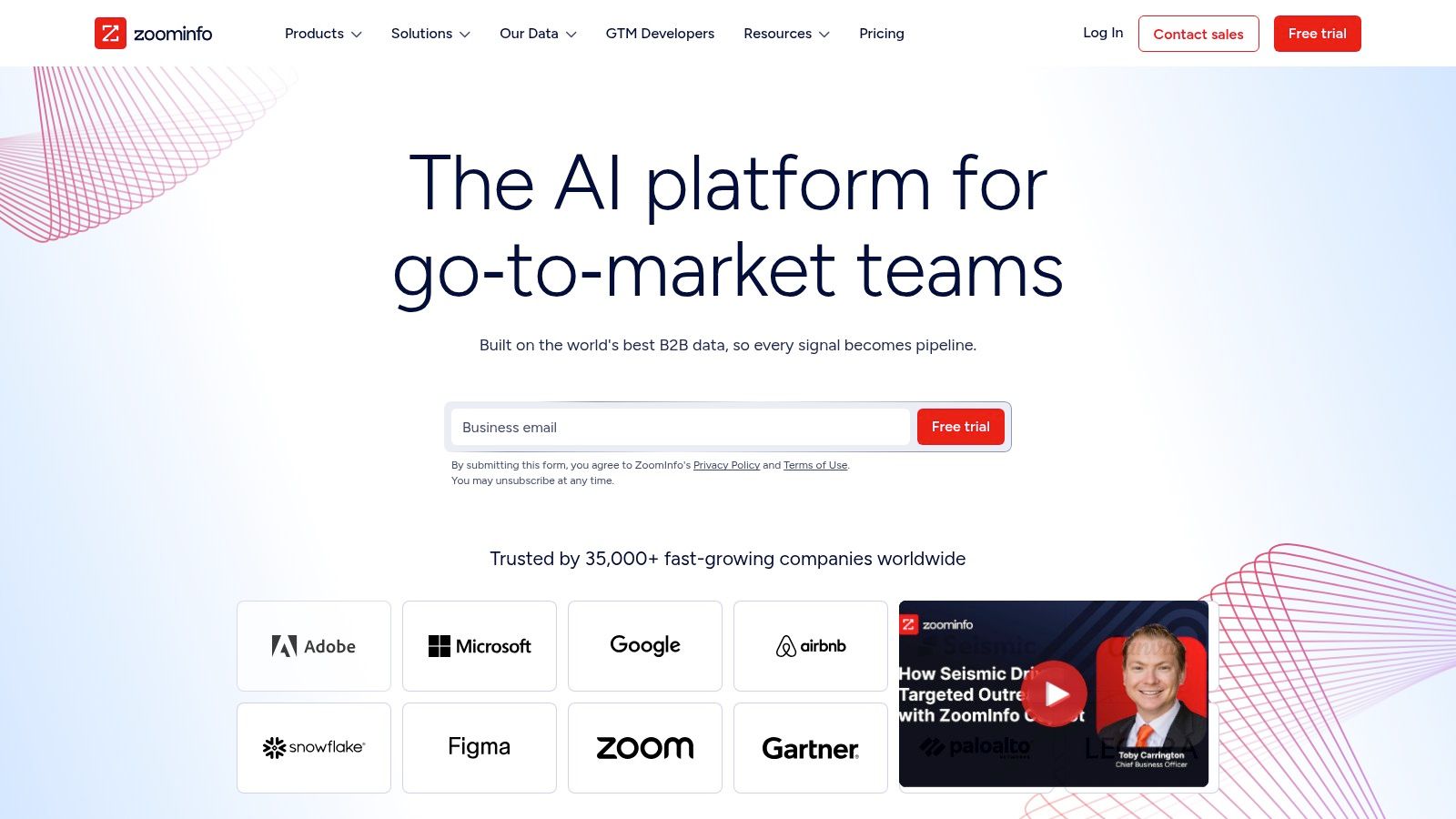
ZoomInfo doesn't compete with RocketReach on "bigger database" alone. It gets bought for a different reason: to reduce manual work when recruiting shares systems, budget and data governance with large sales or operations teams.
That nuance changes the comparison.
In a recruiting flow, ZoomInfo tends to perform better at enrichment, partial verification and segmentation at scale than at fine-grained talent discovery. If your team covers generalist positions or works against already-defined target accounts, that broad coverage can save considerable time. If the challenge is finding scarce, local or highly specialised profiles, the advantage narrows, because the breadth of a database doesn't substitute for contextual sourcing.
Its role relative to the ATS changes too. With Teamtailor, Viterbit or Workable, ZoomInfo works as a prior or parallel data layer, not as a system for managing pipeline, feedback or interview coordination. It can replace part of the work RocketReach does today, especially enriching and completing contact data at volume. It doesn't solve the full selection process on its own.
A serious evaluation here doesn't start with credits, but with operating cost and organisational fit. A small team usually pays for capacity it doesn't use. An enterprise team can justify it if it needs permissions, integrations, management by area and more formal data-usage rules. In the EU, it's also worth reviewing in detail how data processing and purpose are framed for recruiting. That point matters more as enrichment volume and legal exposure grow, as we explain in this guide to data enrichment applied to recruiting and compliance.
A practical way to read ZoomInfo is this:
- Discovery: useful if you start from companies, sectors or accounts. Less differentiating if you do niche search leaning heavily on qualitative signals.
- Enrichment: one of its clearest use cases, especially when the team needs to complete large batches of contacts.
- Verification: it helps, but validate real quality by market and channel before making it your primary source.
- Filtering: strong in environments where recruiting shares segmentation criteria with other departments.
- Outreach: it can support the start of contact, though it doesn't replace a well-built recruiting operation or the subsequent work inside the ATS.
The main friction is in purchasing and implementation. Opaque pricing, annual contracts and an adoption curve that makes more sense for teams with mature operations than for small agencies or independent recruiters.
The direct reference is ZoomInfo.
6. Kaspr by Cognism
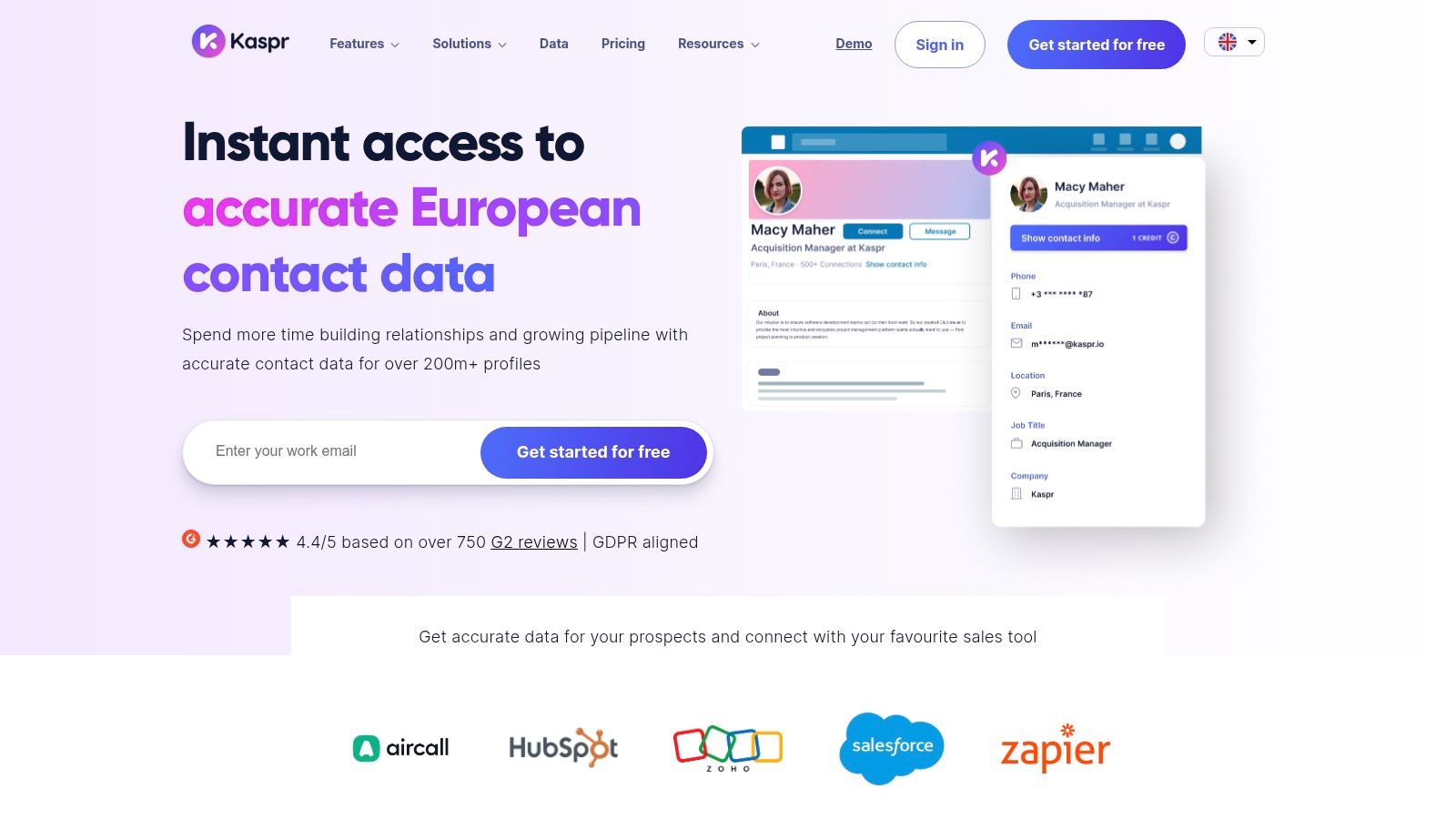
RocketReach is usually evaluated as a broad contact base. Kaspr is better read differently. It works best as a tool for fast capture and enrichment inside LinkedIn, with less ambition outside that environment.
That difference matters in recruiting because it changes the problem being solved. If the bottleneck is discovering talent from scratch, Kaspr contributes less than options with broader databases and filters. If the jam appears later — when you've already found profiles on LinkedIn and need to pull contact data, verify quickly and move to outreach — it fits much better.
In a real flow, its place sits between discovery and outreach:
- Discovery: heavily dependent on LinkedIn. It doesn't widen the search universe much on its own.
- Enrichment: this is where it adds most value. It lets you complete emails and phone numbers while you review profiles.
- Verification: useful for a first operational validation, though it's worth cross-checking quality by market before using it as your only source.
- Filtering: limited compared with platforms designed for advanced segmentation outside LinkedIn.
- Outreach: it speeds up the first step, but follow-up, pipeline and traceability still live better in an ATS such as Teamtailor, Viterbit or Workable.
For agencies and recruiters with high output on LinkedIn, that logic makes sense. It cuts tool-switching and shortens the time between identifying a profile and launching first contact. For internal teams with broader processes, it usually works better as a tactical layer than as a genuine RocketReach replacement.
There is also a clear operational limitation. Kaspr works with credits and caps that force you to control fairly tightly which profiles get enriched and when. In small teams that's managed without much trouble. In operations with several recruiters, it can create friction if there are no clear rules on usage and priority.
Its proposition, in short, is specific: less general coverage, more speed sourcing from LinkedIn. The direct reference is Kaspr.
7. Hunter
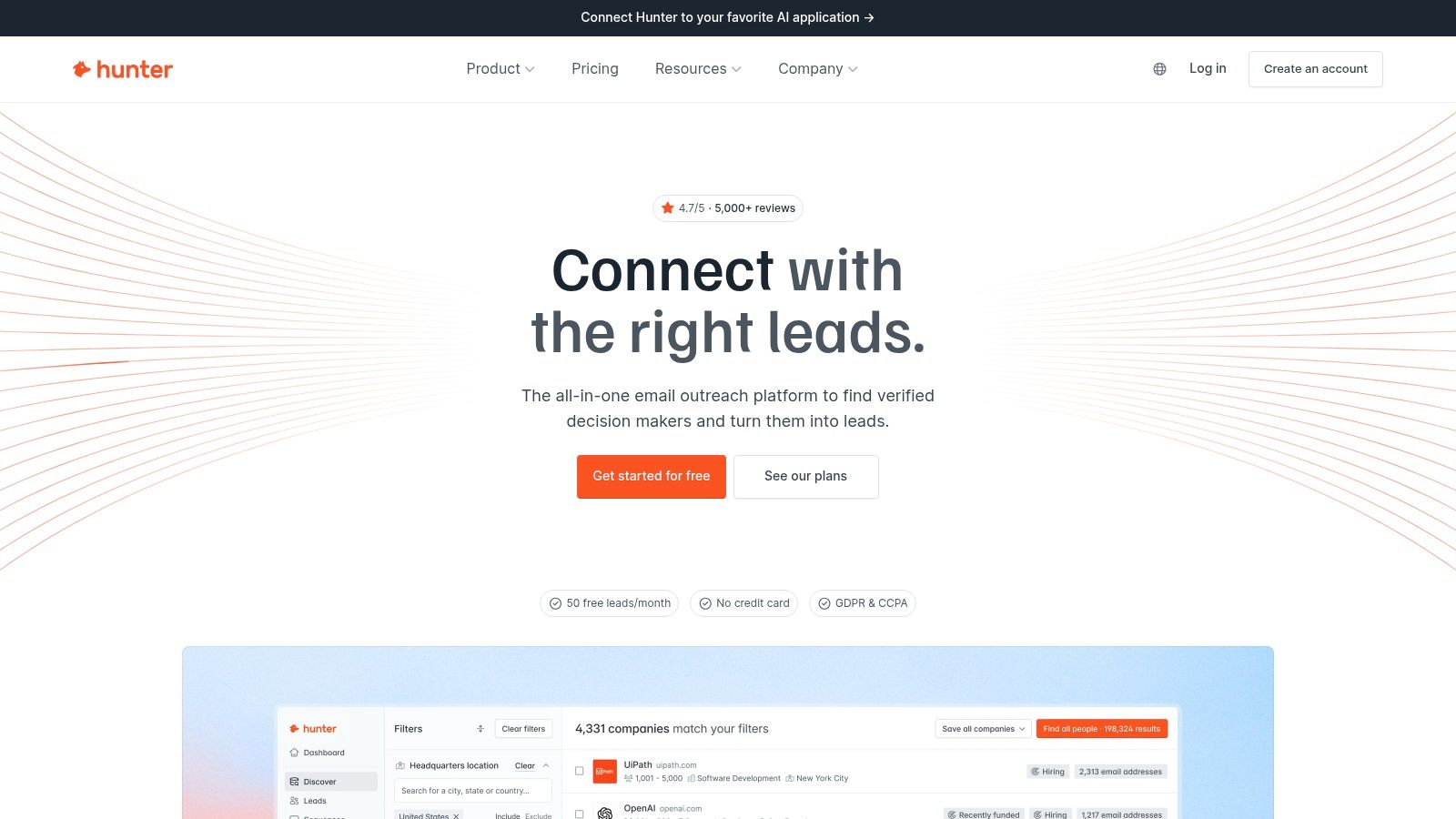
Hunter doesn't really compete as an all-in-one suite. It competes as a reliable email finding and verification layer. And for many teams, that's already enough.
If your problem isn't discovering talent but verifying or completing professional email addresses from specific domains and companies, Hunter can be a very efficient piece. Especially in processes where the phone isn't a priority.
When it makes sense in recruiting
Hunter shines when you work target accounts or company lists and need several valid contacts at each one. It also serves as an additional verification layer if your main source of profiles is something else.
Its logic fits simple workflows well:
- Domain search: locating contacts associated with a company.
- Email Finder: estimating email addresses from a name and company.
- Bulk verification: cleaning batches before outreach.
Not every RocketReach alternative has to replace RocketReach entirely. Sometimes the most profitable decision is to use a specialised tool for the exact part that's failing.
Its limits are clear
Hunter has a minimal learning curve and a stable API, which is valuable for teams with their own processes. But it isn't built for mobile numbers or for recruiter-first sourcing. If you want advanced talent filters, recency signals or sequences oriented to selection, you'll have to combine it with other pieces.
The official site is Hunter.
8. Snov.io
Snov.io is interesting when the team wants predictability. Not so much for the depth of the data, but for the combination of finder, verifier and multichannel campaigns with visible pricing.
For a small agency or a consultancy that needs to unify search, validation and sending without entering an enterprise contract, that balance can be enough.
Where it adds value
Snov.io serves teams that want an execution tool more than a data intelligence platform. Finder and verifier cover the basics. Campaigns help activate sequences without leaving the platform. And the model of unlimited seats and unlimited exports on higher tiers gives a good deal of operational comfort.
That approach makes sense when you aren't looking for "the best database", but for less friction in daily work.
Where it falls short
- Less depth in telephony: not the best tool if the direct mobile number rules.
- LinkedIn automation sold separately: adds cost and complexity.
- Less powerful in advanced enrichment: compared with more data-first platforms.
Its strength is the balance between visible pricing, execution and order. If your current stack is chaotic, it can simplify more than it appears.
The official reference is Snov.io.
9. ContactOut
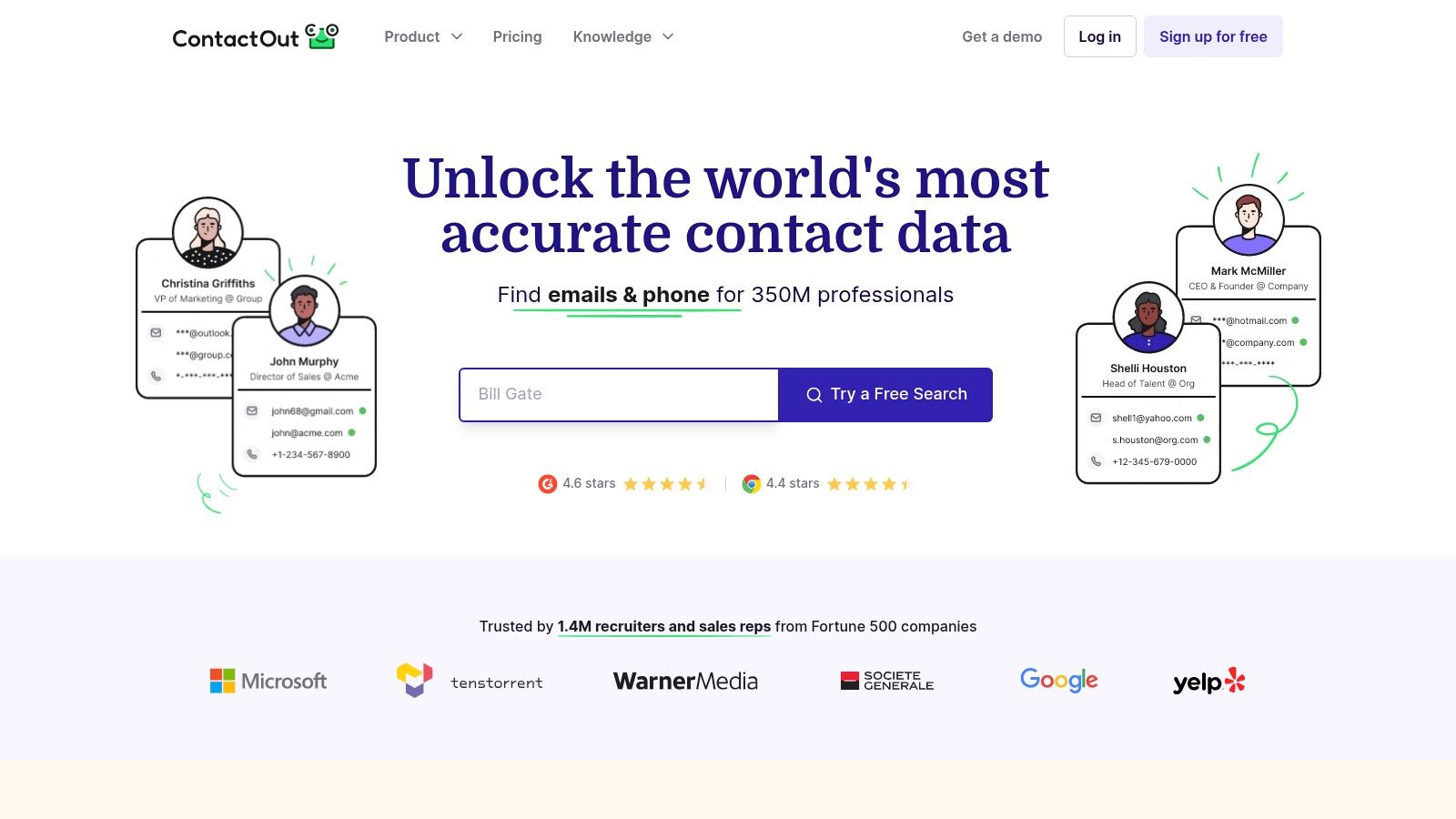
ContactOut is well known in recruiting for one specific reason. Its experience from within LinkedIn is very fluid, and it tends to attract people who want email addresses visible inside the profile itself with the fewest possible steps.
For many headhunters, that's already half the battle. Less context-switching and more speed to contact.
When it fits best
ContactOut tends to be useful in direct searches and in roles where the recruiter works almost entirely inside LinkedIn. It can also appeal to consultancies that prefer a lightweight tool for lists and basic campaigns rather than a more complex suite.
Even so, there's an important legal and operational point to remember. Company data and personal data are not the same thing. Using named email addresses and mobile numbers of identifiable people falls within the scope of the GDPR, and for commercial email, national rules add further restrictions — in Spain, the LSSI-CE imposes strict limits except in specific cases, as explained in the report by Catalonia's public employment service on business prospecting and contact data. Equivalent rules exist across the EU, so check the ones that apply in your market.
The good and what needs care
- Very comfortable in LinkedIn: speeds up lookup and list building.
- Popular among recruiters: especially for direct outreach.
- Light and usable: little friction to get started.
Its accuracy can vary by sector and market, so validate it in your niche before scaling. And if your team then stores that data in an ATS or CRM, candidate notification and traceability can't be left out.
The site is ContactOut.
10. Dropcontact
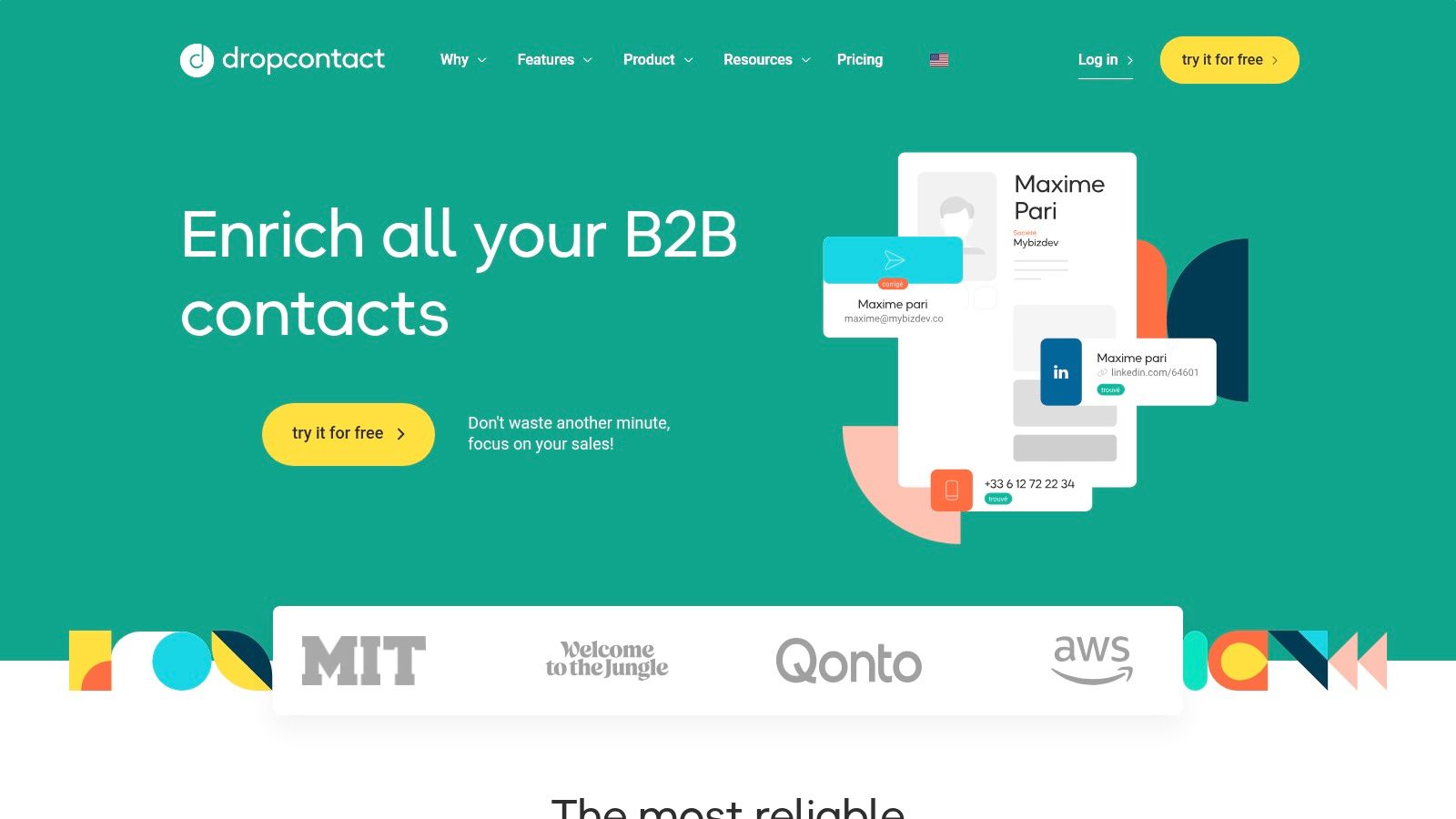
Dropcontact isn't the typical RocketReach alternative built on "a bigger database". Its proposition revolves around algorithmic enrichment, verification, deduplication and updating, with an explicit focus on the EU and on compliance.
That makes it interesting for teams that already have contacts or profiles and want to clean, complete or maintain data quality inside their CRM or recruiting stack.
Which problem it solves best
Dropcontact works as a maintenance and enrichment layer rather than as a discovery engine. If your ATS, CRM or in-house database already holds useful but incomplete records, this approach makes sense. Especially in teams with strict data-processing policies and a need for EU-based servers.
In European recruiting, that angle matters a good deal. Many generalist comparisons talk about price and credits but leave the question of whether a tool is adequate under the GDPR poorly answered. This approach is well covered in the guide to GDPR-compliant sourcing tools.
Advantages and limits
- EU focus and GDPR by design: interesting for highly demanding environments.
- Useful for continuous cleaning and enrichment: more value in the CRM than in initial sourcing.
- A good complement: it doesn't try to replace the whole stack.
For teams with internal audit or enterprise clients, less abundant but better-governed data can be worth more than a huge database with no clear traceability.
Its limit is obvious. It's more focused on email than on mobile, and it doesn't compete as a complete outreach or sourcing suite. It fits better as a complement.
The official site is Dropcontact.
Comparison of 10 RocketReach alternatives
| Product | Key features | Quality and compliance | Target audience | Price / differential value |
|---|---|---|---|---|
| HeyTalent | AI sourcing from LinkedIn, verified email/phone enrichment, customisable AI variables, automated outreach | Real-time profiles, up to 60% faster, 2.5x replies from follow-ups; GDPR (legitimate interest + opt-out) | Headhunters, agencies, TA teams, freelance recruiters, RPO/staffing firms | Plans from €109/mo (up to 2,000 candidates) to €599/mo (14,000); unlimited users; stated saving vs LinkedIn Recruiter |
| Cognism | B2B data and verified mobiles, intent data, API/enrichment | GDPR-first, good EMEA coverage, mobile verification | Sales and recruiting teams that need direct mobiles in Europe | Quoted pricing (enterprise); strong for operations at scale |
| Lusha | Emails and phone numbers, Chrome extension, enrichment and integrations, shared credits | Free plan (40 credits/mo), usage control and rollover on some plans | Freelancers, small agencies, recruiters who work from the extension | Credit-based model (phone = 5 credits); easy entry with a free plan |
| Apollo.io | B2B database, advanced search, outreach sequences and integrations | Good value for money; mobile quality in the EU is variable | Small businesses, freelancers, small agencies and high-volume teams | Self-service and enterprise plans; ideal for starting quickly |
| ZoomInfo | Modular platform (Sales, Talent, Marketing), org charts, intent data | Enterprise data depth, strong in the US | Large companies, corporate TA, enterprise sales/marketing teams | No public pricing; enterprise contracting and high cost |
| Kaspr (by Cognism) | LinkedIn-first approach, extension, bulk extraction and export, integrations with Sales Navigator and Recruiter Lite | Transparency on credits and annual bundles; caps by plan | Recruiters who work intensively from LinkedIn and need volume | Credit/export plans; clear pricing per contact/export |
| Hunter | Email Finder, Domain Search, Email Verifier, API and bulk processing | Robust bulk verification; stable API; less focus on mobiles | Teams doing deliverability, verification and enrichment in their own workflows | Free plan available; paid plans for verification and API |
| Snov.io | Finder and Verifier, multichannel campaigns, LinkedIn automation add-on | Public, predictable pricing; unlimited exports/seats on higher tiers | Teams and agencies unifying search, verification and outreach | Public plans with an annual discount; predictable cost, optional LinkedIn add-on |
| ContactOut | LinkedIn extension for emails (including personal ones) and some phone numbers, lists and campaigns | Personal-email coverage is appreciated; accuracy varies by market | Recruiters looking for personal emails from LinkedIn | Custom pricing; demo/sales contact is common |
| Dropcontact | Algorithmic enrichment with no static database, deduplication, CRM integrations | EU processing and hosting, GDPR by design, pay-on-success | Companies with strict data policies, CRM enrichment (HubSpot, SFDC, Pipedrive) | Pay-on-success and credit model; reliable for GDPR compliance |
How to choose and test your alternative
The best RocketReach alternative depends less on the name of the tool and more on where your team is actually stuck. If you're an agency with several open roles at once, the problem is usually volume, shortlist speed and repeatable contact. If you're a freelance recruiter, self-service, controllable cost and not depending on a demo tend to weigh more. If you work in corporate TA, procurement, legal, traceability and compatibility with internal systems normally come into play. And if you only need to enrich emails on a base you've already built, a specialised tool may beat a full suite.
It's also worth separating clearly which part of the job RocketReach was doing in your case. Sometimes it was used only to find email addresses. Other times as a quick lookup from LinkedIn. Other times as an intermediate piece between sourcing and outreach. That distinction avoids paying for features you won't use. And it helps decide whether you need a complete replacement or just a targeted improvement in enrichment, verification or automation.
There's an additional filter that can no longer be treated as secondary. Spain's data protection authority has clarified that individuals are not obliged to allow their social media profiles to be investigated during a selection process, and that using data obtained from third parties requires justifying the legal basis, the purpose and access relevant to the role. On top of that, AI applied to selection falls under a more demanding framework: under the EU AI Act it is classified as a high-risk system, with requirements for transparency, human oversight, bias assessment, traceability and technical documentation, as summarised in this overview by Ayanet on technology applied to selection. If a tool filters, prioritises or automates decisions, saving time isn't enough. It has to be explainable and controllable.
That's why the best test isn't a polished demo. It's a controlled trial on one and the same role. Use the same type of position, the same geography and the same seniority level over a short period. Compare contact coverage, verification rate, time to shortlist, replies, cost per valid contact and operational load on the recruiter. Look as well at how many manual steps each tool requires. That's usually where the differences you can't see on a pricing page show up.
In practice, you can think about it like this:
- Agency or staffing firm with volume: prioritise tools that bring together sourcing, enrichment and outreach, or that at least integrate well with your flow.
- Freelance recruiter: put more value on self-service, visible pricing and a short learning curve.
- Corporate TA: look first at compliance, data governance, internal permissions and integration with the ATS and CRM.
- Team that only needs verified emails: don't over-buy a full suite if a verification or enrichment layer solves the problem.
Before scaling, review four things. The legal basis for processing. The opt-out mechanism. Internal retention and access policies. And how the tool fits with your ATS, whether that's Teamtailor, Viterbit, Workable or another. The best RocketReach alternatives for recruiting don't replace that system. They feed it better.
If your team wants to combine Boolean search, AI filters, email and phone enrichment and automated outreach without replacing its ATS, it's worth looking at a platform built specifically for recruiting rather than merely adapted from sales.