When a role stalls because there is nobody to call, HeyTalent is the better choice over Lever: it finds passive talent on LinkedIn, gets their email and phone number, runs the outreach and comes with a free ATS on top. Lever wins when the problem starts later, with applications that already exist and interviews, feedback and offers that need structure. That is why HeyTalent vs Lever is rarely settled by replacing one with the other: many agencies keep Lever as their system of record and put HeyTalent in front of it. What decides it is the stage where candidates and hours get lost.
What HeyTalent is and what Lever is
Lever is an ATS with a built-in talent CRM: it records applications, organises hiring stages, coordinates interviews and lets you re-engage people already in its database. An ATS (applicant tracking system) is the software that follows each candidate from the moment they enter the pipeline until the offer or the rejection.
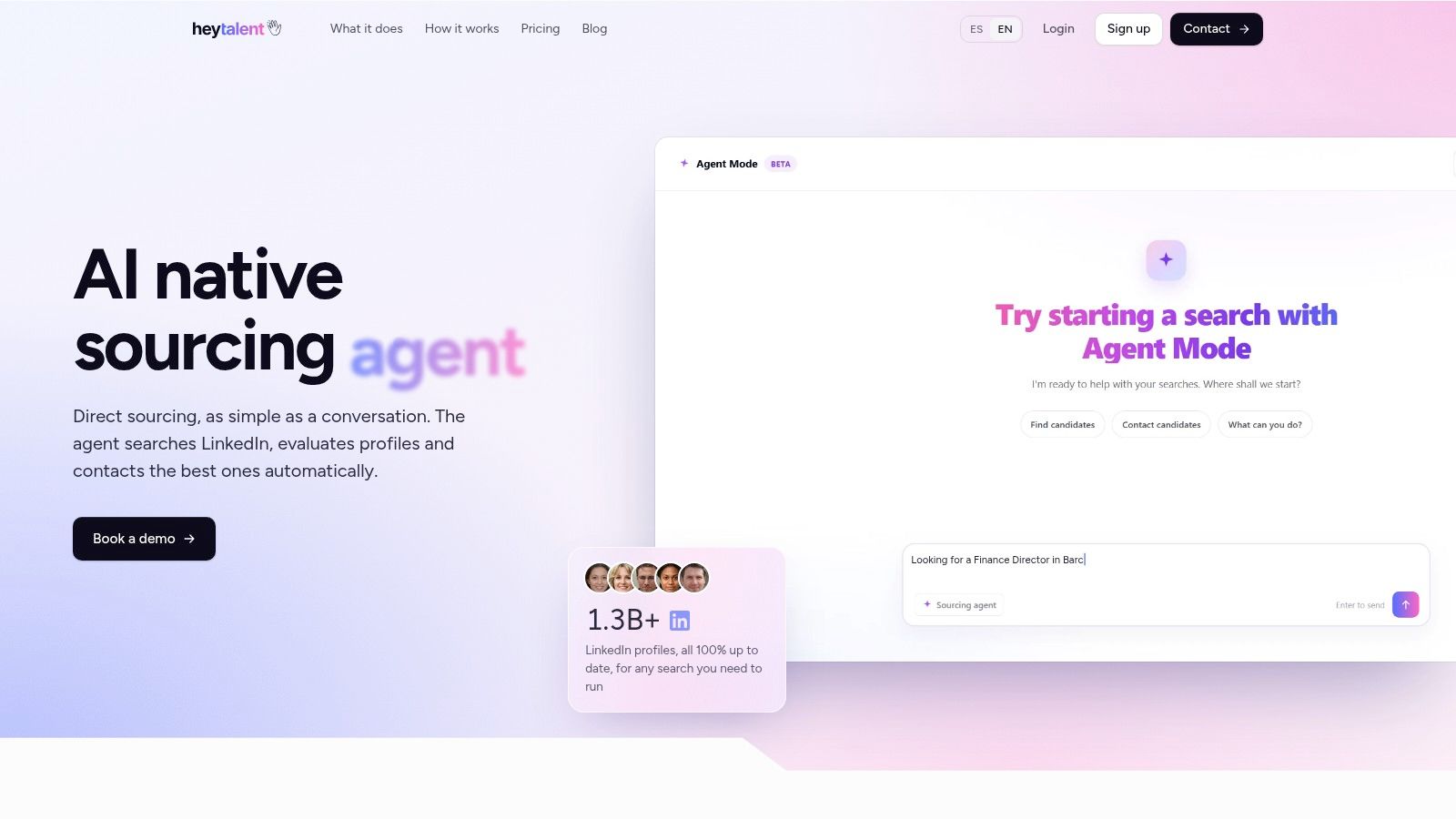
HeyTalent is an AI sourcing platform: it turns a job brief into a LinkedIn search, ranks profiles with AI variables, finds emails and phone numbers and automates outreach on LinkedIn. It works before a formal application exists.
The difference is one of category: HeyTalent's sourcing creates pipeline and Lever's ATS organises it.
HeyTalent vs Lever in 2026: a task-by-task comparison
HeyTalent covers search, contact and a basic ATS; Lever covers structured process management. The table compares concrete recruiter jobs, not feature lists.
| Team task | HeyTalent | Lever | Sign it fits |
|---|---|---|---|
| Finding passive profiles | Boolean search and AI variables on LinkedIn | Not its core job | You lack profiles who are not applying |
| Getting email and phone | Finds the email and phone of each profile | Not its core job | You need to reach people who have not applied |
| First contact | Automated LinkedIn invitations, follow-ups and InMails | Nurture for candidates already in its database | Manual outreach does not scale |
| Process management | Free ATS: pipelines per job, forms, career page, comments with @mentions | ATS with interviews, feedback, offers and reporting | You have candidates, but the process gets messy |
| Pricing model | Published plans, per organisation | No public pricing on its website | The budget needs predictability |
Buying rule: if the role has no contactable shortlist, start with HeyTalent. If the shortlist exists and the process jams afterwards, the piece that is failing is the ATS, Lever or otherwise.
Where each tool sits in the hiring funnel
HeyTalent works before a profile becomes an application; Lever comes in once the candidate has been identified or engaged. In the earlier stage, the recruiter defines the search, finds profiles, applies fit criteria and prepares the first message. In the later stage, Lever organises interviews, feedback and offers. The guide on what an ATS is and what work it covers explains that boundary in detail.
The Spanish labour market shows why separating the two stages matters. In Q2 2025 Spain's job vacancy rate was 0.8%, around 150,000 positions, and 42.9% of surveyed companies reported labour availability problems, according to the SEPE report on labour market trends.
For digital profiles in Spain, more than 60% of companies report difficulty filling digital roles and 87% of Spanish IT companies struggle to attract talent, according to Randstad on the most in-demand digital profiles. An ATS organises the applications that arrive; it does not bring in the ones that are missing.
An example with a tech role: the recruiter describes the job in HeyTalent, reviews the shortlist the search returns and launches the LinkedIn sequence. Whoever replies and moves forward goes into Lever, where the team centralises interviews and feedback.
What HeyTalent automates that Lever does not
HeyTalent automates the work that happens before an application: searching, filtering, enriching with contact data and the first contact. Lever automates the follow-up of people already in the process. Each one saves hours in a different stretch of the job.
For filtering, HeyTalent's AI variables rank profiles against requirements the team defines, such as English level or a specific type of experience. The recruiter reviews the list before launching anything: a variable ranks, it does not reject on its own.
For contact, HeyTalent schedules LinkedIn invitations, follow-ups and InMails and gathers replies in an inbox the whole team shares. HeyTalent's finder locates emails and phone numbers for the final nudge, although campaigns are sent on LinkedIn only.
Search criteria should follow what the role actually requires. An analysis of nearly 190,000 job ads published in Spain in 2025 and more than 651,000 professionals found a preference for profiles able to execute, scale and create impact, according to the analysis of tech talent demand. HeyTalent's variables should reflect those skills, not buzzwords.
What GDPR requires when you combine sourcing and an ATS
When you combine HeyTalent and Lever, GDPR requires every piece of data to have a purpose, a legal basis and a retention period. A received application, a public professional profile, an enriched email and an AI score are different categories. A profile being visible does not make every use of it appropriate.
Spain's data protection authority, the AEPD, states that candidate data must be adequate, relevant and necessary, and that checking social networks during hiring is only justified for a professional purpose and with the person informed. The practical guide to sourcing and data protection turns those criteria into an agency's day-to-day practice.
According to HeyTalent, the platform works with public data under legitimate interest and does not resell it; even so, whoever sends the message is accountable for the processing. Before running a search in HeyTalent or moving profiles into Lever, put the following in writing:
- Source: whether the data comes from an application, a public professional profile or an enrichment.
- Purpose and legal basis: which hiring need it covers and why it is relevant.
- Owner: which team controls the search, the contact and the record.
- Human oversight: who reviews an AI score before a decision is made.
- Retention and exit: how long it is kept and how it is corrected or deleted.
Lever should only receive the data needed for the application. An AI variable is audited for each role; it is not switched on by default or turned into an automatic filter without assessing necessity and possible discrimination.
HeyTalent or Lever by type of team
The priority tool depends on where each team's bottleneck sits. A headhunter, a multi-client agency and a TA team do not break down at the same point, so HeyTalent and Lever carry different weight in each case.
Independent headhunter
For an independent headhunter, HeyTalent is usually the first purchase: the cost lies in search hours and in missing contact data. HeyTalent's Recruiter plan covers up to 2,000 candidates a month with unlimited users, and its free ATS is enough to share status updates with clients without paying for a second licence. Lever makes sense when the number of parallel processes calls for a fuller ATS.
Recruitment or staffing agency
A recruitment or staffing agency needs to build pipeline without loading every profile it finds into the ATS. HeyTalent filters and contacts first, and only people who show interest move into the management system, whether that is Lever or HeyTalent's ATS. If it is HeyTalent's, paid plans generate an AI client report per candidate from the CV, interview notes and the interview transcript as text, shared by link or as a PDF.
Segmentation matters: Spain registered 15,420,104 employment contracts in 2024, with permanent contracts at 42.04% and part-time at 29.58%, according to the SEPE executive summary of the labour market. The guide to recruitment software for small agencies covers this scenario in more depth.
Growing TA or RPO team
A TA or RPO team that already runs on Lever should keep it as the system of record for interviews, offers and reporting. HeyTalent comes in when inbound applications do not fill the roles; its Ultra plan reaches 14,000 candidates a month and includes priority support. The practical rule: if the calendar is full of interviews, invest in the process; if it is empty, invest in sourcing.
How much HeyTalent and Lever cost
HeyTalent publishes its pricing and Lever does not: Lever quotes on request, so comparing cost means asking for a proposal. HeyTalent's entry plan is €93/month billed annually, or €109/month on quarterly billing (prices published by the company in October 2026), charged per organisation with unlimited users.
The figure that changes the maths most: HeyTalent's ATS costs €0 and what you pay for is sourcing. With that ATS the agency gets its own career page, publishes jobs to Google Jobs or keeps them private behind a link, adapts application forms, filters its candidate database and opens a pipeline for each job, which the client can follow through the stages the agency chooses to show. For a small agency, that can save a separate ATS licence.
Against the other usual sourcing expense, the benchmark is LinkedIn Recruiter: according to HeyTalent, charging per organisation instead of per seat means savings of up to 5x, larger the bigger the team and smaller for someone working alone.