LinkedIn for recruiters works best as the first layer of sourcing: it is for discovering candidates, verifying career paths and opening a conversation, not for running the whole process by hand. In practice it comes down to five decisions: Boolean searches that filter out noise, the Recruiter plan that matches your volume, short three-touch sequences, a minimal record to stay GDPR-compliant and four metrics reviewed every week. The repetitive work (bulk extraction, contact enrichment, first-pass prioritisation) is better moved outside LinkedIn.
What is LinkedIn for recruiters
LinkedIn for recruiters is the use of LinkedIn as a talent acquisition tool: searching for active and passive profiles, checking their experience, contacting them and managing a team's open roles. It covers the free account, Premium and the LinkedIn Recruiter licences.
LinkedIn for recruiters is not an ATS or a complete tracking system. It serves the top of the funnel: discover, verify and open the conversation. Process tracking, assessment and data records are better kept in other tools.
Why LinkedIn is still the starting point for sourcing in Spain
LinkedIn is still the starting point because that is where the professional conversation and most passive candidates are. The platform had almost 3 million Spanish professionals when it officially opened in Spain in March 2012 and 19 million registered users in 2023, according to the academic reference from the Universitat Oberta de Catalunya cited by Bankinter. Registered users are not the same as active users.
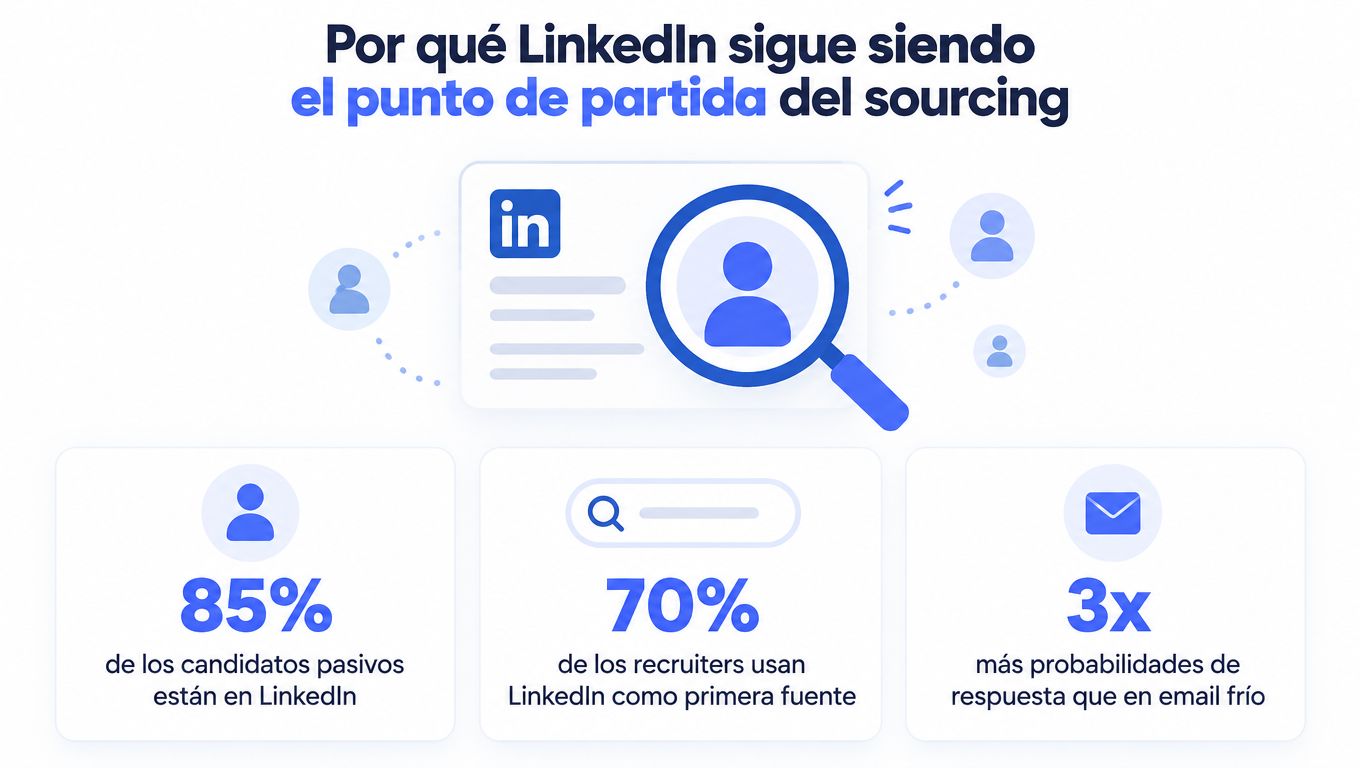
Behaviour matters more than size. As early as 2012, 44% of Spanish professionals considered social networks important or very important for their career, and 38% of Spanish internet users used online professional networking every day, according to Bankinter. People do not go on LinkedIn just to browse jobs: they go there to position themselves.
HR teams in Spain also use LinkedIn directly. An analysis based on the Adecco and Infoempleo report found that 79% of HR managers used LinkedIn at least occasionally to attract talent and 78% used it to find passive candidates, according to INESE.
How to run a LinkedIn Boolean search that filters out noise
A LinkedIn Boolean search combines quotation marks for multi-word titles, OR for synonyms, AND for must-have requirements, NOT to exclude noise and brackets to group logic. Done well, it cuts manual review on hybrid profiles where LinkedIn's native filters fall short.
The key is real-world synonyms, not the client's internal job taxonomy. A backend profile shows up as "backend developer", "backend engineer" or "software engineer". A B2B salesperson may be listed as account executive, business development or sales manager without the word "sales" in the title.
Three mistakes break most LinkedIn Boolean searches:
- No quotation marks around multi-word titles: the search returns profiles that look nothing like the role.
- Overusing NOT: it throws out valid candidates because of a secondary match.
- Too many conditions from the start: the search ends up in a dead end. Start with a broad version, see which profiles keep coming up and refine afterwards.
When the role is hard to fill, it pays to search for adjacent career paths instead of the exact title. That is where HeyTalent combines Boolean search with custom AI variables that rank profiles by fit before anyone has to read them one by one. For the basics, see what Boolean search is; for longer queries, this guide to Boolean operators with examples.
Boolean search templates for recruitment agencies
These LinkedIn Boolean templates cover three common agency profiles and work as a first screen, not as a final search:
- Backend development:
("backend developer" OR "backend engineer" OR "software engineer") AND (Java OR Python) AND (London OR remote) NOT junior
- B2B sales:
("account executive" OR "sales manager" OR "business development") AND (SaaS OR B2B) NOT internship
- SAP project manager:
("project manager" OR PMO OR "project lead") AND SAP AND (implementation OR rollout)
Recruiter Lite, Professional Services or Corporate: which LinkedIn plan to choose
The right LinkedIn Recruiter plan depends on how many roles you handle and how much real collaboration the team needs. Recruiter Lite suits a recruiter working alone; Professional Services, agencies; Corporate, in-house teams sharing a portfolio of roles.
| Plan |
Best for |
InMails/month |
Indicative cost |
| Recruiter Lite |
Solo recruiter or very small team |
30 |
about €160/month or €1,600/year |
| Recruiter Professional Services |
Recruitment agencies and consultancies |
100 |
€5,700 to €9,500/licence/year |
| Recruiter Corporate |
In-house teams with real collaboration |
150 shared |
€8,300 to €13,900/licence/year |
The ranges come from Kanbox's pricing analysis, which adjusts them to real-world use rather than list price. For more on the smallest plan, read our LinkedIn Recruiter Lite review.
When paying for LinkedIn Recruiter is worth it
LinkedIn Recruiter pays off with constant hiring and several open roles at once, as long as the team makes full use of filters and messages. It does not pay off if searches are occasional, if InMails go unanswered or if, after buying Corporate, the team keeps copying profiles into Excel. Sales Navigator is useful for testing the market, but it is not a complete recruiting tool.
The pricing model matters too. LinkedIn Recruiter is billed per seat, so the cost grows with every recruiter you add. HeyTalent charges per organisation rather than per seat, which according to the company means savings of up to 5x compared with the cost of LinkedIn Recruiter; the gap widens with team size and is smaller for a recruiter working alone.
How to write LinkedIn InMails and sequences that get replies
A LinkedIn sequence that gets replies is short: a first touch with real context, a second with a different reason to answer, and a third only if there is still a fit. Keep InMail for reaching outside your network or for urgent roles; a connection request with a note opens the door more lightly.
Three elements explain almost every reply to a LinkedIn message:
- Real personalisation: a change of company, a specific technology or a coherent career path.
- A concrete value proposition: why this role deserves their time.
- A low-friction ask: a short conversation, not a long application.
Scale makes automation necessary. In 2025, temporary work and employment agencies in Spain signed 4.36 million placement contracts, according to Asempleo as reported by EFE. At that volume, writing every first touch by hand creates a bottleneck; it makes sense to automate the first personalised note and let the recruiter take over the conversation. We explain it step by step in our guide to automating LinkedIn messages.
HeyTalent covers that part with automated sequences that send connection requests, follow-ups and InMails at the scheduled moment, plus an email and phone finder for when LinkedIn goes quiet.
What GDPR allows when using LinkedIn data in recruitment
GDPR allows recruiters to look at LinkedIn profiles in a hiring process only for a professional purpose, when the processing is necessary and relevant to the role and the person has been informed. That is the position of Spain's data protection authority, the AEPD, which adds that candidates are not obliged to give access to their private profiles.
A LinkedIn profile being public does not give you free rein to store and reuse it without criteria. Name, job title, company and experience sit in defensible territory; inferring age, marital status or personal traits falls outside the purpose of recruitment.
A minimal GDPR record for LinkedIn data has four fields:
- Source and date: where the profile came from and when it was viewed.
- Purpose: which role or process it was collected for.
- Separate fields: contact data on one side, assessment notes on the other.
- Deletion: erased when the process closes if there is no longer a basis to keep it.
An example of a valid record: "LinkedIn profile viewed on Tuesday for the SDR role; job title, current company and work email stored for contact, no personal notes." If you automate part of your sourcing, that traceability has to be built in from the start. How it fits into a tool is covered in our guide to GDPR-compliant sourcing tools.
Which metrics to track in a LinkedIn sourcing workflow
A LinkedIn sourcing workflow is measured by useful volume, not raw volume: how many profiles were reviewed, how many were a fit and how many turned into a conversation. Looking only at reply rate and gut feeling is intuition, not management.
Four weekly metrics are enough to keep the channel under control:
- Reply rate by channel: InMail, connection request with a note and enriched email neither cost nor perform the same.
- Cost per useful contact: per candidate worth following up, not per message sent.
- Time to shortlist: if it spikes, the search is badly set up.
- Hiring manager acceptance: if the shortlist is rejected, the initial segmentation failed.
AI helps mostly with operational work. AI adoption among Spanish companies sits around 11%–13%, and 89.66% say AI has not yet had a significant impact on hiring, according to ITuser. That slow uptake is an opportunity to use it for prioritising profiles, not for final decisions.
When LinkedIn Recruiter is enough and when to complement it
LinkedIn Recruiter is enough when volume is low, the role is very specific and the team knows the tool well. A recruiter working alone can stay inside LinkedIn; a team sharing roles and needing permissions justifies Corporate. An agency, temp agency or headhunter whose pain point is cost per contact needs an external layer to extract, enrich and prioritise.
Market scale pushes in that direction. In Spain, InfoJobs recorded 4,253,610 people who applied to at least one job in 2025, 5% more than the previous year, according to its annual report. The higher the volume, the harder it is to keep manual controls going: the market rewards whoever filters best, not whoever piles up licences.
What HeyTalent adds to a LinkedIn sourcing workflow
HeyTalent is a sourcing platform that works on top of LinkedIn: it extracts profiles in real time, including outside your network, applies Boolean search and custom AI variables to rank them by fit, finds emails and phone numbers and launches automated outreach sequences. It is the repetitive layer this article recommends moving outside LinkedIn.
HeyTalent works alongside the ATS you already use and also includes its own: HeyTalent offers its ATS at no cost and charges for the sourcing layer, with plans starting at €93/month billed annually. That free ATS includes a branded careers page, job posts pushed to Google Jobs, one pipeline per role and the option to share the pipeline with your client.
HeyTalent does not replace LinkedIn for building the candidate relationship or for checking career paths by hand. Nor does it remove the account: you do not need a LinkedIn licence to use it, but connection campaigns with a note may require LinkedIn Premium Business. The useful test is measuring how many hours it gives back on a real open role.