A biomedical engineer turns a clinical need into health technology that is verifiable and safe: they design, validate, integrate and maintain medical devices, diagnostic equipment, medical imaging and clinical software. In practice, the same job title covers five sub-roles that are not interchangeable: clinical engineering, R&D, health software and AI, quality and regulatory, and field service. Hiring well means screening by sub-role, environment and verifiable deliverables, not by the name of the degree. And in Spain the market is small: the SEPE, Spain's public employment service, recorded 219 contracts for this degree in 2025.
What is a biomedical engineer
A biomedical engineer is a professional who applies engineering to healthcare: they design, validate and improve health technologies, from prosthetics and monitoring devices to diagnostic equipment, medical imaging and clinical software. To do that they combine electronics, mechanics, computing, materials and data analysis, according to the profile description published by Spain's statistics institute, the INE.
Biomedical engineering is not "working in health" in the abstract. The biomedical engineer acts as a bridge between clinicians, technology, procurement and regulation. The job is done when a solution can be measured, documented and defended in front of both the clinical team and the business.
What a biomedical engineer does day to day
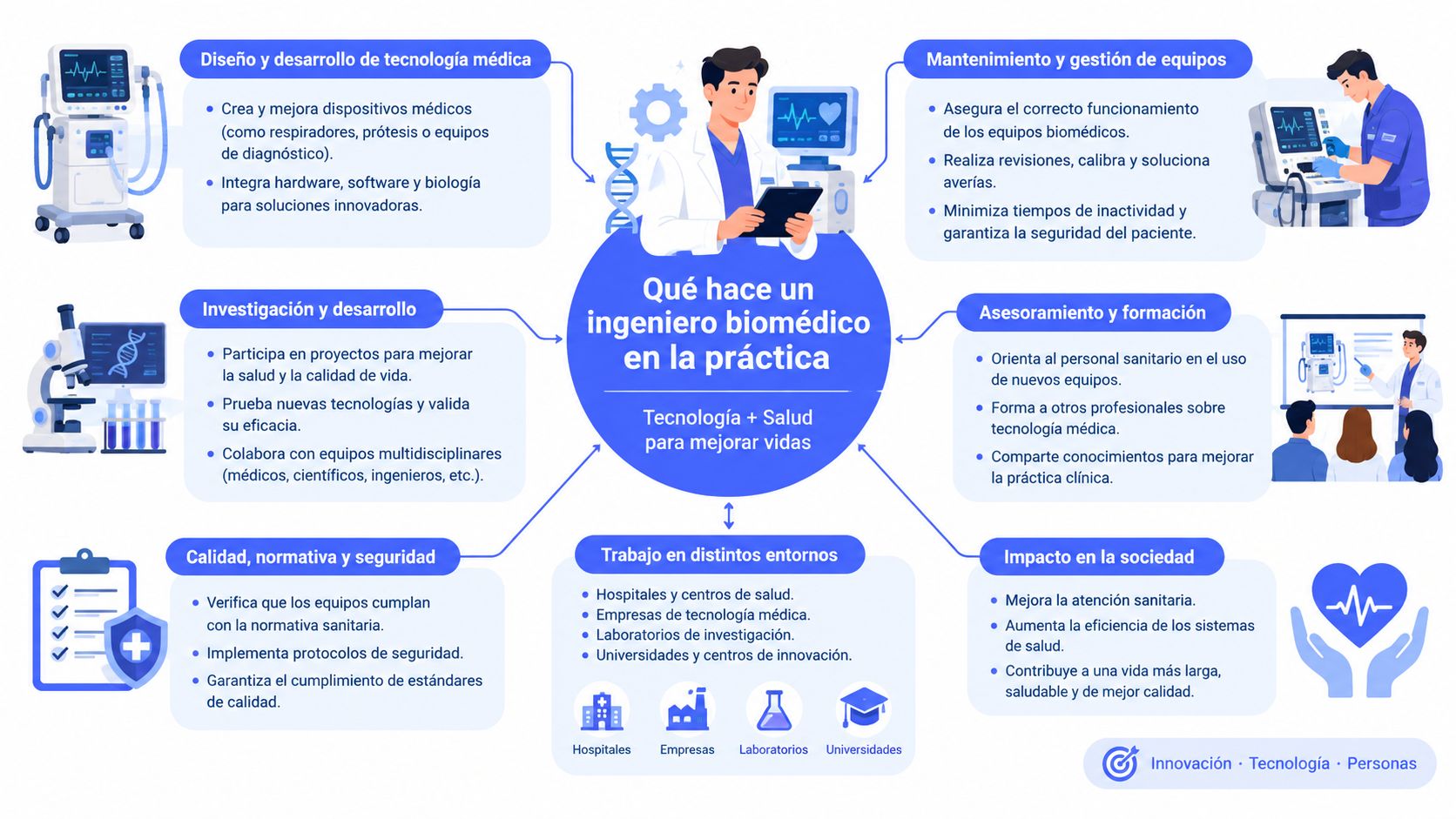
In a normal week, a biomedical engineer converts clinical needs into technical specifications, validates that a device or algorithm works in a real setting, and documents the evidence. The split between those three tasks changes with the sub-role, but the underlying pattern is the same.
From clinical problem to technical specification
A biomedical engineer's workflow has three steps. First, someone spots a real clinical need. Next, the engineer turns it into measurable variables, validation criteria and technical deliverables. Finally, they check whether the system works, whether it is usable and whether the measurement holds up in a clinical context.
That work is expressed in sensitivity, specificity, reproducibility and the link between a measurement and a clinical outcome. For a recruiter, that vocabulary separates the candidate who has only seen the equipment from the one who characterised it. If you want a clinical parallel to calibrate the level of detail, a visual reference is what an ophthalmologist does, another profession that turns care needs into concrete technical decisions.
What deliverables a biomedical engineer produces
A biomedical engineer's typical deliverables are specifications, validation reports, technical documentation, interoperability tests and support for equipment roll-outs. It is not a general helper role: it connects science, clinical use and technical evidence.
In hiring, that means asking about concrete deliverables. If a biomedical engineering candidate cannot explain what they validated, with which metric and to whom they defended it, they probably lack the depth the role needs.
The five sub-roles of biomedical engineering
Biomedical engineering splits into five functional lanes that you hire with different filters: clinical engineering, R&D, health software and AI, quality and regulatory, and field service. A job posted as "biomedical engineer" with no sub-role attracts candidates from all five.
| Sub-role | Key tasks | Tools and signals | Main stakeholder |
|---|---|---|---|
| Clinical engineering | Selecting and validating equipment, systems integration, hospital support | Device inventory, technical documentation, interoperability | Clinical staff and procurement |
| R&D | Prototypes, technical iteration, proofs of concept, experimental validation | Sensors, signal, prototyping, materials, lab work | Product and research |
| Health software and AI | Algorithms, image processing, clinical data integration | Python, TensorFlow, PyTorch, medical imaging | Product and data |
| Quality and regulatory | Documentation, risk management, traceability, compliance | Regulations, technical files, audits | Quality and authorities |
| Field service | Installation, maintenance, incident handling, user training | Technical service, manuals, calibration | End users and after-sales |
False equivalences are the most expensive mistake when screening biomedical engineers. Hospital experience is not regulatory experience, knowing medical imaging does not mean knowing how to deploy a clinical system, and building software is not the same as validating a physical device. To see how a development-focused profile differs from one with healthcare context, compare it with what a computer engineer does.
Where biomedical engineers work: hospitals, industry, R&D and startups
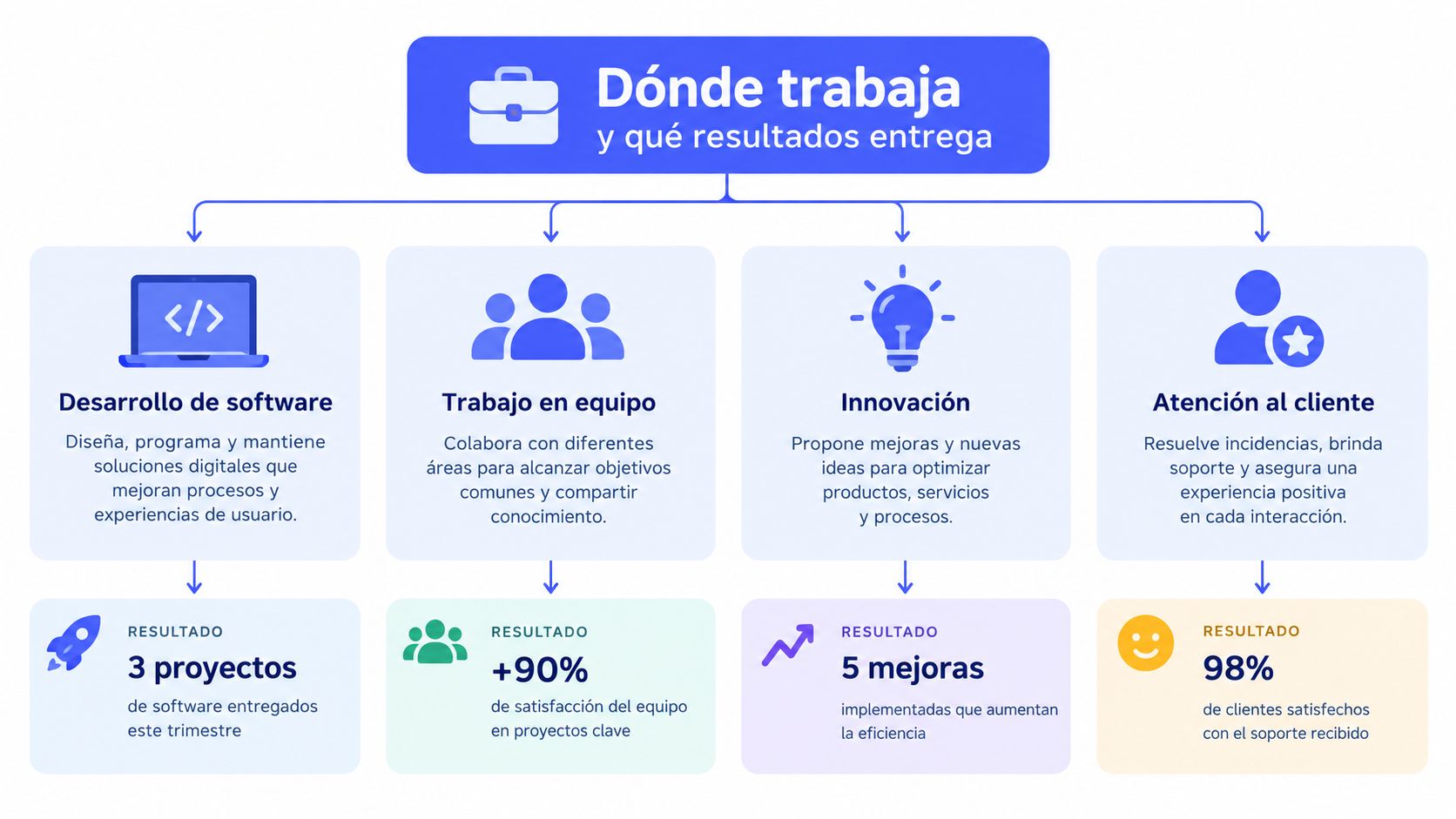
A biomedical engineer works in four main environments, and each one shifts the focus of the job: in a hospital, continuity of care comes first; in the medical device industry, development and industrialisation; in R&D, generating evidence; and in a healthtech startup, the pace of the product.
| Environment | Usual stakeholders | Expected outcome |
|---|---|---|
| Hospital | Clinical staff, hospital engineering, procurement, suppliers | Equipment that works, is integrated and is safe |
| Medical device industry | Product, quality, regulatory, manufacturing, after-sales | Traceability, scale-up and solid documentation |
| Research centre | Researchers and technology transfer | Testing, iteration and intellectual property |
| Healthtech startup | Product and customers | Solve a specific need fast without technical debt |
In a hospital, reliability matters more than technical flair, with the same documentation rigour required by the indications and risks of surgery. A candidate who cannot say which stakeholder signed off their work has probably not lived in the environment they describe.
What a biomedical engineer studies in Spain and what the degree qualifies them for
In Spain, the bachelor's degree in Biomedical Engineering sits in the Engineering and Architecture branch and does not qualify the holder for a regulated profession, according to the Spanish Official Gazette (BOE) on the Biomedical Engineering degree. The degree provides a technical foundation, but on its own it does not entitle someone to any healthcare or regulated position.
Spanish curricula already include design, evaluation, accessibility, ergonomics, safety, return on investment, interoperability and health data management, not just lab work or prosthetics, as the Biomedical Engineering programme at the University of Zaragoza shows. That is why two biomedical engineers with the same degree can have completely different working weeks.
Elective courses steer the profile. Monitoring, diagnosis and therapy, medical device interoperability or signal and image processing point towards hospitals and imaging; applied AI, additive manufacturing of medical products or biomedical virtual reality point towards R&D and software, according to the official curriculum of the Technical University of Cartagena. Master's degrees separate them even further: one in biomedical data moves the candidate towards information systems and software; one in biomedical technologies, towards devices, robotics, implants or advanced imaging.
Keywords to search for biomedical engineers by sub-role
To find biomedical engineers, combine a context term with sub-role keywords instead of searching by job title alone. "Hospital", "clinical engineering", "medical devices", "health software", "healthtech", "telemedicine" or "medical imaging" narrow the results far better than a flat title search. These are the combinations by sub-role:
- Instrumentation and hospital: "clinical engineering", "monitoring", "medical equipment", "interoperability", "hospital support".
- Imaging and data: "medical imaging", "signal processing", "Python", "clinical AI", "image analysis".
- Regulatory and quality: "validation", "technical documentation", "risk", "compliance", "audit".
- R&D and prototyping: "prototyping", "sensors", "biomaterials", "proof of concept", "biomechanics".
If a biomedical engineering profile cannot show real experience in one of these layers, it does not make the shortlist on the degree alone. To build the strings, there are Boolean operator examples ready to adapt, and to turn tasks into screening questions, the competency-based recruitment approach.
How to assess a biomedical engineer's real level in the interview
A biomedical engineer's real level shows when you ask for a specific project, the technical decisions they made and the validation they defended. Three questions separate the person who was close to the problem from the one who only brushed past it:
- What technical decision did you make? If they cannot explain a concrete decision, the experience is thin.
- What did you validate, and with which metric? No metric, no depth.
- Who received the result? If they cannot name the stakeholder, they do not understand the context.
For a clinical engineering profile who validated hospital monitoring, the useful interview does not ask about brands: it asks about physiological variables, noise, error, alarms, usability, who reviewed the results and how usage incidents were resolved.
For a health software profile who trained an imaging model in Python, the filter is not "did they do AI?" but which problem they solved, how they measured performance and what the model's limits are.
How many biomedical engineers are on the Spanish job market
The Spanish market for biomedical engineers is small and fragmented. In 2025, Spain's public employment service, the SEPE, recorded 150 jobseekers with this degree, 86 of them unemployed, and 219 contracts signed by 166 people, of which 117 were permanent and 102 temporary.
With numbers like these, a biomedical engineer role cannot be filled like a volume hire. With so few registered jobseekers, the search depends on reaching passive talent too, with a message that names the sub-role and the specific problem.
How to find biomedical engineers with HeyTalent
HeyTalent covers the most time-consuming part of searching for biomedical engineers: it extracts LinkedIn profiles in real time, including outside your network, and applies custom AI variables to filter by sub-role, environment and signals such as Python, medical imaging or clinical-setting experience.
Once the list is built, HeyTalent finds email addresses and phone numbers and launches automated, omnichannel outreach sequences. According to HeyTalent, its users work 60% faster during their first month of use, an efficiency gain the company attributes to tightly scoped lists and filters.