In Spain, S.S.N. usually refers to the Social Security number (NUSS, Número de la Seguridad Social) and, less often, to the Social Security system as a whole. The NUSS is a unique, lifelong identifier issued by the General Treasury of the Social Security and, once the person starts working, it is used as their affiliation number (NAF, Número de Afiliación). In a hiring process you only need it when you prepare the new hire's registration with Social Security, not during sourcing or the first screen. Asking for it earlier adds friction with the candidate and clashes with the data-minimisation principle enforced by the AEPD, Spain's data protection authority.
What is S.S.N. in Spain
S.S.N. is an informal abbreviation, not the name of any public body: in employment and benefits it almost always points to the Social Security number or the Social Security system. The official acronym for the number is NUSS. Outside Spain, and above all in the United States, SSN stands for the Social Security Number, a different identifier that cannot be used to register anyone with Spanish Social Security.
In recruitment, asking for "the S.S.N." without saying what you mean leaves the candidate unsure which piece of data to send and adds back-and-forth that contributes nothing to the decision.
Rule of thumb: if a piece of data does not help you assess suitability at this stage, don't ask for it yet.
Difference between NUSS and NAF
The NUSS and the NAF are the same number used at two different moments. The Social Security number is the individual identifier the General Treasury assigns to link the person to the system. When that person starts work covered by Spanish Social Security, the same number becomes their affiliation number.
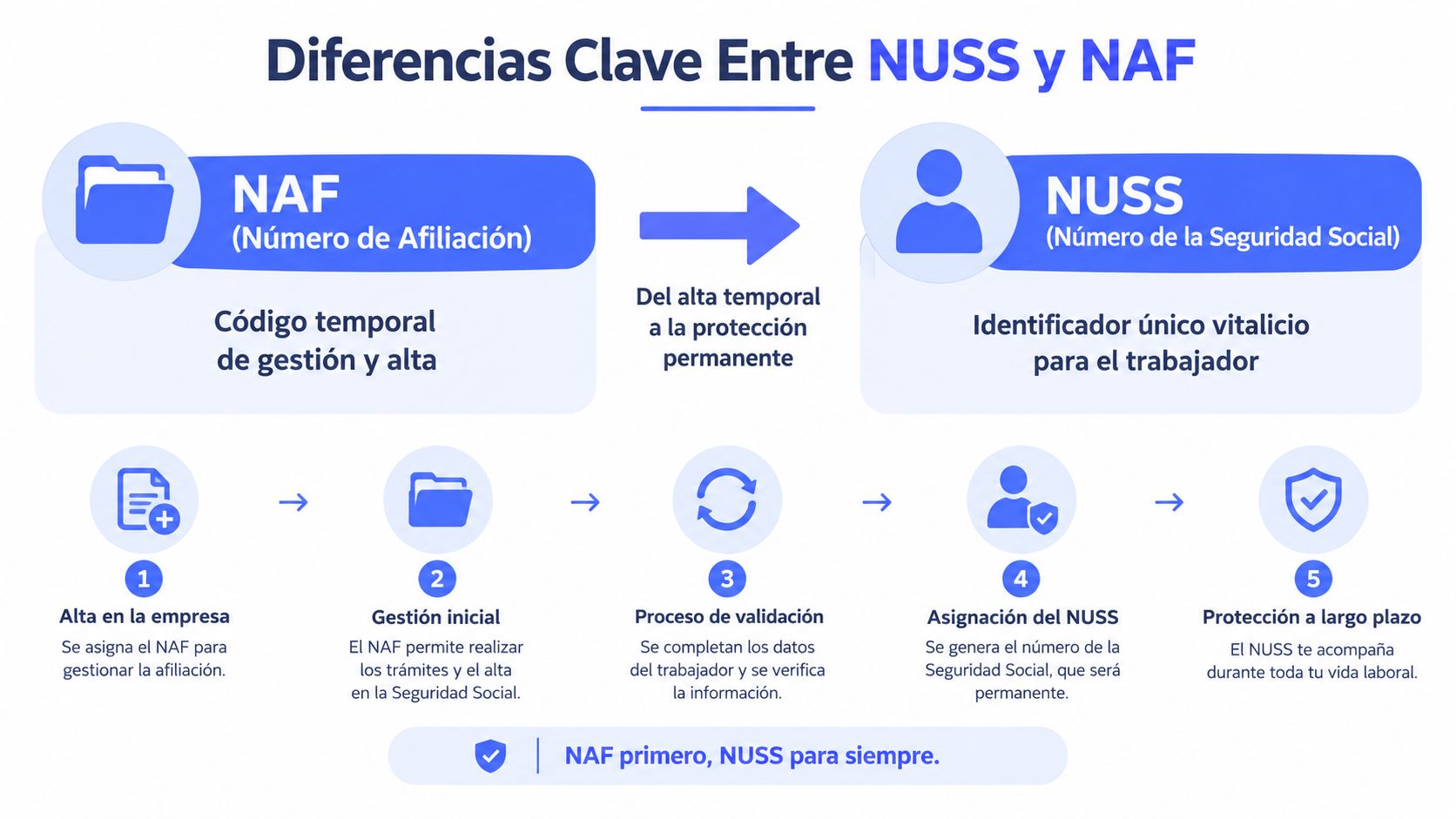
| Attribute | NUSS (Social Security number) | NAF (affiliation number) |
|---|---|---|
| What it identifies | The person within the system | The person as an affiliated worker |
| Who assigns it | General Treasury of the Social Security | The same number, no new assignment |
| When it appears | Can exist before the first job | When the first employment starts |
| Validity | Unique, lifelong, unchanged by job moves | Unique, lifelong, unchanged by job moves |
| Hiring stage when it is requested | Onboarding registration | Onboarding registration |
The Spanish Social Security number is not renewed when someone changes employer, scheme or employment status, so you should never ask for "a new number".
When should a recruiter ask for the Social Security number
A recruiter should ask for the Spanish Social Security number only when preparing the registration or the employment paperwork, in other words once an offer has been accepted. During search, screening and interviews, the NUSS does not help decide whether someone fits the role: it is onboarding data, not selection data.
| Hiring stage | What is decided | Data you do need | NUSS / NAF? |
|---|---|---|---|
| Sourcing | Who to contact | Role, experience, skills, location, contact details | No |
| First screen | Whether to move forward | Fit with requirements, availability, expectations | No |
| Interviews | Whether this is the right person | Evidence of skills, references | No |
| Offer | Contract terms | Salary, start date | No |
| Onboarding registration | Formalising employment | ID and NUSS / NAF | Yes |
At the search stage what matters is professional fit and how to reach the candidate. If you need to get that part in order, this guide to contact data explains which data actually works for first contact.
Storing the NUSS as just another profile field clutters the candidate database with information that helps no one prioritise anybody.
Why the NUSS should stay out of sourcing
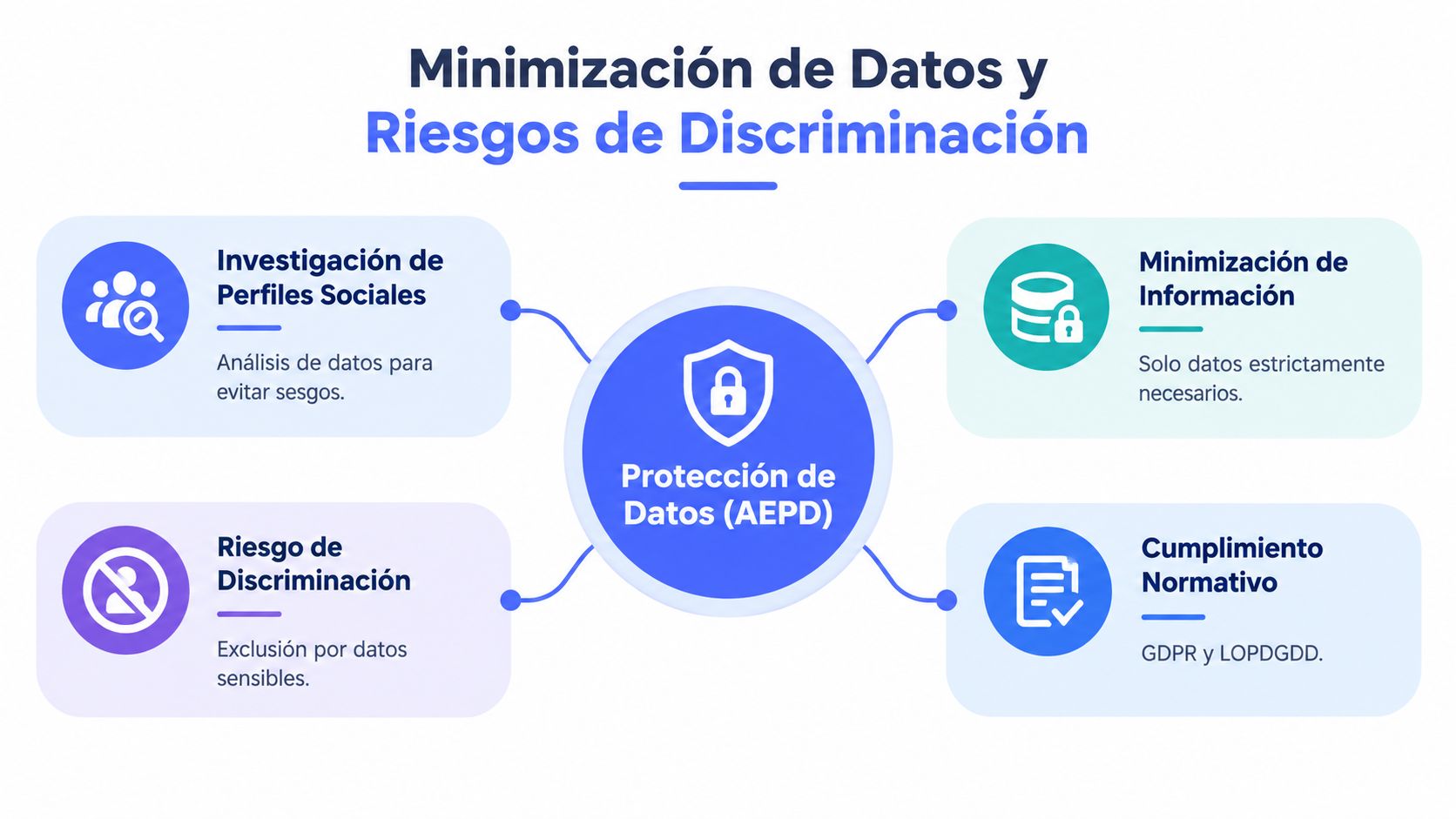
The NUSS should stay out of sourcing because the AEPD requires employment data to be adequate, relevant and limited to what is necessary for the purpose. In recruitment, that translates into minimisation by attribute and by stage: if a piece of data is not essential to assess suitability, it does not enter the search workflow.
According to the AEPD, when a company looks into candidates' social profiles, the processing must be tied to professional purposes, be necessary, rest on a sufficient legal basis and be disclosed to the person. When a process ends without a hire, the data must be deleted or kept only if another valid basis exists. To apply that standard to search tools, this guide to GDPR-compliant sourcing tools walks through it step by step.
Data minimisation and discrimination risk in recruitment
The risk in a hiring process lies not only in collecting too many fields but in inferring attributes that must not be used. A tool that deduces age, origin or other non-essential traits from public information raises the risk of discrimination and makes the process much harder to defend legally.
Sound selection practice: if an attribute does not improve the hiring decision, it should not improve the automated ranking.
Automated scoring should not rely on discriminatory proxies. With diverse groups, it also helps to see how communication changes when sensitive information is handled with care, as in Contigo inclusive schools in Sabadell.
For minimisation to hold up in an audit, every field in the candidate database should record:
- Source of the data.
- Purpose: which decision it is used for.
- Date collected.
- Retention rule: when it is deleted.
- Professional reason that makes it relevant.
How to look up or recover the NUSS online in Spain
The NUSS can be looked up on the Social Security e-office (Sede Electrónica), where the person can view their number, save or print an identification report and apply online for a number if they don't have one yet (official affiliation and registration service).
The most common mistake is assuming the number arrives with the first payslip. The NUSS can exist before the first job and becomes the NAF when employment starts. If the obligation to apply for it is not met, the provincial offices of the Social Security can also assign it on their own initiative.
Typical cases at a recruitment agency:
- First job: check whether the person already has a number before registration.
- Self-employed registration: keep the identifier separate from the commercial handling of the profile.
- Foreign candidate: review the paperwork well in advance.
- Lost document: use the official channel, never screenshots or stray emails.
If the team already manages digital records, the NUSS belongs in the employee's personnel file and not in the candidate profile; this guide to the personnel file explains how to organise it.
How many people are registered with Social Security in Spain
Spanish Social Security recorded 21,337,962 average affiliates in December 2024, the highest level for that month in the historical series, 501,952 more than a year earlier and year-on-year growth of 2.41%. Women accounted for 10,109,202 average affiliates, 47.4% of the total, and the ratio stood at 2.44 contributors per pensioner, according to Spain's Ministry of Inclusion, Social Security and Migration (official data and context).

In April 2025, the unadjusted series reached 21,588,639 affiliates, up 2.3% year on year. The daily series passed 21.7 million workers for the first time on 28 April, according to La Moncloa (official April 2025 update).
At that volume, any error in data collection multiplies into registration incidents, and mishandled registrations cause conflict from day one, as this resource on how to claim when you were not registered with Social Security explains.
How much Social Security contributions cost an agency or temp agency in Spain
The contribution rate for common contingencies in Spain is 28.30% in 2026: 23.60% paid by the employer and 4.70% by the worker, according to the official Social Security table (official contribution table). For an agency or a temp agency (ETT), getting that cost wrong squeezes the margin before the deal is closed.
Spanish temp agencies also carry a specific obligation: allocating 1% of their annual payroll to training the workers they place, under Law 14/1994 (applicable law).
How to run sourcing without mixing in administrative data
An agency runs sourcing well when each stage asks only for the data it needs: professional signals to search, contact details to reach out, and administrative data for onboarding.
The market also forces you to segment. In 2025, the cumulative number of contracts in Spain rose 1.46% on the previous year and the annual hiring stability rate reached 41.18%; within permanent hiring, the standard permanent contract accounted for more than 90%, according to SEPE, Spain's public employment service (key Spanish labour market data 2025). Each type of vacancy calls for its own filter and its own message.
What works in practice:
- Filter before contacting: fewer repeated searches.
- Enrich selectively: only data that helps you decide or reach out.
- Automate the repetitive work: consultants focus on fit and closing.
- Separate sourcing from onboarding: selection and admin in different workflows.
What candidate data HeyTalent uses at the sourcing stage
HeyTalent covers the professional layer of sourcing: LinkedIn profiles, filters and contact details; administrative identifiers such as the NUSS stay out of that stage. According to HeyTalent, 100% of the profiles it shows are up to date because it extracts them from LinkedIn in real time, at the moment of the search, so the candidate's experience is current when the recruiter assesses it.
On top of those profiles, HeyTalent applies custom AI variables to filter by the vacancy's requirements, Boolean search and an email and phone finder for first contact. Automated outreach sequences handle the follow-ups.
HeyTalent states that it processes public data under legitimate interest and never resells data, in line with the minimisation the AEPD requires.