Swordfish AI is not the only way to find talent, but swapping it for another tool just because it promises more emails is usually a mistake. A recruiter has to weigh several things at once: search across LinkedIn and other sources, the quality of phone numbers and emails, verification, outreach, automation, cost per candidate, GDPR and ATS integration. The useful question is not who delivers the most contacts, but which platform solves the team's real bottleneck.
In Spain, LinkedIn and InfoJobs accounted for more than 65% of online job ads, with shares of 45.67% and 36.54% respectively, according to the Cedefop analysis of online vacancies in Spain. That is why the best Swordfish AI alternatives for recruiters tend to combine access to LinkedIn profiles, Boolean filters, enrichment and direct contact.
Pricing should always be verified before you sign. Several vendors work with custom quotes, variable credits or enterprise negotiation. As an end-to-end sourcing benchmark, HeyTalent lets you compare extraction, AI filters, enrichment, outreach, speed and cost control in a single workflow.
1. HeyTalent
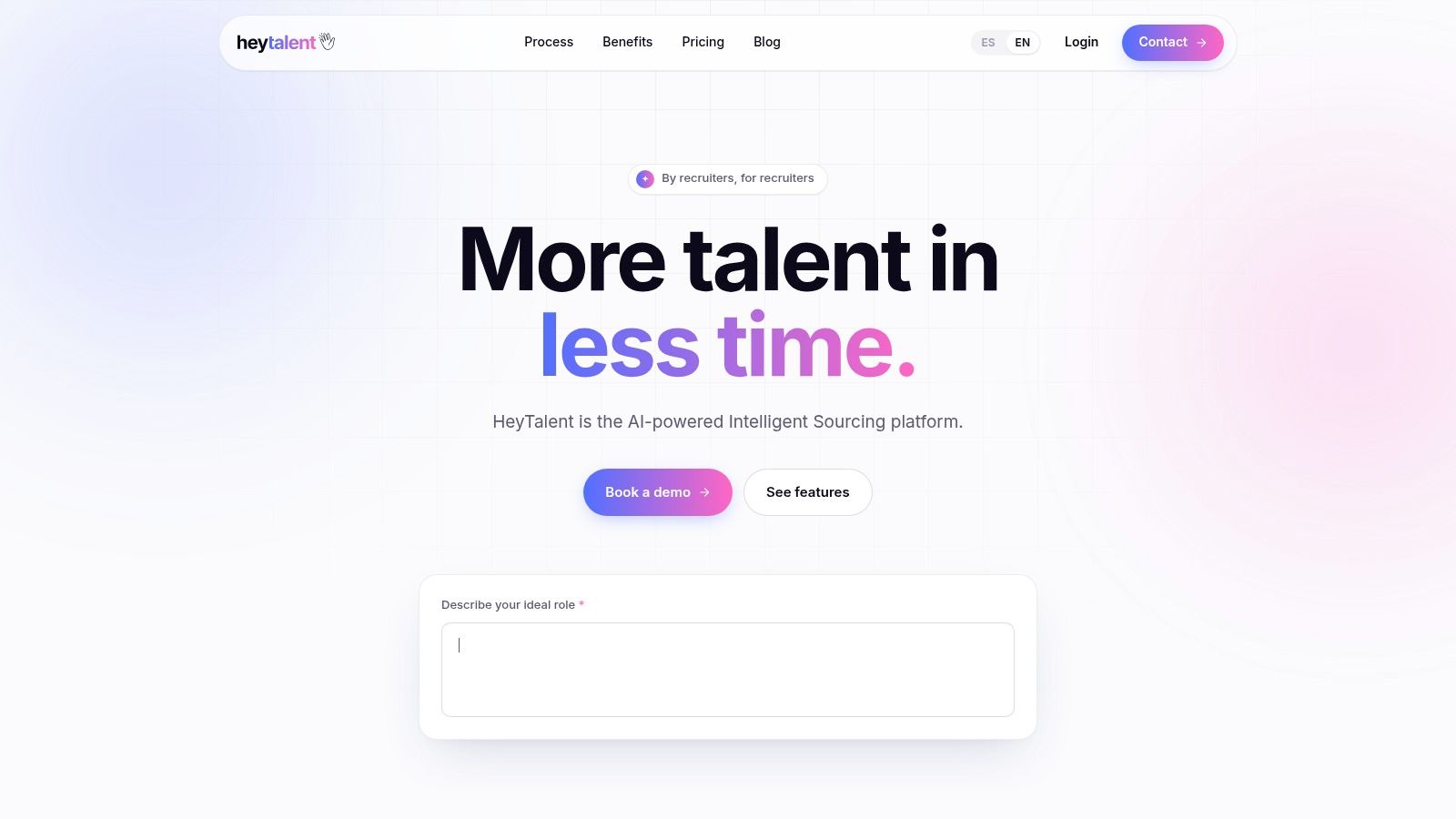
HeyTalent is the most complete alternative when the problem does not end once you have found a profile. The platform brings together real-time extraction of public profiles, AI filtering, email and phone enrichment, and automated outreach, so a recruiter can go from a Boolean search to a contact campaign without constantly switching tools.
The workflow is especially useful for headhunters, SMB agencies, freelance recruiters, talent acquisition teams and RPO or staffing consultancies. You can search by role, keywords, location, experience and company size, and then apply custom AI variables. Those variables can help you prioritise signals such as English level, accumulated experience or the kind of company someone has worked for.
Where it adds the most value
The difference compared with a tool focused purely on contact data is operational continuity. HeyTalent combines extraction, filtering, enrichment and personalised messaging, with automated connection and follow-up sequences. That cuts down the manual work that usually appears after you discover a candidate.
According to figures published by the platform itself, its users can get up to 60% more sourcing speed during the first month, a reply rate of 2.5 times through automated follow-ups, and a cost up to 5 times lower than LinkedIn Recruiter. These are HeyTalent's own claims and should be validated in a test using your team's own market, role and messaging.
Operational read: an end-to-end platform makes more sense when the bottleneck sits between identifying the candidate and the first contact, not only in getting hold of a phone number.
Cost, scale and limits
The published plans are Recruiter, 109 euros per month, billed every three months and with up to 2,000 candidates per month; Agency, 214 euros per month, with up to 5,000 candidates; and Ultra, 599 euros per month, with up to 14,000 candidates. The platform states that it offers unlimited users and CSV exports, plus an annual billing option with a 15% discount. The final price should be confirmed before you sign.
HeyTalent describes a GDPR-compatible approach based on public data, legitimate interest, transparency and instant opt-out. It does not require a LinkedIn licence to work, although certain connection-with-note campaigns may need LinkedIn Premium Business. Nor does it replace an ATS such as Teamtailor, Viterbit or Workable. Its job is to complement the system of record and speed up sourcing.
2. ContactOut
ContactOut suits the recruiter who already works inside LinkedIn and needs to turn an interesting profile into a contact channel. Its Chrome extension overlays data on LinkedIn and other networks, and lets you look up work emails, personal emails and, in certain cases, mobile numbers.
The proposition is straightforward. You find the profile, activate the extension and review the available data. Multi-step email verification helps separate usable addresses from less reliable information, while CSV export and the API, available depending on the plan, make it easy to move into a CRM, a working sheet or an ATS.
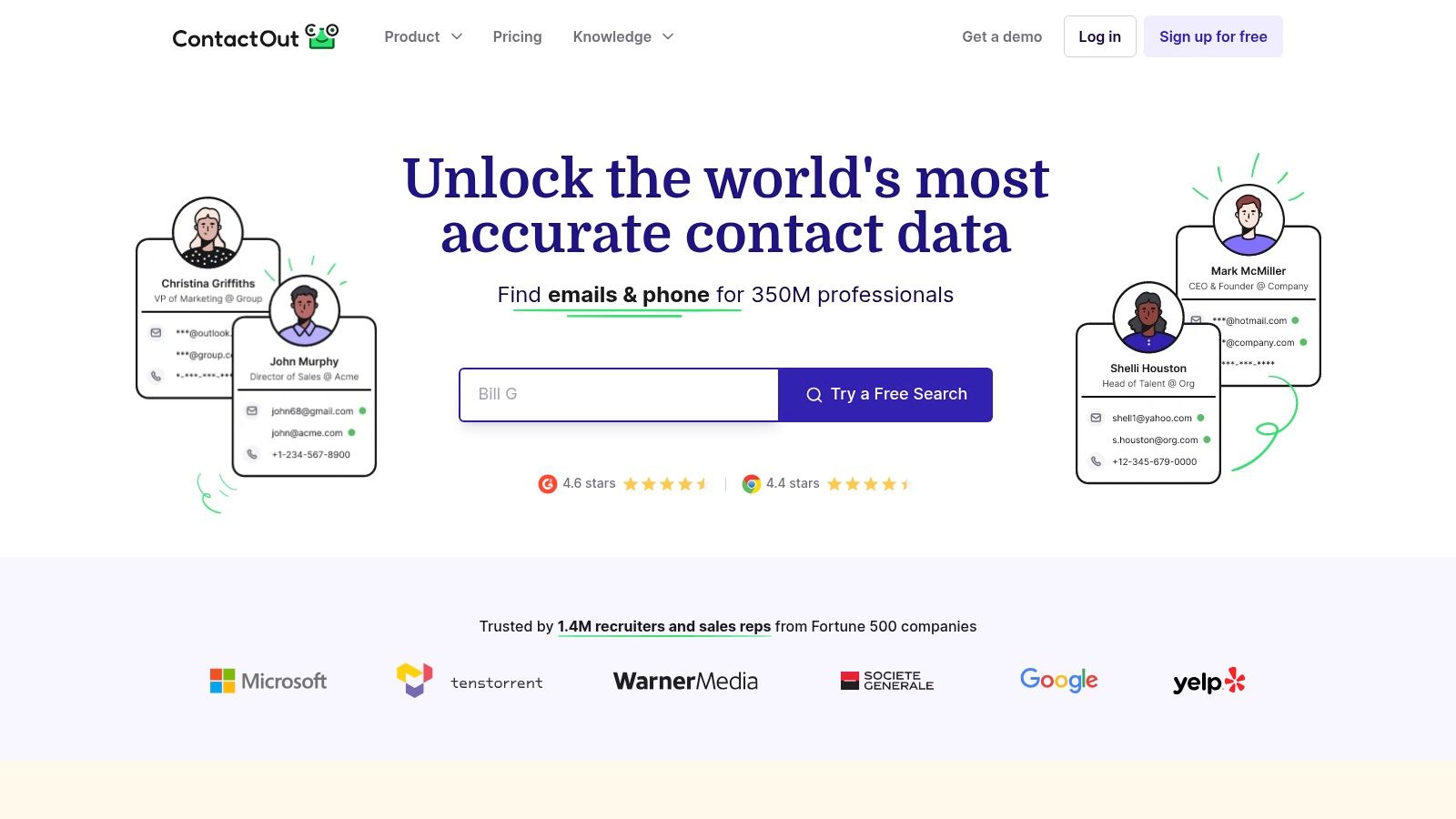
Its strength is the speed of the LinkedIn workflow. For a headhunter who already has a list of profiles and wants to activate direct contact, it avoids building a search from scratch. Emails tend to be more consistent than phone numbers, according to experience shared by users, so it is worth measuring both fields separately before you calculate the real cost per contactable candidate.
The commercial page shows "Contact us" on several plans, so the final budget may depend on a quote. That makes ContactOut harder to compare with openly priced platforms. An agency should ask in writing for the number of searches, exports, users, API access and credit-consumption rules.
In Spain, getting hold of a contact detail does not remove the obligations around using it. The candidate privacy notices published by Spanish companies illustrate that a selection process may handle name, national ID or foreigner ID, address, phone number and email, as well as honouring rights of access, rectification and erasure. ContactOut can solve access to the data, but the agency still needs a legal basis, data minimisation and a procedure for objection or deletion.
For a comparison more focused on day-to-day work, see these ContactOut alternatives.
3. hireEZ
hireEZ, formerly Hiretual, is built for teams that want to reduce the fragmentation between sourcing and outreach. Instead of using one extension to find profiles, another solution to enrich them and a third to run campaigns, it combines multi-source search, enrichment, sequences, pipelines and channel analytics.
Its search combines LinkedIn and the open web with advanced filters. It also lets you explore more than 50 networks and web sources, a breadth that helps when your target candidate does not maintain a complete presence on LinkedIn. For agencies with recurring searches, the pipelines and lightweight CRM help preserve the context of contacts without turning the ATS into a prospecting tool.
The trade-off between breadth and complexity
hireEZ makes sense when the team needs to centralise a sourcing process that already spans several tools. The advantage is not necessarily revealing one particular phone number, but keeping search, enrichment, outreach and analytics inside one connected operation.
The counterpart is the learning curve. A platform with more modules requires you to define search conventions, pipeline stages, permissions and quality criteria. Public reviews also reflect a perception of high cost, so an agency should work out the cost per completed search, not just the licence price.
"More features" only improves the process if the team folds them into its routine. Before migrating, try a difficult role and check how many tasks actually disappear.
For recruiters in Spain, governance has to be part of the evaluation. AI adoption in Spanish recruitment went from 16% in 2023 to 50% in 2025, and the European Union AI Act obligations for hiring and selection apply in full from 2 August 2026. An alternative that filters or ranks candidates must be able to document the process, enable human oversight and allow possible bias to be reviewed.
Here are some other hireEZ alternatives if you want to compare centralisation against a lighter solution.
4. AmazingHiring
AmazingHiring is a specialist option for technical searches. Its value shows up when the job title is not enough to assess a candidate and the recruiter needs signals of activity or experience in communities such as GitHub and Stack Overflow.
The meta-search engine pulls information from more than 50 sources, with filters designed for technical profiles. That combination lets you search by technologies, contributions, communities and other engineering-related signals. For a team hiring developers, data engineers or infrastructure profiles, it can give a more useful read than a generalist contact database.
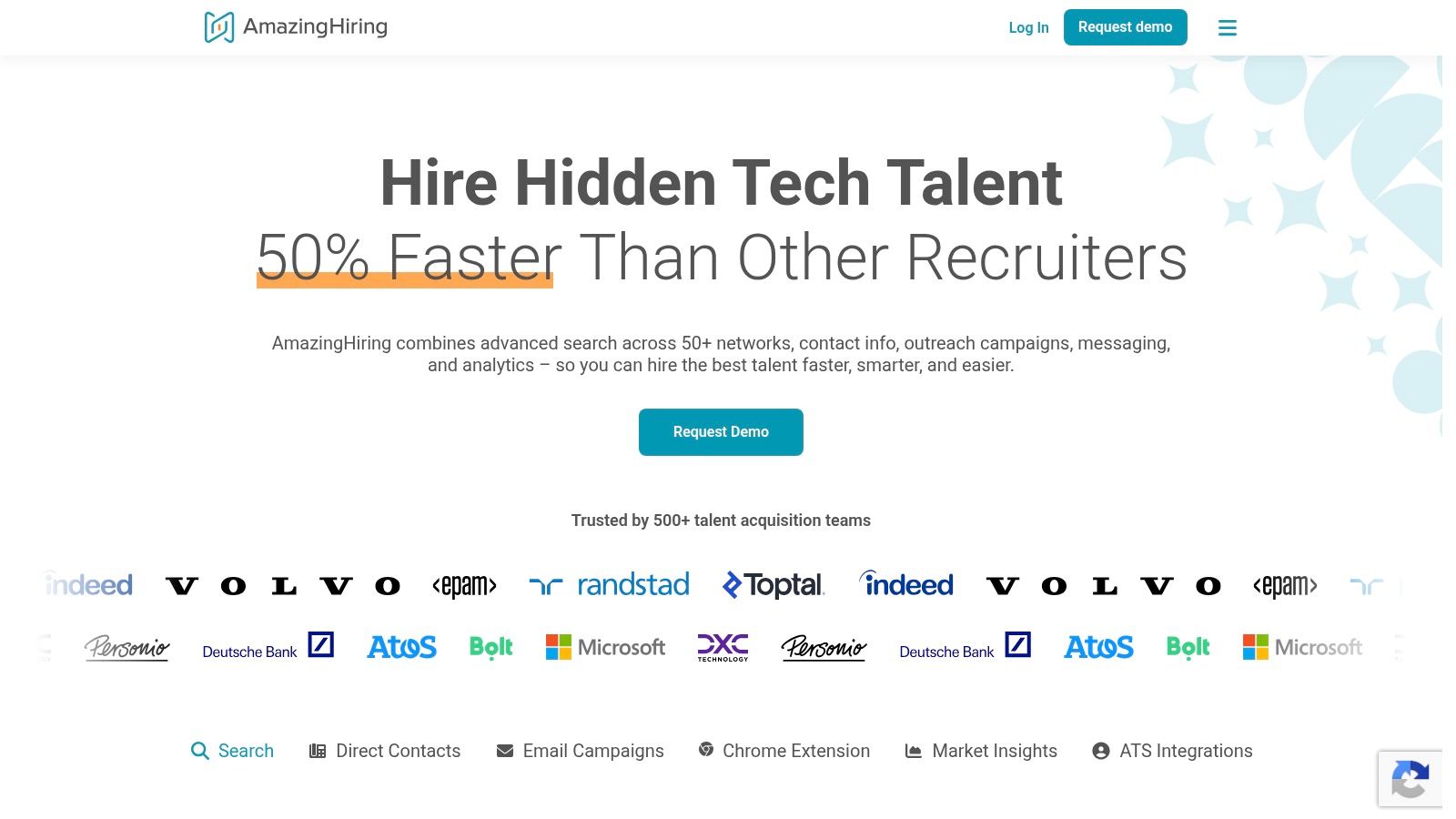
The platform also includes contact enrichment, messaging and analytics. That means you can identify technical talent and start the outreach from the same environment. Even so, the depth of the technical signals does not on its own guarantee that the candidate is available, will reply or will fit the role's conditions. The recruiter has to combine the technical signal with experience, location, expectations and professional context.
Pricing is offered by quote, with no public rate card. For an agency, that lack of a reference point means asking for a demo built on a real case. It is worth handing over a specific technical search and asking for the number of relevant profiles, the level of email and phone coverage, and the cost of the exported contacts.
Compliance also deserves attention. Consulting public profiles can be defensible when there is a legitimate basis and the information is tied to professional activity, but how relevant the data is depends on the role. This legal analysis of personal data in selection processes is a reminder that an agency may act as processor or controller depending on who decides the purposes and means of the processing.
To dig deeper into where this tool fits, look at these AmazingHiring alternatives.
5. SignalHire
SignalHire prioritises fast data capture from public profiles. Its browser extension surfaces emails and phone numbers on LinkedIn, GitHub, X and other networks, and then exports the information into CRM or ATS platforms.
The multi-network model is practical when a candidate's professional footprint is spread around. A technical profile may be more visible on GitHub, while another contact may keep their professional information mainly on LinkedIn. In both cases SignalHire helps gather the data into a single record, although the final quality will depend on the specific source.
Its credit-based model offers a simple entry point, with free credits on install. That makes an initial trial easy for a small agency, but the real cost appears when the team widens the search, repeats enrichments or uses phone numbers more frequently. Do not compare only the entry price. Measure how many credits a candidate with an email, a phone number, or both consumes.
Integrations with ATS and CRM systems such as Bullhorn, Zoho and Recruitee cut down manual exporting. Even so, a technical integration does not automatically solve data governance. The team has to decide which fields enter the system, how long they are kept and how an objection request is logged.
Mobile numbers are less consistent than emails according to user feedback, and quality varies by source. That is why SignalHire works better as an enrichment tool for small and mid-sized teams than as the single source for a high-volume campaign.
6. RocketReach
RocketReach works well as a second source. It becomes useful when your primary tool cannot find the email or phone number of a priority profile and the recruiter needs another route before dropping the candidate.
It offers self-service plans with search and export limits, plus a browser extension and an API for bulk enrichment. The org-chart and company-trend features, available on higher tiers, add context for searches covering managers and senior positions.
The relative transparency of the plans lets you make a first usage forecast. However, the lookup limits on the cheaper tiers can change the maths quickly. Users have also mentioned price jumps at renewal, so an agency should confirm the renewal price, the treatment of unused limits and the export terms in writing.
How to test it without overbuying
Pick a small list of candidates that has already failed at your main provider. Record how many emails show up, how many phone numbers can be validated and how many contacts are genuinely relevant to the role. That experiment separates nominal coverage from useful coverage.
RocketReach is not a complete sourcing platform for every team. It does not replace Boolean search, AI filters or the outreach sequences of an end-to-end solution. Its best position is to complement the stack, while the ATS keeps the candidate's formal history and the recruiter controls how the data is used.
7. Lusha
Lusha focuses on B2B data, verified emails and direct dials. Its LinkedIn extension, API and enrichment features make it a logical option for recruiters who need to find a contact channel without leaving the profile page.
The system uses separate credits for email and phone. That separation reflects an important operational reality: a candidate with a valid email is not necessarily a candidate with a usable mobile number. To budget a campaign, an agency has to estimate both types of consumption and check whether the chosen plan allocates seats, API and exports the way it needs.
Lusha publishes compliance materials covering GDPR and CCPA. That makes internal conversations with legal, procurement or security easier, although vendor documentation does not replace the controller's own analysis. In Spain, a company still has to justify the professional purpose, limit the data to what is necessary and properly inform the people being contacted.
The plans include Free, Starter, Pro, Premium and Scale options, but credits and cost can vary by team and contracted tier. Simulating consumption is essential for an agency with several open searches. A plan that looks cheap can stop being cheap if phone numbers burn credits at a different rate from emails.
Lusha fits best when direct contact is the priority and the organisation already has an ATS, a CRM and an outreach process. If the team needs to discover, filter and contact candidates in a single flow, it will have to pair Lusha with another platform.
8. Cognism
Cognism is aimed at teams that need European coverage, direct dials and a more formal compliance structure. Its proposition is particularly relevant for agencies, RPOs, staffing firms and in-house departments that have to justify how they take in and use contact data in recurring campaigns.
The platform offers B2B enrichment, emails, direct dials and enterprise options. It also works with processing agreements and compliance documentation, which makes evaluation easier for procurement, security and legal counsel. Its focus on European markets can be an advantage over providers whose coverage is stronger in North America.
The commercial model is based on packages and quotes. There are no public prices, and negotiation and annual contracts are the norm. To compare honestly, ask for a proposal detailing markets, included fields, volume, number of users, API, support, refresh cycles and exit terms.
Cognism is not necessarily the most efficient option for an independent recruiter who only needs to find a few emails from LinkedIn. Its advantage appears when European coverage and documentation matter more than the simplicity of an extension.
The review should cover the DPA, the data sources, the deletion mechanisms, the response times for data-subject rights and the way opt-out is recorded. The digitalisation of talent in companies shows that professional networks are a central attraction channel, while corporate sites and job boards are also part of the mix. So a solid European solution has to complement network search with traceability, not just store contacts.
9. Kaspr
Kaspr offers a simple entry point for recruiters and agencies that work mainly from LinkedIn. Its extension reveals emails and phone numbers, allows contacts to be exported and automates part of the outreach, with a lighter experience than an enterprise suite.
The tool fits Boolean searches and fast-moving processes. A recruiter can research profiles, capture data and start an initial approach without a long implementation. For small teams, that low friction can matter more than having advanced account intelligence.
As a Cognism product, Kaspr inherits the group's compliance approach and policies. That helps kick off the internal review, but the agency remains responsible for defining its legal basis, its messaging, its objection procedure and its data minimisation. An extension does not automatically turn any public profile into a contact you can use for any purpose.
Its limits show up in complex scenarios. It has fewer enterprise intelligence, intent and advanced analytics features than the larger suites, so it can fall short when an organisation needs to segment accounts, coordinate multiple teams or audit campaigns at scale.
Kaspr is a good option for individual and small-team productivity. For a complete sourcing operation, check whether outreach, enrichment and export cover the whole process or whether you will need to add another tool alongside the ATS.
10. ZoomInfo Talent
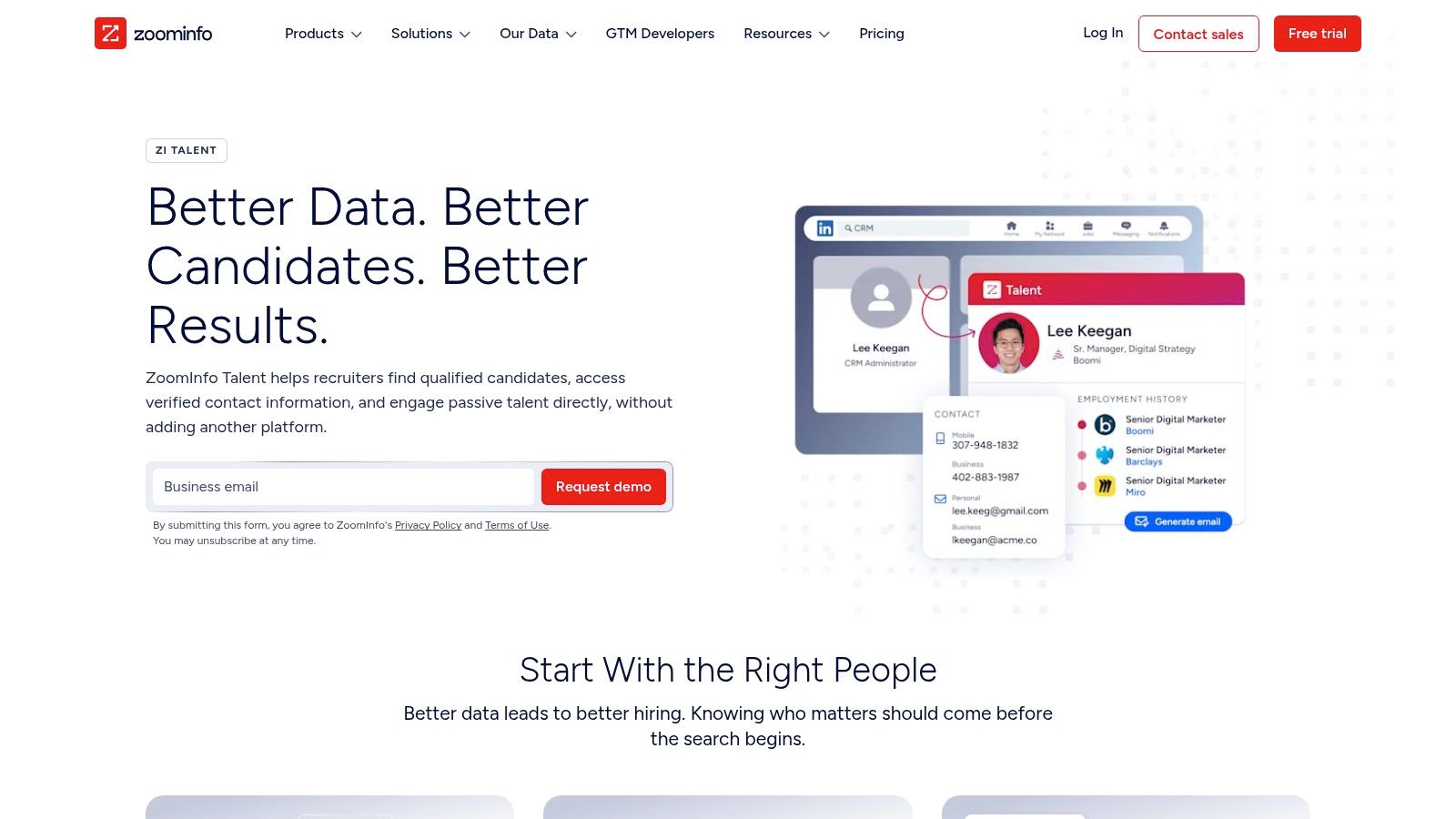
ZoomInfo Talent is the alternative for organisations with enterprise needs, large volumes and a strong orientation towards the United States. It combines a broad B2B contact database, emails, direct dials, company signals, org charts and specific features for recruiting and sourcing.
The depth of its company information enables something an isolated contact tool does not always solve: identifying who to contact, understanding the structure of the organisation and prioritising the approach. That context is useful for teams working on hard roles, high-volume searches or talent strategies connected to business planning.
The product offers the support and deployment typical of enterprise solutions. Its price is high, presented as "on request", and buying usually requires a demo and negotiation. For a small agency, the investment may not pay off if usage is limited to revealing emails from a handful of LinkedIn profiles.
When its scale pays off
ZoomInfo Talent makes more sense when several teams share the platform and need company data as well as candidates. It also fits when procurement, security and operations require a vendor with formal processes and deployment capacity.
The main caution for Spain and Europe is real coverage by market. Declared strength in the United States does not guarantee the same performance in Spain, Portugal, France or other EMEA markets. Ask for a trial with local roles and measure emails, mobile numbers, freshness and relevance before signing.
The Spanish context also justifies measuring the economic impact. One industry reference puts the average cost per hire between 6,000 and 10,000 euros, average time-to-fill at 32 days and agency fees between 12% and 18% of salary, according to this reference on sourcing and hiring. ZoomInfo can add value if it improves a high-volume or high-value operation, but it is not worth paying for enterprise intelligence when the problem is simply getting up-to-date contacts.
A comparison of 10 Swordfish AI alternatives
| Product | Key features | Experience and metrics | Pricing and value proposition | Target audience and differentiator |
|---|---|---|---|---|
| HeyTalent (Recommended) | Real-time extraction (LinkedIn), email and phone enrichment, customisable AI filters, automated outreach | Up to 60% faster, 2.5x more replies (per the platform), published per-plan candidate limits | Plans: €109/mo (2,000), €214/mo (5,000), €599/mo (14,000); up to 5x cheaper than LinkedIn Recruiter | Headhunters, agencies, freelance recruiters and TA teams; USP: customisable end-to-end AI, GDPR-ready, team with a recruitment background |
| ContactOut | Chrome extension, reveals emails and sometimes mobiles, email verification, export/CSV and API (by plan) | "One click" LinkedIn workflow, good email accuracy, more irregular phone numbers | Price on request/by quote; variable final cost | Recruiters focused on LinkedIn; USP: speed and direct use from the profile |
| hireEZ (Hiretual) | Search across 50+ sources, enrichment, integrated outreach, pipelines/lightweight CRM | Well-regarded search depth, reduces tool sprawl; learning curve | Enterprise model, perception of high cost in reviews | Recruiting teams that want multi-source search plus pipeline; USP: very broad searches and integrated analytics |
| AmazingHiring | Technical meta-search (GitHub, Stack Overflow and 50+ sources), technical filters, outreach from the platform | Very effective for hard IT profiles, relevant technical signals | Price by proposal only; negotiated model | Tech teams and recruiters specialised in engineering; USP: deep technical coverage |
| SignalHire | Browser extension that reveals contacts, ATS/CRM integrations, credit-based model | Affordable entry point, useful multi-network coverage, quality varies by source | Credit-based model, free credits on install | SMBs and mid-sized teams integrating with an ATS; USP: direct export to CRMs and accessible credit pricing |
| RocketReach | Self-service plans, extension and API, org charts on higher tiers | Good option as a second source, transparent about limits | Self-service plans with lookup limits; renewals and limits to review | Users who need a data fallback; USP: transparency and API for bulk enrichment |
| Lusha | LinkedIn extension, separate email/phone credits, tiered plans, compliance documentation | Emphasis on direct dials, published compliance (GDPR/CCPA) | Credit system by data type; several tiers (Free→Scale) | B2B teams and recruiters who prioritise direct dials; USP: direct dials and compliance material |
| Cognism | B2B coverage focused on the EU/UK, enrichment, direct dials, DPA and compliance | Suitable for strict EU privacy requirements, good phone coverage | Price by quote; enterprise contracting and DPAs | Organisations that prioritise GDPR compliance and European coverage; USP: legal and enterprise focus in the EU |
| Kaspr (by Cognism) | LinkedIn extension, email/mobile reveal, export and basic automation, inherited compliance | Low adoption curve, useful for Boolean searches on LinkedIn | Public plans aimed at SMBs; simple entry point | SMBs, SDRs and recruiters; USP: ease of use and inherited compliance policies |
| ZoomInfo Talent | Broad B2B contact database, direct dials, company signals and org charts, recruiting features | Very deep US database, enterprise deployment and support | High price, pricing on request; sold via demo and contract | Mid-sized and large organisations with high demand and budget; USP: scale and depth of US data |
How to choose and migrate without breaking your process
The right alternative depends on the bottleneck, not on how many features appear on the sales sheet. HeyTalent fits when you want end-to-end sourcing and outreach, AI filters, enrichment and transparent costs. ContactOut, SignalHire, RocketReach, Lusha and Kaspr are options more focused on enriching contacts, with differences in sources, credits, phone numbers and integrations.
For technical profiles, AmazingHiring offers a specialisation that a generalist database can hardly replicate. Cognism is a better fit when European coverage, direct dials and privacy requirements weigh on the decision. hireEZ suits teams that want to centralise sourcing and outreach, while ZoomInfo Talent targets enterprise organisations with a strong focus on the United States and a need for business intelligence.
The Spanish context calls for more than a price comparison. Between January 2025 and July 2026, Spanish public administrations tendered 541 AI-related contracts worth more than 208 million euros, and the share of national job ads mentioning AI reached 13.5%, against 6.2% in the United States, according to the published information on AI investment and demand in Spain. For selection teams, that adoption increases the pressure to automate, but also the pressure to show that the automation is under control.
A practical decision matrix
- Sourcing and outreach in one flow: prioritise HeyTalent if you need to extract profiles, apply custom filters, enrich data and launch sequences without switching tools.
- Emails and phone numbers from specific profiles: compare ContactOut, SignalHire, RocketReach, Lusha and Kaspr using a real sample of candidates.
- Technical talent: try AmazingHiring on an engineering role and measure the relevance of the technical signals, not just the number of results.
- European coverage and privacy: ask Cognism for processing documentation, coverage by country and refresh terms.
- Centralising the stack: evaluate hireEZ if your team keeps sourcing, outreach and pipelines separate.
- Enterprise scale and the United States: consider ZoomInfo Talent when you need org charts, company intelligence and corporate deployment.
Migration should start with your monthly candidate volume, your priority markets and the percentage of profiles for which you need a phone number. Then run a controlled test with one role and one sequence. Measure valid emails, usable phone numbers, replies, time invested and candidates who reach the next step. Do not rely only on the number of contacts found, because that indicator can reward incomplete or irrelevant data.