The Wiza alternatives that make the most sense for recruiters in 2026 are HeyTalent, Apollo.io, Lusha, Hunter, Snov.io, Skrapp.io, SalesQL, Evaboot, PhantomBuster and TexAu. Wiza solves one very specific stretch — turning a LinkedIn or Sales Navigator search into an exported list with emails — so the right alternative depends on whether your problem is export volume, data quality or what happens next. Choosing by "which one pulls the most emails" is how teams end up paying for two tools to cover a single workflow.
What is Wiza and what it solves in a sourcing workflow
Wiza is a contact extraction tool that turns LinkedIn and Sales Navigator searches into exportable lists with verified emails and, depending on the plan, phone numbers. Its unit of work is the list: not a single contact, but the full result of a search.
What Wiza doesn't do marks where to look for a replacement. Wiza doesn't discover talent that isn't already in your search, doesn't prioritise candidates by fit with the role and doesn't sustain a follow-up sequence. That is why the ten options in this guide cover three distinct layers — export, contact data and outreach — and aren't interchangeable.
How to choose a Wiza alternative: the five layers of the workflow
A Wiza alternative is evaluated by the layer it covers, not by the number of credits it promises. Score each option against these five layers and mark which one is your bottleneck today:
- Discovery: finding profiles that aren't in your search yet.
- Export: pulling the full list, clean and without duplicates.
- Contact data: verified email and phone for the right candidate.
- Prioritisation: deciding who to write to first.
- Contact and record: sequences, follow-ups and where the data lands in your CRM or ATS.
Comparing the 10 Wiza alternatives in 2026
| Tool | Main layer it covers | Pricing model |
|---|---|---|
| HeyTalent | Discovery, prioritisation, contact and outreach | Per organisation, not per seat; from €93/mo annual |
| Apollo.io | B2B database and prospecting sequences | Free Starter plan; credit-based paid plans |
| Lusha | Email and phone enrichment | Unified credits; phone costs more |
| Hunter | Email search and verification | Credits per search and verification |
| Snov.io | Verification and multichannel campaigns | Credits; LinkedIn Automation as an add-on |
| Skrapp.io | B2B email from LinkedIn | Charges only deliverable emails; daily limits |
| SalesQL | LinkedIn and CSV extraction | Free 50 credits/month; paid and Enterprise plans |
| Evaboot | Sales Navigator export and cleanup | By plan; requires an active Sales Navigator |
| PhantomBuster | Automation using your own accounts | Per execution and slots; pay-as-you-go |
| TexAu | Chained workflows and enrichment | Pay-on-match; usage-based plans |
HeyTalent: LinkedIn extraction, AI filters and outreach in one workflow
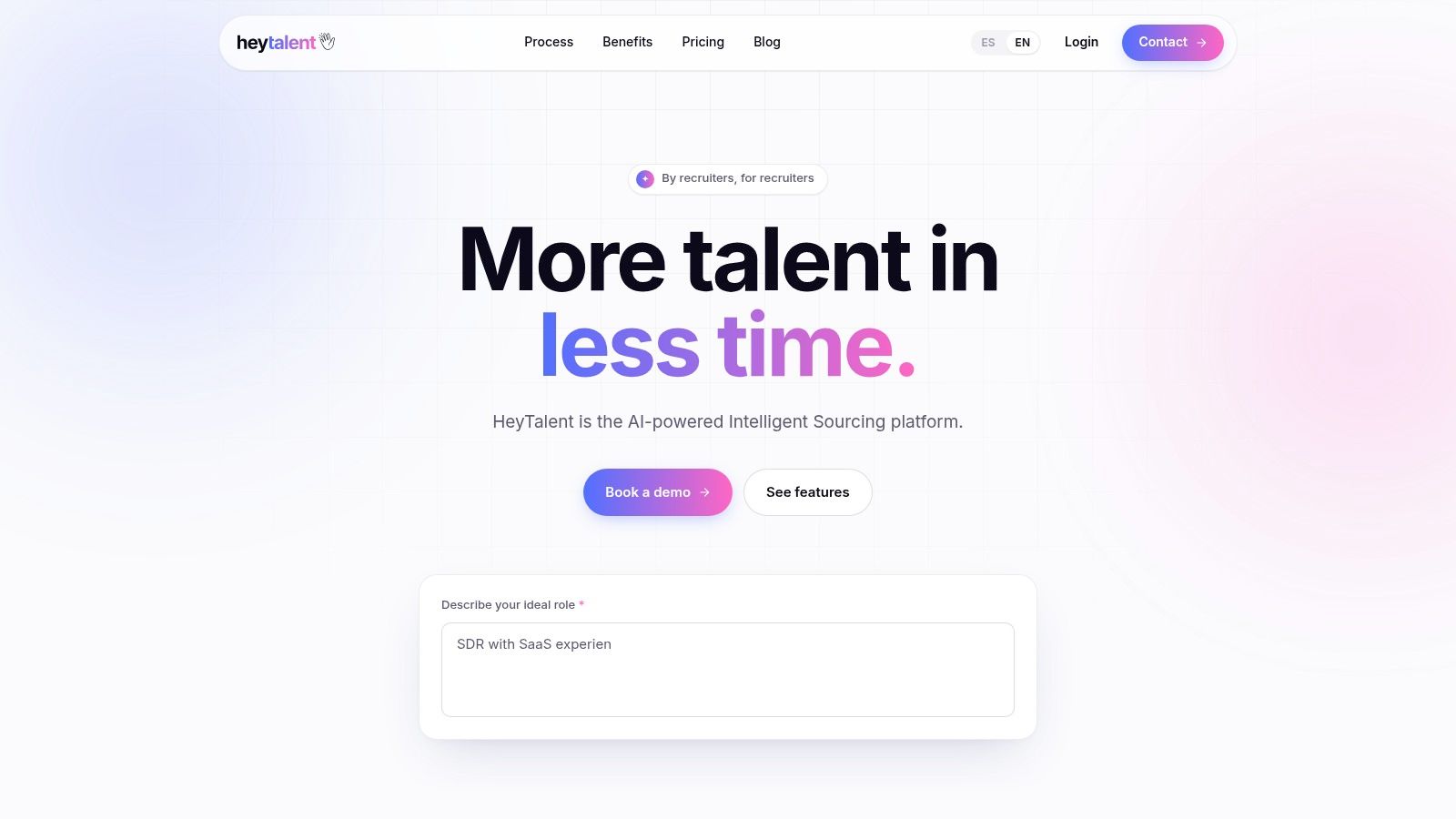
HeyTalent covers four of the five layers in a single tool: it extracts LinkedIn profiles in real time, filters them with custom AI variables, finds email and phone, and runs automated, omni-channel outreach sequences. It is the Wiza alternative designed around candidate sourcing rather than commercial prospecting.
The practical difference is prioritisation, the layer Wiza doesn't touch. Exporting 500 profiles solves nothing if someone has to read them one by one to decide who to write to; custom AI variables build that filter from the role's own criteria. According to HeyTalent, its users work 60% faster during their first month of use, an average efficiency gain the company attributes to tighter lists and filters.
On the contact side, HeyTalent reports a 2.5x multiplier on its users' reply rate thanks to automated sequences. That is a multiplier on each team's previous rate, not an absolute percentage.
Plans are billed per organisation rather than per seat, with unlimited users and unlimited CSV export: Recruiter up to 2,000 candidates per month, Agency up to 5,000 and Ultra up to 14,000 with priority support. They start at €93/month billed annually. Its two limits: AI variables prioritise a shortlist but don't replace human validation, and it's worth validating a data sample before a wide campaign.
Wiza alternatives for finding and verifying emails
Hunter, Skrapp.io and SalesQL are the Wiza alternatives closest in philosophy: they solve email and leave the rest of the workflow out. All three fit when the main channel is email and the search already happens on LinkedIn. If you end up stacking a discovery tool and a sequencing tool on top, compare the total against a platform like HeyTalent, which covers all three layers under one licence.
Hunter finds addresses by person or domain, runs bulk verifications and organises campaigns through Sequences, with a credit model that is easy to forecast. It doesn't provide phone numbers: if a role demands a direct call, you'll need another source.
Skrapp.io finds and verifies B2B emails from LinkedIn, Sales Navigator and websites, charges only for deliverable emails and offers rollover to reduce waste. Its per-plan daily limit means you can't treat it as an unrestricted source when several roles are open at once.
SalesQL extracts verified emails from LinkedIn profiles and surfaces mobile numbers on paid plans, with CSV enrichment and an API. Its free plan offers 50 credits a month, enough to test fit, and Enterprise handles jobs of up to 50,000 rows according to its specifications; confirm current terms on the SalesQL page. That limit describes operational capacity, not coverage or accuracy.
Wiza alternatives with contact data and built-in sequences
HeyTalent, Apollo.io, Lusha and Snov.io are the Wiza alternatives for teams that want the data and the campaign under one licence. All four demand discipline so the ATS stays the source of truth.
HeyTalent parts from the other three at the origin: Apollo.io, Lusha and Snov.io were built for commercial prospecting, HeyTalent for candidate sourcing. That changes the filtering, because its AI variables are built on role criteria rather than firmographics, and with it the shortlist criteria.
Apollo.io combines a B2B database, email verification and sequences, with a Chrome extension and mature Salesforce and HubSpot integrations. Its focus sits closer to sales engagement than to headhunting, so check profile depth and passive-candidate coverage before replacing a LinkedIn-first tool. Its "Unlimited" plans are subject to fair-use policies.
Lusha focuses on enrichment, with unified credits across web, extension and API and billing on reveal. The phone number is its differentiator for hard roles and also its biggest cost: one number consumes 5 credits, according to the product information gathered in this comparison of Lusha alternatives.
Snov.io blends finder and verifier with multichannel campaigns, warm-up and analytics, and depending on the plan allows unlimited seats and campaigns capped by recipient count. Check a cost that shows up later: LinkedIn Automation is an add-on sold per slot.
Wiza alternatives for exporting and automating LinkedIn lists
Evaboot, PhantomBuster and TexAu are the Wiza alternatives that attack the export layer, which is exactly where Wiza competes. None brings its own database: they work on the sources and accounts you configure.
All three leave one thing unsolved: where the candidate lands once exported. HeyTalent closes that stretch with an ATS at no cost — a branded career page, customisable forms, a candidate database and one pipeline per job you can share with your client choosing which stages they see. It comes with any sourcing plan, so it adds no further licence to the chain.
Evaboot exports LinkedIn Sales Navigator lists, removing duplicates and normalising fields before importing into a CRM. It requires an active Sales Navigator subscription, doesn't work with basic LinkedIn and provides neither phone numbers nor full enrichment, so it fits as the first step in a chain rather than a full replacement.
PhantomBuster chains "Phantoms" that collect public data and run actions using the team's own accounts, on LinkedIn, Sales Navigator and other platforms. Its cost is configuration: you have to define limits, pauses and timing to reduce risk on LinkedIn. Automating messages demands care with consent, frequency and opt-out, and this guide on automating LinkedIn messages explains why extracting a profile and contacting a person are different decisions.
TexAu works as a workflow engine with spreadsheet-like logic, with more than 200 actions according to its product specifications and more than 30 integrations, sending results to sequencers such as Smartlead, Instantly or Lemlist. It declares SOC 2 Type II compliance and GDPR and CCPA compatibility, with a DPA on request. Its pay-on-match model links spend to matches, but a badly defined workflow duplicates contacts or fires a sequence before the recruiter has reviewed the profile. The next step is covered in this guide to data enrichment for recruitment.
How much a Wiza alternative costs against LinkedIn Recruiter
The real cost of a Wiza alternative isn't the plan price, it's the price per valid candidate contacted. A credit that returns a deliverable email for someone who already changed jobs costs the same as one that opens a conversation, and that difference appears on no price list.
The billing model changes the maths with team size. HeyTalent charges per organisation rather than per seat, which according to the company means savings of up to 5x against the cost of LinkedIn Recruiter; those savings grow with the number of recruiters and don't apply the same way to someone working alone.