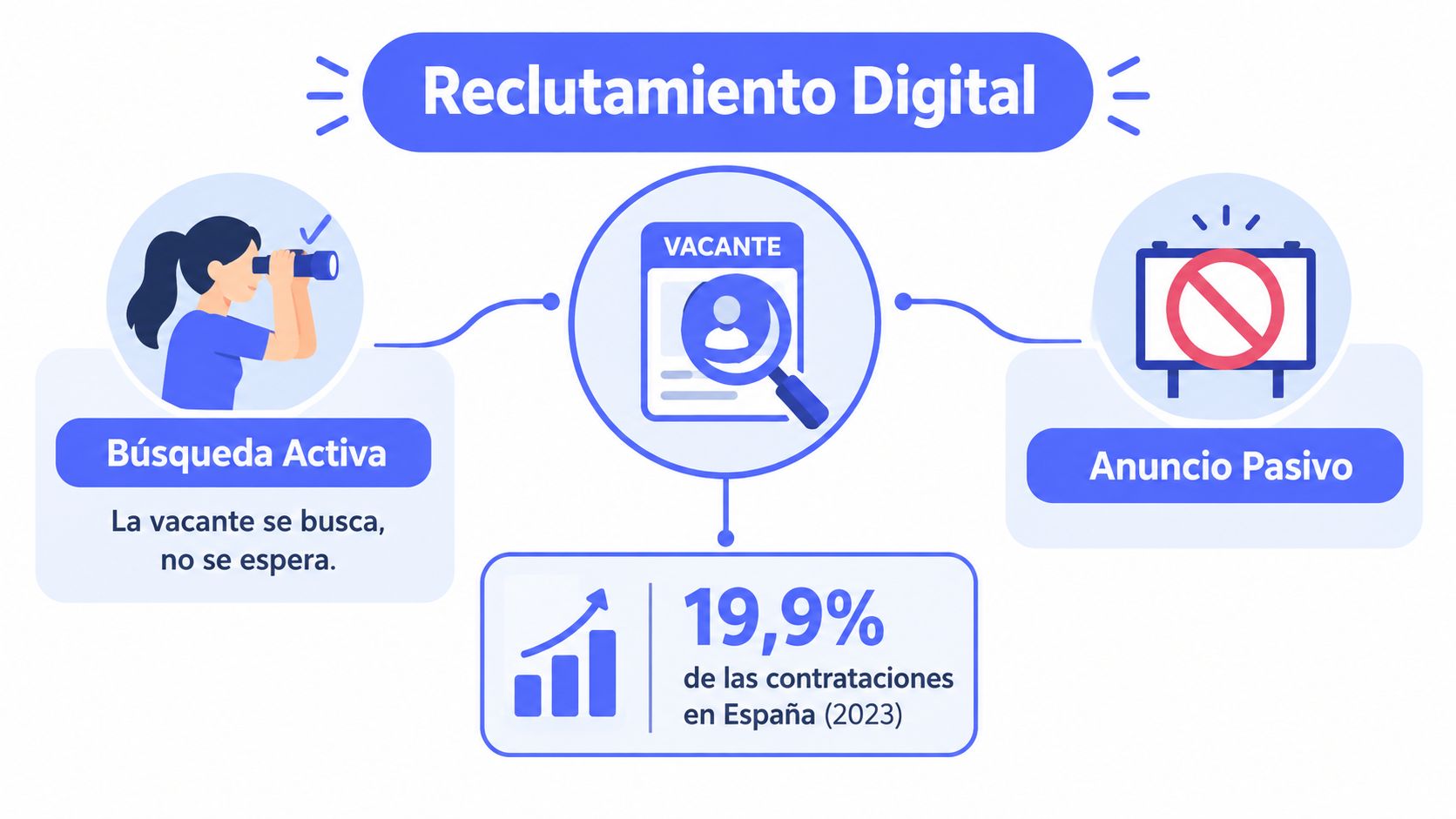
Digital recruitment means finding, assessing and contacting candidates with online tools, instead of just posting a job ad and waiting. In Spain, 19.9% of people used the internet to look for work or access job-matching services in 2023, 6.5 points more than in 2008, according to the SEPE analysis of job intermediation in the digital era. Applying it means choosing channels per vacancy, combining three tactics (Boolean search, social ads and outreach) and tracking time to first contact, outreach reply rate, interview rate and cost per hire by channel. When AI is involved, you also need to be able to show which data is used and what human review is applied.
What is digital recruitment
Digital recruitment is the set of practices that use online tools to find, assess and contact talent, on top of posting vacancies. It covers direct search on professional networks, job boards, targeted ads, outreach by message or email, and AI used to prioritise profiles.
Compared with simply posting jobs, digital recruitment lets you open conversations with professionals who have never answered an ad. It pays off most on hard-to-fill roles or roles that need very specific experience. The guide to digital transformation in HR covers the stack and roadmap for the whole department.
Digital recruitment vs traditional recruitment
Digital recruitment differs from traditional recruitment in who makes the first move: in traditional hiring the candidate answers an ad; in digital recruitment the recruiter also goes out and finds them. That difference changes the channels, the metric that matters and the risk you have to manage.
| Attribute | Traditional recruitment | Digital recruitment |
|---|---|---|
| Who starts the contact | The candidate | The candidate or the recruiter |
| Profiles it reaches | Active candidates who see the ad | Active and passive candidates who are not applying |
| Main channels | Job ads, employment offices, personal contacts | Professional networks, job boards, ads, outreach |
| Recruiter's work | Screening incoming applications | Defining criteria, searching, prioritising, contacting |
| Main metric | Number of applications | Replies, interviews and cost per hire |
| Main risk | Low or irrelevant volume | Mishandled personal data and indiscriminate outreach |
Digital recruitment does not fully replace in-person channels: if 19.9% of people in Spain used the internet for these services in 2023, according to SEPE, roughly four in five did not.
HeyTalent as the sourcing layer in digital recruitment
HeyTalent is an AI sourcing platform that covers the search-and-contact part of digital recruitment: it extracts LinkedIn profiles in real time from a search, filters them with custom AI variables or Boolean search, finds emails and phone numbers, and runs automated, omnichannel outreach sequences.
Contact is where digital recruitment usually stalls, and that is where HeyTalent's most direct figure sits: the company reports multiplying its users' reply rate 2.5x thanks to automated sequences and follow-ups. It is a multiplier on each user's previous rate, not an absolute rate.
HeyTalent does not force you to switch ATS: its sourcing layer feeds the system you already use. If you don't have one, HeyTalent offers its ATS at no cost and charges for the sourcing layer; the ATS includes a careers page, job posts pushed to Google Jobs, one pipeline per job and pipelines you can share with clients.
HeyTalent plans are priced per organisation, not per seat, with a monthly candidate limit depending on the plan, and start at €93/month billed annually.
The honest limit: HeyTalent prioritises and contacts, but it does not decide. Every profile HeyTalent suggests should be reviewed before it enters your process, as with any AI tool.
Which digital recruitment channels work in Spain
In Spain, the right channel depends on the candidate you need, not on a platform's total audience. In November 2023, LinkedIn had roughly 11.7 million users in Spain, InfoJobs had over 6 million, Indeed was close to 3 million and Infoempleo recorded 971,666, according to audience data for job boards in Spain.
| Channel | Approx. monthly users (Nov 2023) | Dominant profile |
|---|---|---|
| 11.7 million | Professionals searchable by career path and specialism | |
| InfoJobs | Over 6 million | Candidates actively browsing job ads |
| Indeed | Close to 3 million | People looking for posted vacancies |
| Infoempleo | 971,666 | Complementary job-board channel |
| SEPE and public services | No comparable figure | Users of public employment services |
These audience figures are not conversions: LinkedIn helps you reach people who are not applying; InfoJobs and Indeed help you capture applications from people answering ads.
Agencies also have their own space: around 29% of unemployed people in Spain contact private employment agencies, compared with roughly 25% who contact public offices, according to SEPE data on job intermediation in Spain.
To compare more channels, see the guide to recruitment sources that widen the reach of your vacancies.
Digital sourcing tactics: Boolean search, ads and outreach
The three core tactics of digital recruitment solve different needs: Boolean search gives precision, social ads widen the funnel and outreach activates specific profiles. A scarce technical profile is not approached the same way as volume hiring.
Boolean search for specialised roles
Boolean search combines alternative job titles, skills and location with operators:
("backend developer" OR "software engineer") AND (Java OR Kotlin) AND Madrid
Use exclusions (NOT) carefully: an overly restrictive Boolean string leaves out valid profiles that use a different title. Test several versions and review a sample before widening the search.
Social media ads to attract applications
Social media ads work when you need visibility among audiences defined by sector or seniority, or for high-turnover roles. An ad will not fix an unclear offer: spell out the role, the location and what makes the job attractive, and measure the quality of applications, not clicks.
Automated outreach with personalised messages
Automated outreach saves work when the team has a long list of target profiles: the first contact and the follow-ups go out on their own. Automating is not sending the same message to everyone: keep the sequence short, mention a relevant professional detail and adjust the message based on replies.

How to use AI in digital recruitment
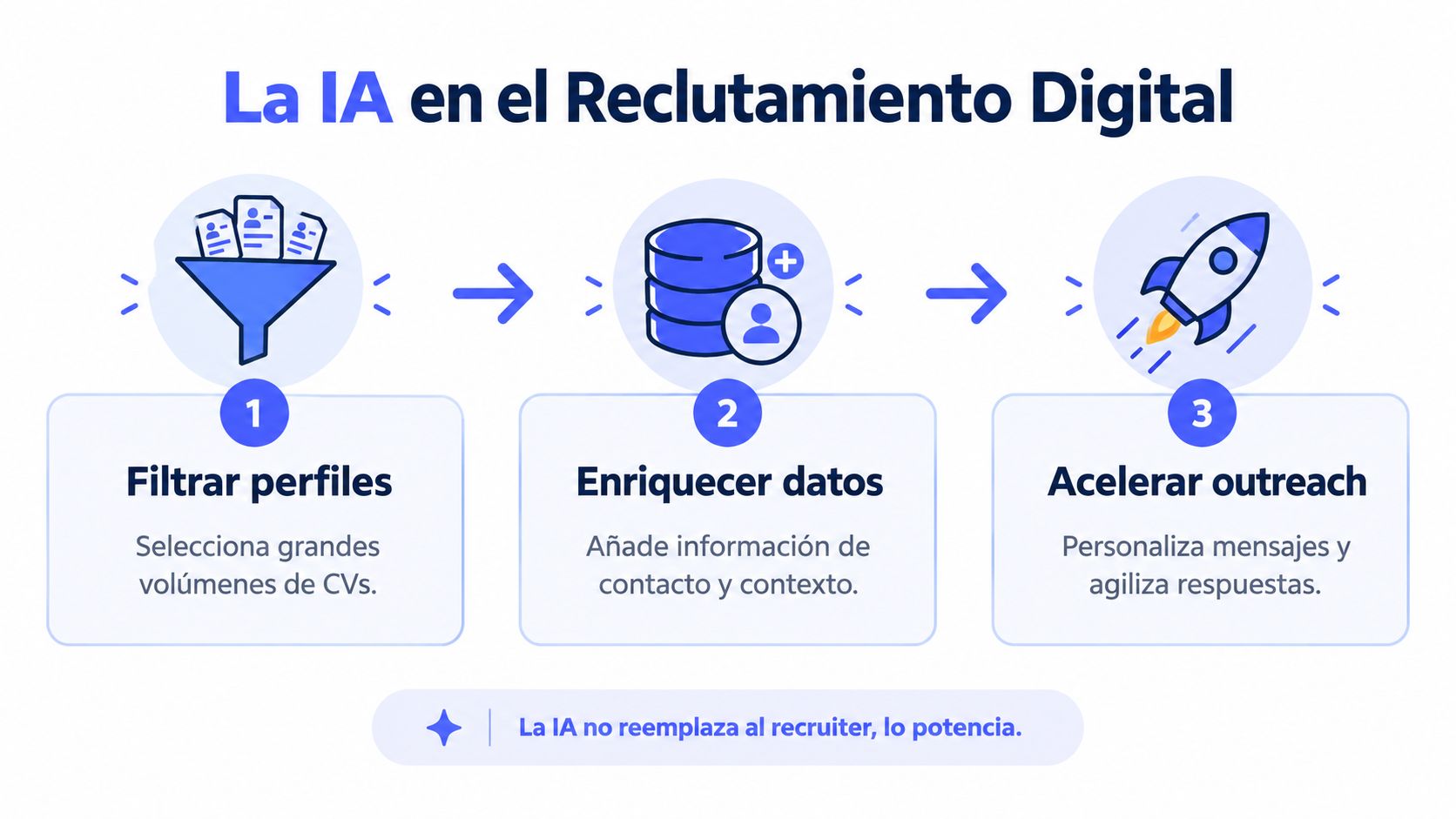
AI adds value to digital recruitment when it solves concrete tasks and the recruiter can review each result: ranking profiles, spotting skills described in other words, enriching contact data and prioritising candidates with configurable variables. AI does not replace the interview, nor does it decide on its own who can do the job.
Adoption in hiring is still a minority practice. Spain's INE reports that 7.67% of companies in Spain use AI specifically for HR management or hiring, according to AEPD information on data protection and employment relations. The opportunity is not processing more profiles, but turning scattered information into comparable signals.
AI in digital recruitment works best as a sourcing layer that feeds the ATS (Teamtailor, Viterbit, Workable or another). Judge it by its precision and false positives, and never treat an inference as confirmed data.
Which metrics to track in digital recruitment
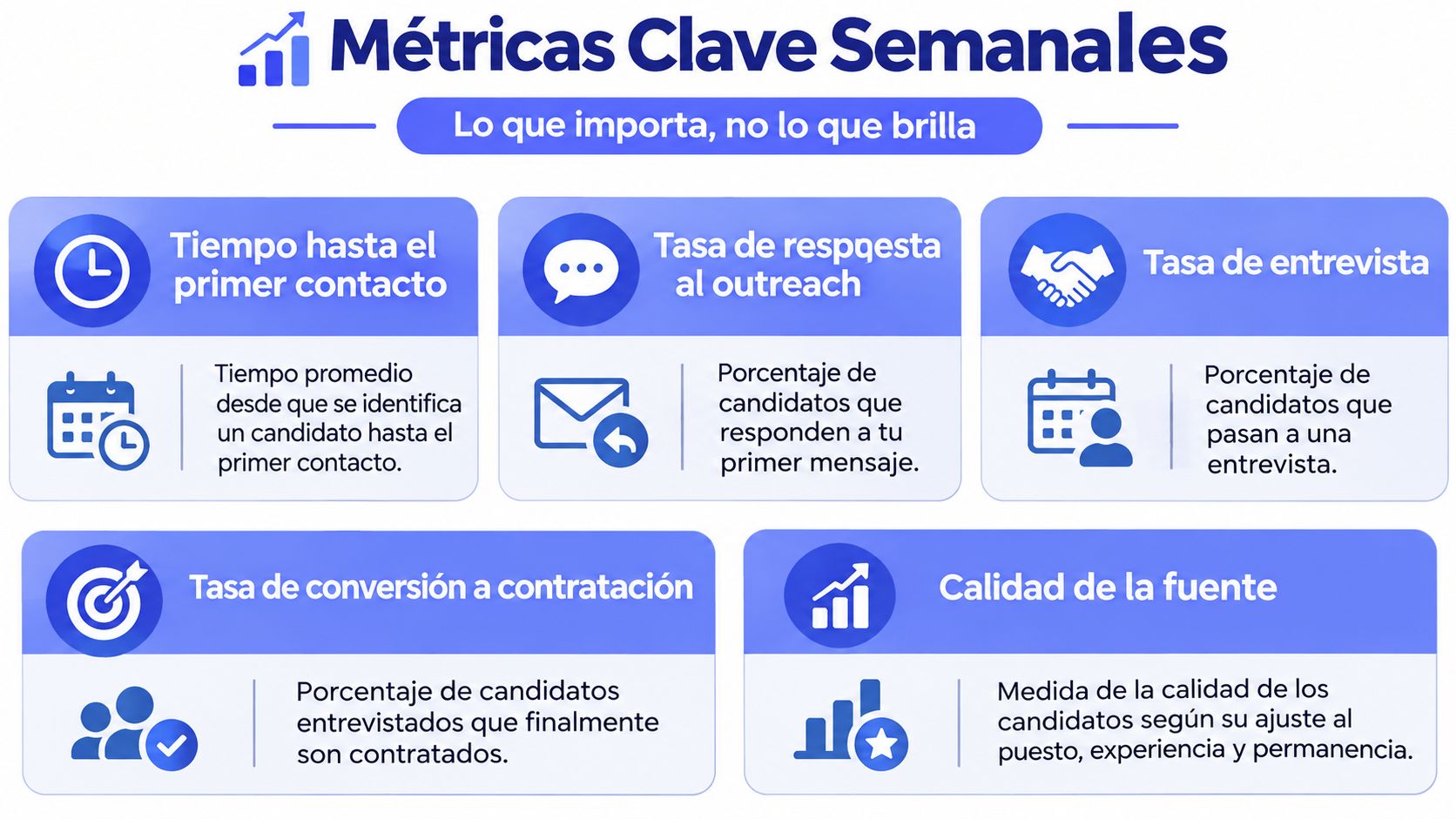
The metrics that matter in digital recruitment measure what happens between first contact and hire, and what it costs in each channel. The number of profiles viewed does not prove that sourcing works: a dashboard can show plenty of activity and hide a search that is going nowhere.
AI adoption is growing: 21.1% of Spanish companies with ten or more employees used some form of AI in the first quarter of 2025, 8.7 points more than in the previous period, according to the INE survey on ICT and AI use.
Five digital recruitment metrics, broken down by vacancy and source:
- Time to first contact: how long the team takes to message a qualified profile.
- Outreach reply rate: which messages and segments start conversations, not just sends.
- Interview rate: what share of contacted candidates reaches an interview.
- AI filter precision: how many prioritised profiles fit on review, and how many valid ones are left out.
- Cost per hire by channel: spend per source, including the team's time.