Recruitment means finding and attracting candidates; selection means assessing them and deciding who moves forward to a hire. A complete process runs through six stages: role definition, attraction, screening, interview and assessment, offer, and onboarding. It is managed with five KPIs: time to fill, time to hire, offer acceptance rate, source of hire and cost per hire. In Spain, the public employment service (SEPE) classed 79.26% of the vacancies it analysed in 2024 as hard to fill, so the bottleneck usually lies in how the role is defined and where the search happens, not in posting more job ads.
What is recruitment and selection
Recruitment and selection is the set of activities a company, an agency or a staffing firm uses to fill a vacancy: first it identifies and attracts potential candidates (recruitment), then it assesses their fit to decide who to hire (selection). The two functions are consecutive, but not interchangeable.
In Spain, article 40 of the Employment Act 3/2023 and the labour-intermediation framework counts both attracting and connecting candidates and selecting suitable people as intermediation: selection is part of one end-to-end function, not just a CV review at the end.
Differences between recruitment and selection
The operational difference between recruitment and selection is this: recruitment builds the funnel, and selection applies the filters that decide who moves forward. Recruitment fills the wide end; selection narrows it down to a shortlist.
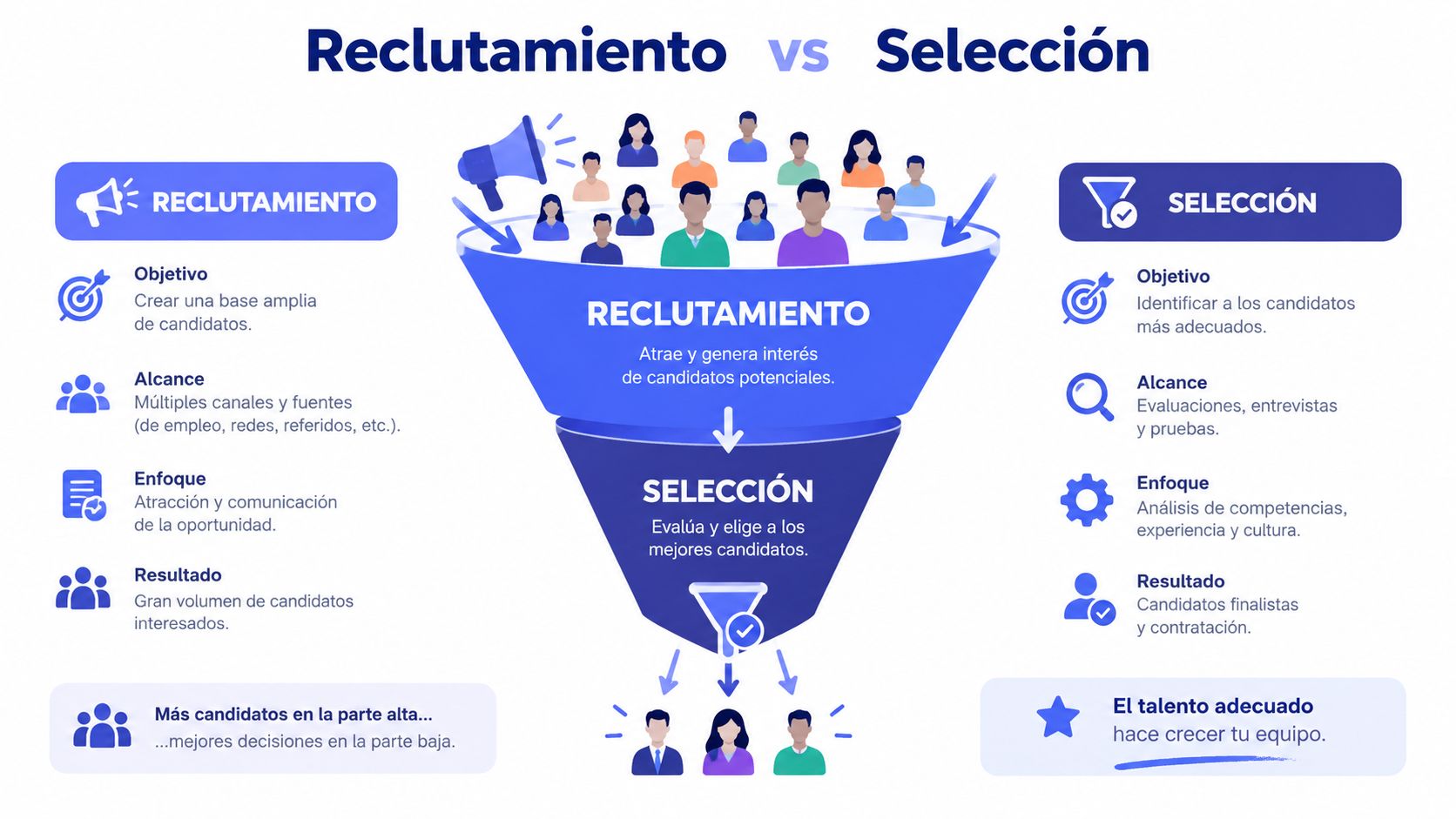
| Criterion | Recruitment | Selection |
|---|---|---|
| Goal | Attract potentially suitable people | Choose the person who fits best |
| Question it answers | Where is the talent and how do I reach it? | Who meets the requirements of the role? |
| Activities | Sourcing, job ads, direct outreach | Screening, interviews, tests, references |
| Output | A broad pool of candidates | A shortlist and a hire |
| Main KPI | Source of hire, candidates per vacancy | Acceptance rate, quality of hire |
| Risk if it fails | Too few valid profiles in the funnel | Decisions without a defensible rationale |
Recruitment is also multichannel: the methodology of the Spanish Labour Force Survey (INE) on job-search methods counts employment offices and job boards, approaching employers directly, personal networks and online ads as active methods. Posting a job ad is one channel, not a full process.
At the kick-off meeting: pin down whether the client expects job advertising, direct search, assessment, a finalist shortlist or support through onboarding.
Stages of the recruitment and selection process
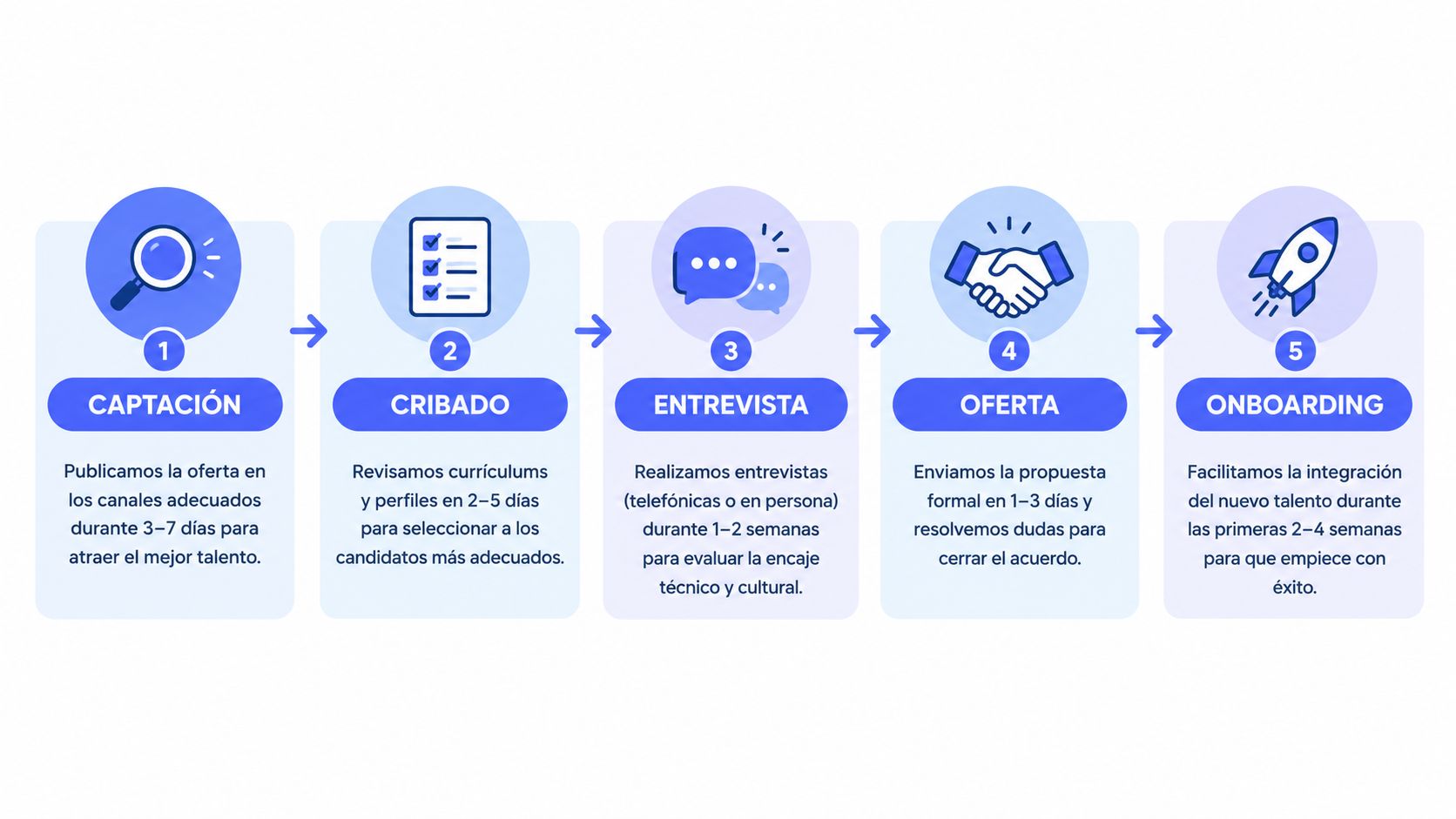
The recruitment and selection process moves through six stages, from defining the need to onboarding. No stage should start without the information the next one needs.
Stages from vacancy to shortlist
The first four stages of the selection process turn a brief into a shortlist of finalists:
- Role definition. Separate, with the client, the must-have skills from those that can be learned, and agree on what evidence proves the level. A job title alone is not enough.
- Attraction. Choose channels by candidate type: inbound applications, direct search, networks or job boards. An attractive job ad does not replace sourcing when the right talent is not looking.
- Screening. Compare every application against agreed, documented criteria. A keyword filter can discard transferable experience simply because the CV uses different terminology.
- Interview and assessment. Test what the profile claims with examples, relevant exercises and consistent questions. The interview validates; it does not make up for a vague role definition.
Stages from decision to onboarding
The last two stages of the selection process close the hire and feed future searches:
- Offer. Align duties, terms and availability between candidate and client before surprises appear.
- Onboarding and follow-up. In outsourced selection, confirm who owns the next steps and collect feedback for the next search.
Recruitment and selection KPIs for agencies, staffing firms and TA
Recruitment and selection KPIs answer three management questions: which channel produces candidates who progress, at which stage processes stall, and how many unique people must be contacted to close a vacancy. Agree the formulas with the client and keep them stable:
- Time to fill: days from opening the vacancy to filling it.
- Time to hire: days from the first meaningful contact until the person accepts the offer.
- Offer acceptance rate: offers accepted divided by offers made.
- Source of hire: the channel the hire came from.
- Cost per hire: team time, tools and paid channels, with the list of included costs fixed upfront.
The guide to recruitment KPIs goes deeper into the formulas. The main KPI changes with the type of operation:
| Type of operation | Main KPI | Indicative threshold |
|---|---|---|
| Staffing firm | Time to fill and available candidates per vacancy | By campaign, location and requirements |
| Boutique agency | Acceptance rate and shortlist-to-offer conversion | Against each specialism's history |
| Corporate TA | Time per stage and quality of hire | Set with the hiring departments |
In Spain, one contract does not equal one person: SEPE recorded 15,645,243 contracts in 2025 for 6,857,161 people, 2.28 contracts per person hired, according to its hiring report. Measuring unique people rather than contracts keeps activity from being mistaken for reach.
Why vacancies are hard to fill in Spain
In Spain, most vacancies are hard to fill: SEPE classes 79.26% of the vacancies analysed in 2024 as hard to fill and 18.62% as impossible to fill; only 2.13% show no difficulty (SEPE labour-market trends report). With those numbers, better job ads are not enough: the role and the search need a better definition.
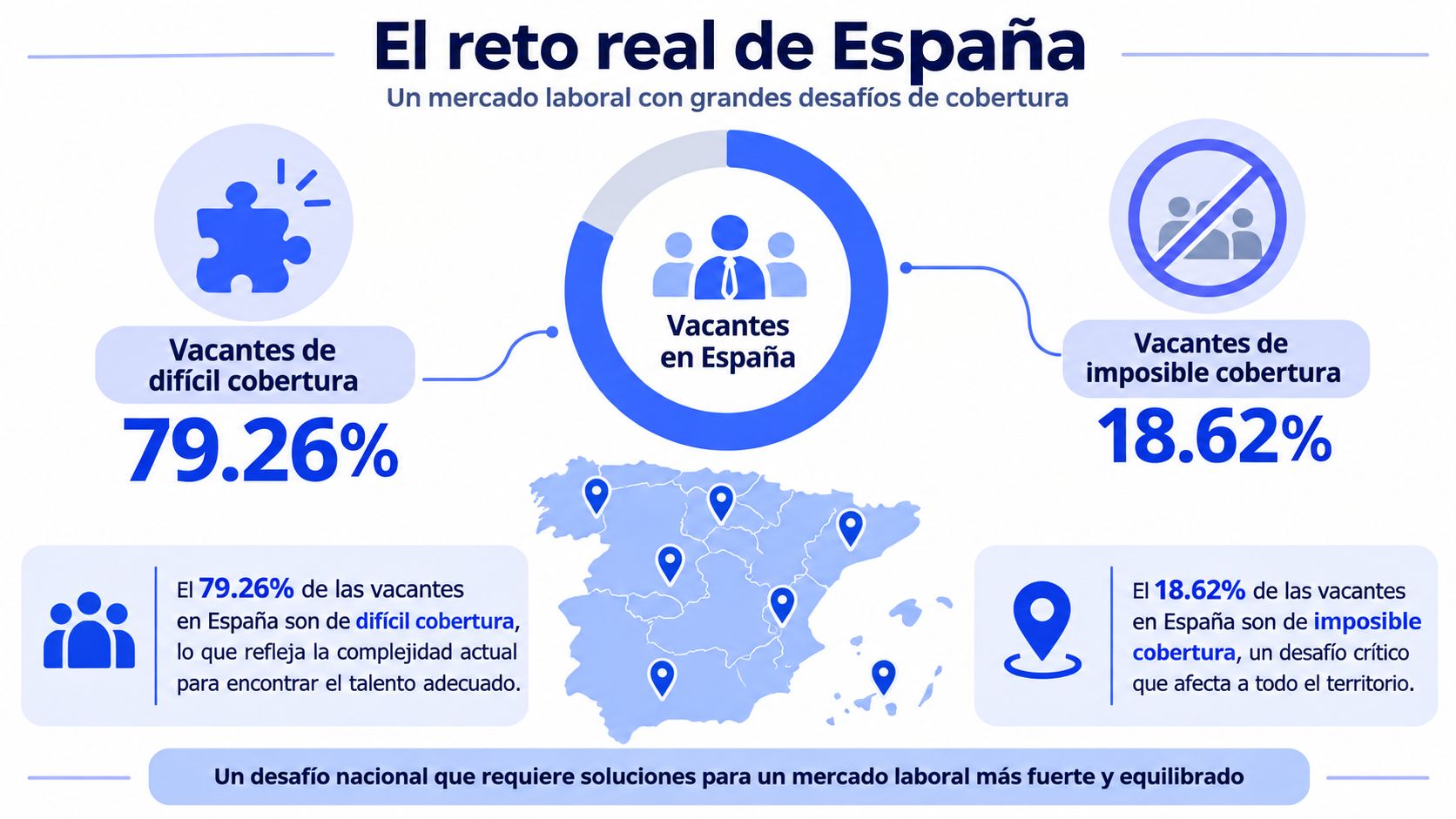
Geography is a technical variable in recruitment in Spain: SEPE's catalogue of hard-to-fill occupations is built province by province and updated every quarter, so an occupation can be hard to fill in one region and not in another. Organise pipelines by location; the analysis of geographic mobility in selection turns location into an operational criterion.
How to segment a candidate search without discriminating
Segmenting a candidate search is legitimate when it rests on skills and availability, never on personal characteristics. In 2025, SEPE recorded 3,990,538 contracts for foreign nationals, up 6.98% on the previous year, and temporary contracts among young people reached 59.26% (data on hiring of foreign nationals and SEPE's youth-hiring data). These are signals for designing searches, not reasons to infer anyone's suitability from nationality or age.
Search criterion: translate the vacancy into skills, verifiable experience, location and mobility, then add alternative job titles. Don't exclude valid talent because of a label.
Boolean search, LinkedIn Recruiter or AI sourcing: which to use
Manual Boolean search, LinkedIn Recruiter and AI sourcing solve different recruitment problems. The useful comparison is how much work each one takes to produce a relevant, contactable list of candidates.
| Criterion | Manual Boolean | LinkedIn Recruiter | AI sourcing (HeyTalent) |
|---|---|---|---|
| Control over the search | Full, term by term | Platform filters | Recruiter's brief and AI variables |
| Direct cost | Low | Per-seat licence | Per-organisation licence |
| Time to a usable list | High: test, review, iterate | Medium | Low if criteria are well defined |
| Contact data | Separate search | InMail inside LinkedIn | Email and phone finder |
| Main risk | Depends on the recruiter's skill | Cost as the team grows | Speeds up a badly defined search |
With manual Boolean strings, the recruiter controls every term at the cost of time; these Boolean operator examples for recruiting help when job titles vary.
Where HeyTalent fits in recruitment and selection
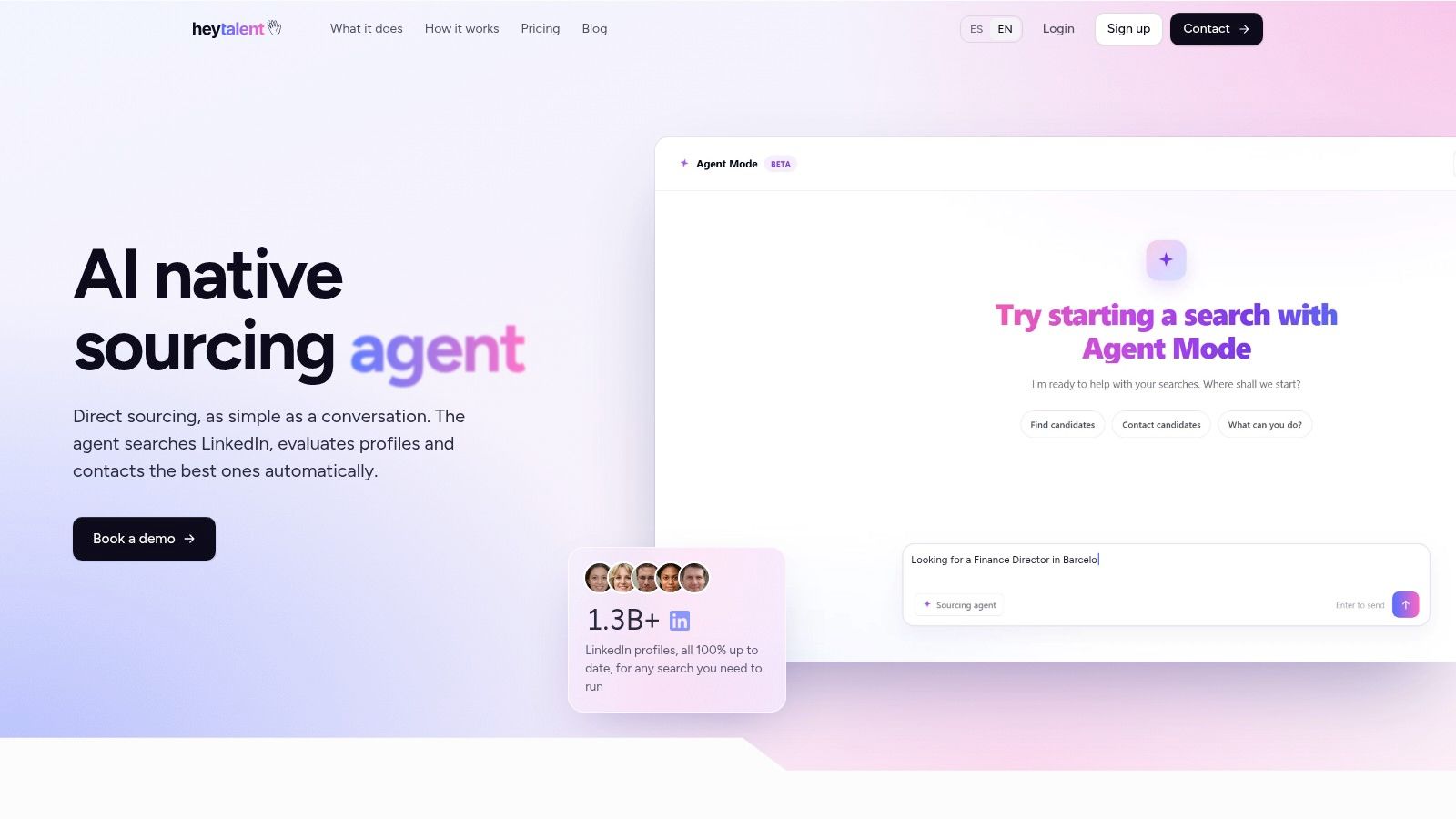
HeyTalent covers the part of recruitment that eats the most hours: it extracts LinkedIn profiles in real time, supports Boolean search, filters with custom AI variables, finds emails and phone numbers, and runs automated outreach sequences. According to HeyTalent, its users work 60% faster during their first month of use.
The pricing model matters when several recruiters share searches: HeyTalent charges per organisation rather than per seat, which the company says means savings of up to 5x against the cost of LinkedIn Recruiter; for a recruiter working alone, the gap narrows.